I don't think the people at TrackMan have taken a position one way or another on the validity of the Hinge Action concept. The challenge comes from other quarters.
All I wanted TrackMan to verify was what 'others' said could not be done. Namely, that I could change the Clubface alignment through Impact simply by using my Flat Left Wrist to execute selectively each of the three Hinge Action Feels, i.e., Roll, No Roll and Reverse Roll.
And it did.
Of course, I already knew I could control the Clubface with my Flat Left Wrist, but I went through the "scientific" exercise in order to "prove" that I could.
And I did.
Case closed. Thanks YODA!
__________________
I could be wrong. I have been before, and will be again.
In the precision Sketch 2-C-1 #3 (2-N-0 / Geometry of the Circle with Separation deliberately assumed at Low Point), the Swing Path (Arc of Approach), the Clubface and the Line of Compression each face directly down the Plane Line (in this case, also the Target Line). TGM contends that this configuration will produce maximum compression (no "glancing force") and a dead straight shot.
Under these exact conditions, does the D-Plane concept predict another result? If so, what? If not, then in this specific instance, how does D Plane theory "trump" Geometry of the Circle / Hinge Action theory? Or vice versa? In a non-adversarial world, could they be equally predictive?
Lynn,
Thanks for the question.
Are you teaching people to produce seperation at lowpoint as described in 2-C-1#3 to produce maximum compression (no "glancing force") and a dead straight shot?
I doubt it.
Clearly, you understand and respect D plane well enough to know that this is the only way you can phrase a question that matches the book in some way.
It's not really the geometry of the circle as I see it drawn on napkins, easels and pieces of paper is it?
This was my experience and I still have not been convinced.
Again, I am quite open to discussion.
__________________
Make Everything.
Last edited by John Graham : 12-16-2010 at 11:43 PM.
Below, is the explanation to what Homer said in the sentence that I highlighted in bold:
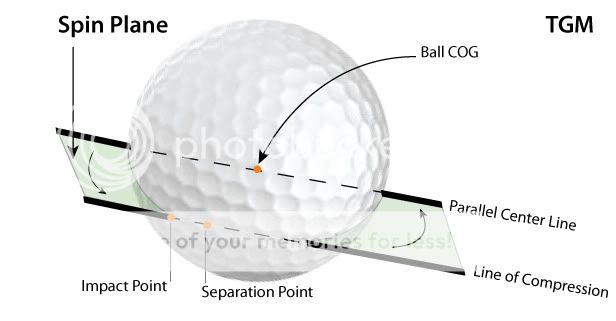
Imagine drilling an off-center hole through a ball (bottom line of compression) on the line of compression and pushing a stick through it so that it sticks out both ends. This stick doesn't pass through the center of the ball. Now drill a second hole through the ball that passes through the center (Top line) and is perfectly parallel to the first hole, then insert a stick. Those two sticks represent the Spin Plane caused by the Line of Compression of that Impact. The Spin Plane is highlighted in green.
After you insert both sticks, no matter how you rotate or orient the ball, the spin plane will always be represented by those two sticks as long as "The original contact points of the Clubface and ball remain in contact throughout the entire Impact Interval". Any Impact that doesn't maintain the impact as also the separation point, unless done intentionally, is a "Mis-Hit". Furthermore, the rate of Spin is determined by the distance between those two Parallel Lines for any given Clubhead Speed.
The "Search for the Perfect Swing" does not include this information. "The Search for the Perfect Swing" and "The Physics of Golf" only outline the conditions of "Mis-Hit" Impacts.
Daryl,
Wonderful pictures.
Does the ball spin perpendicular to the spin plane, parallel to it or something else?
Are you teaching people to produce seperation at lowpoint as described in 2-C-1#3 to produce maximum compression (no "glancing force") and a dead straight shot?
I doubt it.
Clearly, you understand and respect D plane well enough to know that this is the only way you can phrase a question that matches the book in some way.
It's not really the geometry of the circle as I see it drawn on napkins, easels and pieces of paper is it?
This was my experience and I still have not been convinced.
Again, I am quite open to discussion.
John,
Thank you for thanking me for my question. Actually, there were several questions, but for whatever the reason, you chose not to answer even one of them.
Let's revisit the situation:
My questions referenced the Impact alignments of Sketch 2-C-1 #3 and asked that your answers address those alignments specifically.
I asked you simple, straightforward questions that deserved simple, straightforward answers.
I did not ask you to ask me a question regarding my teaching.
Nor did I ask you to ask me a question regarding your perception of the "geometry of the circle as .... drawn on napkins, easels and pieces of paper".
Finally, I did not ask for your comment as to how I chose to "phrase" my question.
So, let's begin again . . .
Please answer my questions. In the interest of brevity, let's make it even more simple and focus on just the first question:
Will the Impact alignments as illustrated in 2-C-1 #3 produce a dead straight shot? Or will they not?
Thank you for thanking me for my question. Actually, there were several questions, and for whatever the reason, you chose not to answer even one of them.
Let's revisit the situation:
My questions referenced the Impact alignments of Sketch 2-C-1 #3 and asked that your answers address those alignments specifically.
I asked you simple, straightforward questions that deserved simple, straightforward answers.
I did not ask you to ask me a question regarding my teaching.
Nor did I ask you to ask me a question regarding your perception of the "geometry of the circle as .... drawn on napkins, easels and pieces of paper".
Finally, I did not ask for your comment as to how I chose to "phrase" my question.
So, let's begin again . . .
Please answer my questions. In the interest of brevity, let's make it even more simple and focus on just the first question:
Will the Impact alignments as illustrated in 2-C-1 #3 produce a dead straight shot? Or will they not?
No "discussion" required.
One word will do.
specious but not being overly technical with the details and specifics of the drawing I have mentioned in the past, I would say yes.
I tried to use one word. I really did but I feared it would get me kicked off.
In fact, the alignments are identical -- only with more detail -- to those you demonstrated in your "level" (Low Point) explanation of the straight shot in Parts 1 and 2 of your well-done YouTube 'D Plane' videos.
I understand the complexities introduced when the ball is located forward or aft of Low Point. As did Homer Kelley. Which is why he differentiated the "precision position per 2-G" from other Impact Locations requiring "Clubface adjustment" (7-10).
For now, we at least agree that the depiction of Impact Geometry in 2-C-1 #3 will produce a dead straight shot. In other words . . .
Well, I don't need to go through this. I'm better off working and studying on my own than to be continually stalled in my progress by someone like John.
A few months off will do me good. I think that I'll start posting on johns website. Until I'm banned. But, since I'll be the only one posting, it may take awhile.



 Actually, there were several questions, but for whatever the reason, you chose not to answer even one of them.


 Linear Mode


