Oh, and if I'm not mistaken, Homer Kelley was the one doing the "assuming" regarding the impact interval. It's not like he had a BizHub SwingVision camera shooting 10,000 frames per second out in his garage to confirm his theories.
The equivalent of an arched left wrist would deliver less loft to the ball, which would compress the ball more than the equivalent of a flat left wrist, all else the same. That's Physics 101, right there.
Secondly, "The Physics of Golf" is not my "bible". Nice little book, but it doesn't really reveal anything new about the impact collision that wasn't shown in 68's "Search For the Perfect Swing". Jorgensen did coin the term "D Plane", however. Big deal.
1.) No Max, you're wrong again and again. You're talking about "How much" of the ball is being compressed, not higher compression.
2.) It's your "Bible". The "D Plane Gods". You know and "Pray" to Both of them. The "Path" God and the "Clubface Angle" God.
2-A RESILIENCE The response of the ball to different applications of force is the factor that determines how force must be applied to produce a desired result.................
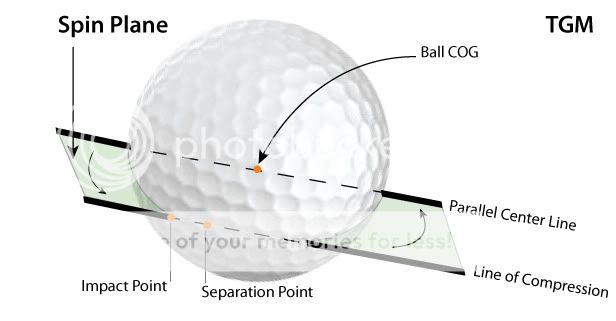
........ Roll of the ball on the face of an inclined striker does not account for all the action produced by such an impact, especially in imparting spin to the ball. When the direction of the compressing force does not pass exactly through the center of the ball, a spin will be imparted to the ball. It will rotate on the plane of a line drawn from the line of compression to a parallel center line.
Bold by Daryl
Below, is the explanation to what Homer said in the sentence that I highlighted in bold:
Imagine drilling an off-center hole through a ball (bottom line of compression) on the line of compression and pushing a stick through it so that it sticks out both ends. This stick doesn't pass through the center of the ball. Now drill a second hole through the ball that passes through the center (Top line) and is perfectly parallel to the first hole, then insert a stick. Those two sticks represent the Spin Plane caused by the Line of Compression of that Impact. The Spin Plane is highlighted in green.
After you insert both sticks, no matter how you rotate or orient the ball, the spin plane will always be represented by those two sticks as long as "The original contact points of the Clubface and ball remain in contact throughout the entire Impact Interval". Any Impact that doesn't maintain the impact as also the separation point, unless done intentionally, is a "Mis-Hit". Furthermore, the rate of Spin is determined by the distance between those two Parallel Lines for any given Clubhead Speed.
The "Search for the Perfect Swing" does not include this information. "The Search for the Perfect Swing" and "The Physics of Golf" only outline the conditions of "Mis-Hit" Impacts.
Have you ever been on one of these Trackman devices?
Id be curious about all the Hubhub about it and whether it would tell you anything about your path or clubface or any other component of your swing that you didn't already know.
How about any of the rest of you guys? Anyone have a revelation by using the device like "i always thought i was doing this but really doing that"?
I guess I struggle with why so many think it is revolutionary.
Da Vinci understood the airplane before we could build it.
Originally Posted by Max Impact
Oh, and if I'm not mistaken, Homer Kelley was the one doing the "assuming" regarding the impact interval. It's not like he had a BizHub SwingVision camera shooting 10,000 frames per second out in his garage to confirm his theories.
The people using that BizHub really have bad explanations quite often. Dorito?
Max, are you near Philly, MNPLS., the South, Chicago? I'd love to buy you beer and just hang. Seriously.
ICT
__________________
HP, grant me the serenity to accept what I cannot change, the courage to change what I can, and the wisdom to know the difference. Progress and not perfection is the goal every day!
Have you ever been on one of these Trackman devices?
Id be curious about all the Hubhub about it and whether it would tell you anything about your path or clubface or any other component of your swing that you didn't already know.
I've been on TM twice in the last month. It is interesting to see ball flights quantified -- particularly with deliberately employed Stroke variations. I have never used it in a teaching situation, but based on my own experiences (live with Jeff Hull and Rob Noel), I have no doubt it can add value if integrated appropriately into the lesson.
My primary purpose (especially with Jeff in my first session) was to challenge the misguided notion that a golfer cannot consciously execute a selected Hinge Action to change the Clubface alignment through Impact and thus affect Ball Behavior. No surprise here:
I've been on TM twice in the last month. It is interesting to see ball flights quantified -- particularly with deliberately employed Stroke variations. I have never used it in a teaching situation, but based on my own experiences (live with Jeff Hull and Rob Noel), I have no doubt it can add value if integrated appropriately into the lesson.
My primary purpose (especially with Jeff in the first session) was to challenge the misguided notion that a golfer cannot consciously execute a selected Hinge Action to change the Clubface alignment through Impact and thus affect Ball Behavior. No surprise here:
Of course you can.
I'm guessing TrackMan doesn't have the capability of measuring it, so they don't acknowledge it's existence?
__________________
I could be wrong. I have been before, and will be again.
I'm guessing TrackMan doesn't have the capability of measuring it, so they don't acknowledge it's existence?
I don't think the people at TrackMan have taken a position one way or another on the validity of the Hinge Action concept. The challenge comes from other quarters.
All I wanted TrackMan to verify was what 'others' said could not be done. Namely, that I could change the Clubface alignment through Impact simply by using my Flat Left Wrist to execute selectively each of the three Hinge Action Feels, i.e., Roll, No Roll and Reverse Roll.
And it did.
Of course, I already knew I could control the Clubface with my Flat Left Wrist, but I went through the "scientific" exercise in order to "prove" that I could.
I think all in golf machine land would enjoy seeing a video of you demonstrating the different hinge actions on the TM, and the corresponding ball flight differences.
Id be fascinated in seeing the different calculations when your swinging and hitting also.




 Linear Mode


