As a constant double checker, I came hear to find out if what I learned and was teaching was incorrect.
From what I have learned here, I'm not convinced that this information about the D Plane has been trumped by the geometry of the circle but I am open minded.
John,
In the precision Sketch 2-C-1 #3 (2-N-0 / Geometry of the Circle with Separation deliberately assumed at Low Point), the Swing Path (Arc of Approach), the Clubface and the Line of Compression each face directly down the Plane Line (in this case, also the Target Line). TGM contends that this configuration will produce maximum compression (no "glancing force") and a dead straight shot.
Under these exact conditions, does the D-Plane concept predict another result? If so, what? If not, then in this specific instance, how does D Plane theory "trump" Geometry of the Circle / Hinge Action theory? Or vice versa? In a non-adversarial world, could they be equally predictive?
Assuming "sweet spot" contact, and The Flat Left Wrist, or its equivalent, both camps would predict a straight, on-target shot with maximum compression.
But Yoda, since you've "arrived", would angled hinging allow the original contact points between ball and clubface to remain intact throughout the arc of the impact interval?
The D Plane assumes that the Ball Rolls on the Clubface. Impact and separation points are always different and D Plane never assumes Max Compression.
All Hinges produce a sustained line of compression, so all hinges give maximum compression. The Angled Hinge tilts the Line of Compression.
The D Plane is a term for the plane connecting two impact vectors. It is not an analytical model. Hence, The D Plane doesn't "assume" anything.
The book clearly identifies only Horizontal Hinge Action as the ideal application of linear force, producing perfect vector alignments.
And for the record, an arched left wrist, or its equivalent, would produce more compression than The Flat Left Wrist, or its equivalent. This would, of course, "hood" the clubface, which the book suggests to avoid. Although, virtually all great ball-strikers do it.
The D Plane is a term for the plane connecting two impact vectors. It is not an analytical model. Hence, The D Plane doesn't "assume" anything.
The book clearly identifies only Horizontal Hinge Action as the ideal application of linear force, producing perfect vector alignments.
And for the record, an arched left wrist, or its equivalent, would produce more compression than The Flat Left Wrist, or its equivalent. This would, of course, "hood" the clubface, which the book suggests to avoid. Although, virtually all great ball-strikers do it.
It's clear that you have NO grasp of "compression", the "line of compression" or "sustaining the line of compression". You said: "And for the record, an arched left wrist, or its equivalent, would produce more compression than The Flat Left Wrist, or its equivalent." Are you delirious?
Furthermore, you don't have a grasp of your own beliefs. Have you read page 80 of your Bible: "The Physics of Golf"? it says:
Quote:
The Ball Slides and Rolls on the Clubface
We shall finally consider the effect of this sliding friction between the ball and the clubface. When the clubhead begins to make contact with the ball, the ball will begin to slide up the clubface, with the force between the ball and the clubface gradually increasing. The resulting frictional force on the ball will gradually give the ball a rolling motion, and when the ball is about to leave the clubface, the ball will be rolling without sliding if there has been enough friction.
It's clear that you have NO grasp of "compression", the "line of compression" or "sustaining the line of compression". You said: "And for the record, an arched left wrist, or its equivalent, would produce more compression than The Flat Left Wrist, or its equivalent." Are you delirious?
Furthermore, you don't have a grasp of your own beliefs. Have you read page 80 of your Bible: "The Physics of Golf"? it says:
Duh? "Slide, then Roll" Duh?
The equivalent of an arched left wrist would deliver less loft to the ball, which would compress the ball more than the equivalent of a flat left wrist, all else the same. That's Physics 101, right there.
Secondly, "The Physics of Golf" is not my "bible". Nice little book, but it doesn't really reveal anything new about the impact collision that wasn't shown in 68's "Search For the Perfect Swing". Jorgensen did coin the term "D Plane", however. Big deal.
Oh, and if I'm not mistaken, Homer Kelley was the one doing the "assuming" regarding the impact interval. It's not like he had a BizHub SwingVision camera shooting 10,000 frames per second out in his garage to confirm his theories.
The equivalent of an arched left wrist would deliver less loft to the ball, which would compress the ball more than the equivalent of a flat left wrist, all else the same. That's Physics 101, right there.
Secondly, "The Physics of Golf" is not my "bible". Nice little book, but it doesn't really reveal anything new about the impact collision that wasn't shown in 68's "Search For the Perfect Swing". Jorgensen did coin the term "D Plane", however. Big deal.
1.) No Max, you're wrong again and again. You're talking about "How much" of the ball is being compressed, not higher compression.
2.) It's your "Bible". The "D Plane Gods". You know and "Pray" to Both of them. The "Path" God and the "Clubface Angle" God.
2-A RESILIENCE The response of the ball to different applications of force is the factor that determines how force must be applied to produce a desired result.................
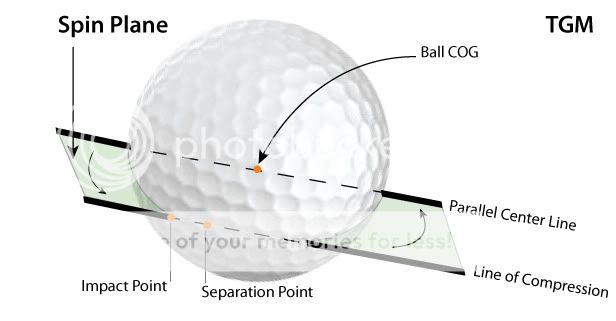
........ Roll of the ball on the face of an inclined striker does not account for all the action produced by such an impact, especially in imparting spin to the ball. When the direction of the compressing force does not pass exactly through the center of the ball, a spin will be imparted to the ball. It will rotate on the plane of a line drawn from the line of compression to a parallel center line.
Bold by Daryl
Below, is the explanation to what Homer said in the sentence that I highlighted in bold:
Imagine drilling an off-center hole through a ball (bottom line of compression) on the line of compression and pushing a stick through it so that it sticks out both ends. This stick doesn't pass through the center of the ball. Now drill a second hole through the ball that passes through the center (Top line) and is perfectly parallel to the first hole, then insert a stick. Those two sticks represent the Spin Plane caused by the Line of Compression of that Impact. The Spin Plane is highlighted in green.
After you insert both sticks, no matter how you rotate or orient the ball, the spin plane will always be represented by those two sticks as long as "The original contact points of the Clubface and ball remain in contact throughout the entire Impact Interval". Any Impact that doesn't maintain the impact as also the separation point, unless done intentionally, is a "Mis-Hit". Furthermore, the rate of Spin is determined by the distance between those two Parallel Lines for any given Clubhead Speed.
The "Search for the Perfect Swing" does not include this information. "The Search for the Perfect Swing" and "The Physics of Golf" only outline the conditions of "Mis-Hit" Impacts.
In the precision Sketch 2-C-1 #3 (2-N-0 / Geometry of the Circle with Separation deliberately assumed at Low Point), the Swing Path (Arc of Approach), the Clubface and the Line of Compression each face directly down the Plane Line (in this case, also the Target Line). TGM contends that this configuration will produce maximum compression (no "glancing force") and a dead straight shot.
Under these exact conditions, does the D-Plane concept predict another result? If so, what? If not, then in this specific instance, how does D Plane theory "trump" Geometry of the Circle / Hinge Action theory? Or vice versa? In a non-adversarial world, could they be equally predictive?
Lynn,
Thanks for the question.
Are you teaching people to produce seperation at lowpoint as described in 2-C-1#3 to produce maximum compression (no "glancing force") and a dead straight shot?
I doubt it.
Clearly, you understand and respect D plane well enough to know that this is the only way you can phrase a question that matches the book in some way.
It's not really the geometry of the circle as I see it drawn on napkins, easels and pieces of paper is it?
This was my experience and I still have not been convinced.
Again, I am quite open to discussion.
__________________
Make Everything.
Last edited by John Graham : 12-16-2010 at 11:43 PM.




 Hybrid Mode

