Dont get me wrong Okie, there is absolutely nothing wrong with the Elbow Plane once you groove the shift down to it. I was referring to Homers opinion circa 1982 , not sure about his thoughts in the 3rd. Im interested though if you dont mind quoting, sharing.
There were certainly a ton of fine players who shifted down to the elbow plane , Hogan chief amongst them. His shift given his flat backswing was nothing compared to Millers. I dont know who had the biggest shift of all time but I bet it'd be someone from the Seventies given those high hands back then.
I guess theoretically you approach Horizontal Hinging as you shift down closer to the true Horizontal Plane (where you get closing only like a door as opposed to a true Vertical Plane where you get layback only like a pet door). Vice versa for higher planes. Which is a good mechanical Address Fix adjustment for short shots where you want a little built in Vertical Hinge..............just increase the shaft or Plane Angle at Fix by snuggling up closer to the ball.
Here's a thought straight from the Lab ......if you Angle Hinge (given its associated clubhead travel) along the Elbow Plane through Follow Through.......you will have more of a "feel" of "swinging left". In fact, you will have more of "real" as well. Not to be confused with non planar versions of "swinging left" however.
I won a tourny at my local muni last year swinging and shifting down to the elbow plane. Hit 16 greens, my personal best in tournament play. Then went back to a single shift and hitting too. This game is so insane or .......is it me? Next year tennis.
Here you go . . . 10-6-A Elbow Plane FIRST AND SECOND EDITION
The location of the Elbow during Impact is the reference point used for this Plane Angle. This alignment not only allows the Right Forearm to move On Plane through the Impact but also allows the torso to be position at right angles to the Plane - which are the unexcelled alginments for Right Arm Power and Control.
Remember-the Right Forearm cannot become "On Plane" until the Right Elbow becomes "On Plane".
10-6-A Elbow Plane THIRD EDITION
Where the Right Elbow touches the waist is the reference point used for this Plane Angle. It is the "flattest" normal Plane that will still allow the Right Forearm to be On Plane during Impact. This means that normally the Right Forearm will be moving at right angles to the torso - which are the unexcelled alignments for Right Forearm Power and Control
10-6-A Elbow Plane FOURTH AND FIFTH EDITIONS
Where the Right Elbow touches the waist is the reference point used for this Plane Angle. It is the "flattest" normal Plane that will still allow the Right Forearm to be On Plane during Impact. This means that normally the Right Forearm will be moving at right angles to the torso - which are the unexcelled alignments for Right Arm Power (6-B-1-0) and On Plane "Throw Out" action (2-K).
10-6-A Elbow Plane SIXTH AND SEVENTH EDITIONS
Where the Right Elbow touches the waist is the reference point used for this Plane Angle. It is the “flattest” normal Plane that will still allow the Right Forearm to be On Plane during Impact. This should produce a very flat Angle of Attack (2-B) with reduced Backspin and should be avoided for Short Shots unless it is also part of your Full Stroke Pattern. The Elbow Plane allows maximum #3 Accumulator requiring earlier Release per 6-N-0. This procedure is executed by the Right Forearm per 7-3 and 10-6-B and Elbow Location per 6-B-3-0-1
All the good stuff got trashed in the 5th, 6th and 7th.
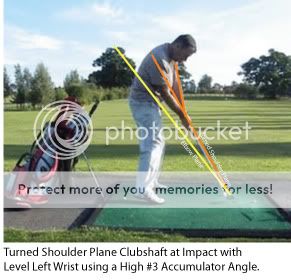
Could somebody put up some players that are on the Turned Shoulder Plane through the ball? Or could you give some examples of players and I'll search out some pictures?
Here you go . . . 10-6-A Elbow Plane FIRST AND SECOND EDITION
The location of the Elbow during Impact is the reference point used for this Plane Angle. This alignment not only allows the Right Forearm to move On Plane through the Impact but also allows the torso to be position at right angles to the Plane - which are the unexcelled alginments for Right Arm Power and Control.
Remember-the Right Forearm cannot become "On Plane" until the Right Elbow becomes "On Plane".
10-6-A Elbow Plane THIRD EDITION
Where the Right Elbow touches the waist is the reference point used for this Plane Angle. It is the "flattest" normal Plane that will still allow the Right Forearm to be On Plane during Impact. This means that normally the Right Forearm will be moving at right angles to the torso - which are the unexcelled alignments for Right Forearm Power and Control
10-6-A Elbow Plane FOURTH AND FIFTH EDITIONS
Where the Right Elbow touches the waist is the reference point used for this Plane Angle. It is the "flattest" normal Plane that will still allow the Right Forearm to be On Plane during Impact. This means that normally the Right Forearm will be moving at right angles to the torso - which are the unexcelled alignments for Right Arm Power (6-B-1-0) and On Plane "Throw Out" action (2-K).
10-6-A Elbow Plane SIXTH AND SEVENTH EDITIONS
Where the Right Elbow touches the waist is the reference point used for this Plane Angle. It is the “flattest” normal Plane that will still allow the Right Forearm to be On Plane during Impact. This should produce a very flat Angle of Attack (2-B) with reduced Backspin and should be avoided for Short Shots unless it is also part of your Full Stroke Pattern. The Elbow Plane allows maximum #3 Accumulator requiring earlier Release per 6-N-0. This procedure is executed by the Right Forearm per 7-3 and 10-6-B and Elbow Location per 6-B-3-0-1
All the good stuff got trashed in the 5th, 6th and 7th.
Hmmmmmm . . . . . .
Thanks Buck
What do you think the reasoning was behind the omission of the "torso at right angles to the plane" thing? Have you ever asked Yoda?
It makes sense in that any turn of the torso would maintain the on plane travel of the right forearm but ..... is that a Pivot to Hands kinda logic maybe? See the glossaries definition of Pivot for instance. Just guessing. I dunno, I really dont know.
As far as the definition of Elbow Plane goes: In the first and second, if Im reading it right, it was any plane angle which saw the Right Elbow and Forearm on Plane at Impact. Where as in later editions it was by definition a singular , low plane angle, referenced by where the Right Elbow touches the waist and amongst the many angles that can see the Right Forearm on Plane at Impact.......
I also see Okies point about it seeming to be a recommended Plane Angle in the Third. Where as in later years he apparently preferred the TSP.
Maybe Yoda'll come in here and provide some background insight?
Could somebody put up some players that are on the Turned Shoulder Plane through the ball? Or could you give some examples of players and I'll search out some pictures?
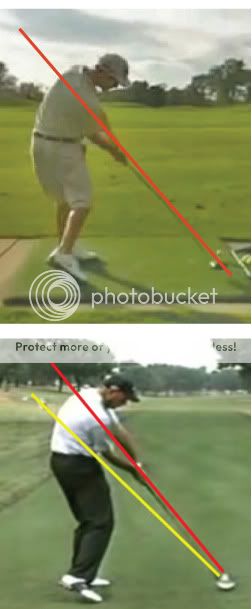
I have more, but each picture below shows golfers with different amounts of shoulder turn at Impact.
What do you think the reasoning was behind the omission of the "torso at right angles to the plane" thing? Have you ever asked Yoda?
It makes sense in that any turn of the torso would maintain the on plane travel of the right forearm but ..... is that a Pivot to Hands kinda logic maybe? See the glossaries definition of Pivot for instance. Just guessing. I dunno, I really dont know.
As far as the definition of Elbow Plane goes: In the first and second, if Im reading it right, it was any plane angle which saw the Right Elbow and Forearm on Plane at Impact. Where as in later editions it was by definition a singular , low plane angle, referenced by where the Right Elbow touches the waist and amongst the many angles that can see the Right Forearm on Plane at Impact.......
I also see Okies point about it seeming to be a recommended Plane Angle in the Third. Where as in later years he apparently preferred the TSP.
Maybe Yoda'll come in here and provide some background insight?
I'm pretty sure this has been discussed but don't know where or when in the forum.
From a geometric standpoint based on the rationale Mr. Kelley gave for the Elbow Plane in the earlier editions vs. the TSP in the later . . . .which do you believe to be more compelling and why? I'll reserve my answer . . . .
I have more, but each picture below shows golfers with different amounts of shoulder turn at Impact.
In your efforts to catalog . . . . was it easier to find golfers on the TSP or the Elbow Plane? I recognize Stewart Cink . . . who are the other cats? Do you think Cink is on the original base line? Or is that plane line shifted?
In your efforts to catalog . . . . was it easier to find golfers on the TSP or the Elbow Plane? I recognize Stewart Cink . . . who are the other cats? Do you think Cink is on the original base line? Or is that plane line shifted?
Is that Cink?
The other two are amateurs who submit their swing videos for analysis. My guesstimate is that there are 20 Elbow Plane Swingers for every TSP Swinger. Long Drive Champs have more TSP Swingers than Elbow Plane Swingers but their videos are so "Circus" oriented that it's rare to find one that can be analyzed.
From a geometric standpoint based on the rationale Mr. Kelley gave for the Elbow Plane in the earlier editions vs. the TSP in the later . . . .which do you believe to be more compelling and why? I'll reserve my answer . . . .
All geometry relates to the geometry of Impact right...........so Id say the Elbow Plane is just as valid as any of the other so called "normal Planes". (To the best of my recollection)
Homer abandoned the right angles thing, it would seem. I get the logic of it , I think, but keep going back to the glossaries definition of the pivot. Which to me is Hands to Pivot. Its all about getting the Right Forearm on Plane, however that is done by the Torso and all.




 Linear Mode


