Homer Kelley was the first in history to identify and articulate this phenomenon. Thirty years ago next January, he explained it to me personally. For that I am grateful.
On the lesson tee now almost every day, I am more aware than ever of its importance. Consciously or subconsciously, the higher-handicap golfer does not allow the natural rotation to occur. Hence, Golf's #1 Snare: Steering (3-F-7-A).
I demonstrate the basic concept two ways. First, using my big club and a plumb bob. Then, with the aid of alignment rods, the interaction between the Sweetspot, the Clubshaft, and their respective Planes.
If I can scare up some help this weekend, I'll do a video.
I would LOVE to see that video!
There is a lot of talk about science and release, but the way you teach the finish swivel has been a huge help in my world, and has saved a lot of my students from steering. I'll never forget working with our friend Dodger on it right after you taught me. HUGE! I think clearing a little more of the fog with a video on the club face would be wonderful.
Thanks!
Kevin
__________________
I could be wrong. I have been before, and will be again.
What a lesson that was. In minutes Kevin had me hitting high draws into a wind coming right at us. I went from a guy who hit pushes, shanks and quack hooks to a guy that actually hit some golf shots with compression. Now when I practice, the first thing I hit is a sand wedge, working on 12-3 and the finish swivel. It usually gets me right where I need to be. Unfortunately I have five months to go before I step on another golf course. Lots to work on in the basement.
What a lesson that was. In minutes Kevin had me hitting high draws into a wind coming right at us. I went from a guy who hit pushes, shanks and quack hooks to a guy that actually hit some golf shots with compression. Now when I practice, the first thing I hit is a sand wedge, working on 12-3 and the finish swivel. It usually gets me right where I need to be. Unfortunately I have five months to go before I step on another golf course. Lots to work on in the basement.
That was a really fun lesson, but I'm still trying to forget the follow up when I brought out the Taly. HaHa, I have wonderful success with that tool, but it sure made a mess with you that day. Oh well, we got it straightened out and learned there are horses for courses.
Cheers Dodger!
Kevin
__________________
I could be wrong. I have been before, and will be again.
Homer Kelley was the first in history to identify and articulate this phenomenon. Thirty years ago next January, he explained it to me personally. For that I am grateful.
On the lesson tee now almost every day, I am more aware than ever of its importance. Consciously or subconsciously, the higher-handicap golfer does not allow the natural rotation to occur. Hence, Golf's #1 Snare: Steering (3-F-7-A).
I demonstrate the basic concept two ways. First, using my big club and a plumb bob. Then, with the aid of alignment rods, the interaction between the Sweetspot, the Clubshaft, and their respective Planes.
If I can scare up some help this weekend, I'll do a video.
David Orr had a really cool club to show the LCOG....someone had drilled a hole in the sweetspot of an iron and attached a yellow string that ran up to the back side of the grip...it was cool.....Pretty illustrative.
David Orr had a really cool club to show the LCOG....someone had drilled a hole in the sweetspot of an iron and attached a yellow string that ran up to the back side of the grip...it was cool.....Pretty illustrative.
Bucket, that reminds me of a video by our friend Jeff Evans who also credits David Orr. Both friends of LBG. Good stuff!
__________________
I could be wrong. I have been before, and will be again.
The line of compression is one of the first things I read about when I began studying the "Golfing Machine by Homer Kelley". Ben Doyle mentions it at the end of the forward, Homer talks about it in Chapter 2-0 and explains what it is in 2-C-0. What I've always wondered was, how it is done?
I've seen many discussions in forums, blogs, videos, etc. All of the explanations I've heard refer to the straight line from the left shoulder to the club-head at impact. Straight left arm, flat left wrist, bent right wrist and forward leaning shaft. This is referred to as the line of compression. I would say that this is actually the alignment of compression.
This morning I woke up with this thought about sustaining the line of compression, "a bullet hole thru a baseball". As the club-head is moving thru the impact interval, it's true path direction is "ever changing on the plane", i.e. moving more and more to the left. The proper un-cocking of your left wrist during this interval will cause the club face to point more to the right. As the butt of the club raises during the un-cocking motion, the lie angle changes and the face points more to the right. These two alignments offset each other creating a straight line, kind of like changing angular force to linear force, thus sustaining the line of compression. The result would be a perfectly struck golf shot.
On a different note, maybe Congress could sustain their line of compression better if the left movers and the right movers could offset each other creating a perfect government! HaHa
__________________
A mile from the place that golf calls home
I've seen many discussions in forums, blogs, videos, etc. All of the explanations I've heard refer to the straight line from the left shoulder to the club-head at impact. Straight left arm, flat left wrist, bent right wrist and forward leaning shaft. This is referred to as the line of compression. I would say that this is actually the alignment of compression.
Yeah the freakin' dude that wrote the forward to the books says that.....that ain't EVEN CLOSE!!!!! How do you mess that up???? It don't say that NO WHERE NEVER EVER NEVER EVER NEVER NEVER EVER in the book....good gravy what in the world is wrong with people...
The sweetspot is the bullet....from a definition standpoint it don't have squat to do with no arms no wrists or even no foward leaning shafts....the manipulation and sustaining may have something to do with the parts...but some dingdong showing a line running up the left arm is fundamentally out of his tree.
LINE OF COMPRESSION Example – bullet hole through a baseball
Mechanical – the line through center of that area from which material flows when displaced by a compressing force.
Golf – The direction of the Impact Force, as related to the various centerlines, for determining Ball Behavior
Uh dude....It ain't up his arm...it'd be down there on the mat...
Test...failed.
__________________
Aloha Mr. Hand
Behold my hands; reach hither thy hand
Last edited by 12 piece bucket : 01-06-2012 at 09:15 PM.
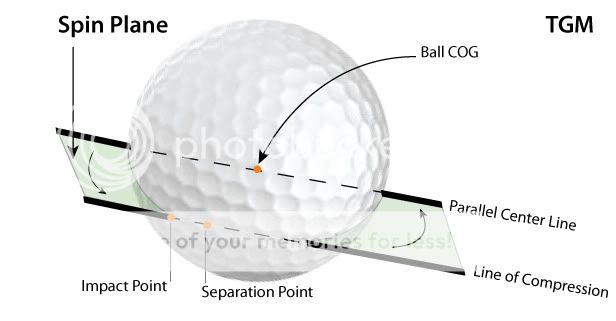
The Ball has a Center of Gravity. The Line of Compression does not pass through the Center of the Ball. Although the Center of Gravity of the Ball intersects the Center of Gravity of the Clubhead Orbit, the Inclined Striker will create an off-center Strike (Vertical Plane). All objects will (eventually) Rotate around their Center of Gravity.
Quote:
2-A RESILIENCE The response of the ball to different applications of force is the factor that determines how force must be applied to produce a desired result.
Resilience is the key factor in ball response. Neither a rock on a spoonful of clay will act the same as a golf ball. The ball is subjected to a violent deforming compression. The ball is actually distorted, not compressed – except for reduction of one dimension. Rubber is incompressible. Trapped air bubbles can be compressed – but not the rubber itself – it flows. It flows in two directions – but acts like a solid in the third. This third direction is the direction of the compressing force. The momentum of the violent return of flow after impact also distorts the ball by exceeding the normal dimension of the compressed point. The “kick” given to the ball by this action is an important factor in ball response. Roll of the ball on the face of an inclined striker does not account for all the action produced by such an impact, especially in imparting spin to the ball. When the direction of the compressing force does not pass exactly through the center of the ball, a spin will be imparted to the ball. It will rotate on the plane of a line drawn form the line of compression to a parallel center line.


 HaHa, I have wonderful success with that tool, but it sure made a mess with you that day. Oh well, we got it straightened out and learned there are horses for courses.




 Linear Mode


