No place for that. You could just "do one", or start behaving with a little more courtesy for fellow members.
Have to agree.
No personal insults on either side please. Usually when a thread gets to this point its either getting really interesting or really overworked. There is still some good subject matter here if y'all can keep your cool.
One warning - this thread now has MikeO's attention so which pill do you want; red or blue?
__________________
Bagger
1-H "Because of questions of all kinds, reams of additional detail must be made available - but separately, and probably endlessly." Homer Kelly
No personal insults on either side please. Usually when a thread gets to this point its either getting really interesting or really overworked. There is still some good subject matter here if y'all can keep your cool.
One warning - this thread now has MikeO's attention so which pill do you want; red or blue?
The reason I pointed out Hogans Left knee flexion is so you could see he stabilized his lower body.
Ok let me add here so more info to develop a better understanding of lower body mechanics
Center Of Mass is where weight is central.Safely say the belly button.
COP Center Of Pressure is the center pressure between the feet.
Normal forces are the normal force applied perpendicular to ground by golfer through the feet/ground interface.
Shear forces are forces applied to parallel to or along the surface of the ground by golfer through the feet/ground interface.
A golfer starts with a shift of the center of pressure toward the rear foot as the club is "taken away" during the initial portion of the back swing. This shift moves the center of pressure behind the center of mass relative to an axis running along the target line. As the golfer nears the "top" of the back swing and begins transition from back swing rotation into down swing acceleration the center of pressure shifts forward toward the front foot. It is this action creating forward momentum that facilitates the production of shear force at the feet/ground interface. Ground reaction to the shear force created by the feet produces a force couple, which is translated through the legs to the hips segment. The force couple acts on the hips segment to produce torque and rotary acceleration. Once speed is transfered the lower body then stabilizes and the hips decelerate at impact.
The main reason for right lateral bending is so the right arm can react low point in the swing.
You can still move forward and maintain the hips and shoulders to be perpendicular to the spine.
The only time the hips can have an impact on lateral bending is if the left side of your lower body isn't stabilized or anchored.
Although this is a lower body stabilizing issue not spine related.
When hogan does his drill can you notice he lost flexion in his left left leg, his hips are open left and his upper body is square to his hips. Hogan lost his ground forces and lower stability. If hogan did this he may create a superficial hip speed, although he wouldn't have lower body stabilization and hip deceleration. this wouldn't allow hips speed to be transfered to his upper body or Load and fire his muscles.
Again the question remains was Hogan really aware how he created hip rotational speed or the demonstration is how he felt was how he created hip rotational speed. I'm not sure Hogan was aware how important the ground forces he created was the essence to Hogan creating hip rotational speed, lower body stabilizing at impact and hip deceleration, which allowed speed to transfer to his upper body, load and fire his muscles then his upper body would square up to his hips.
What we think or feel we are doing sometimes can be totally opposite to what we are truly doing.
Like it. Makes sense . . . . Now question for you on the two pics . . . .
A couple of observations on the two pics (drill vs. real) and your comments would be appreciated . . .
1. Shifting focus a bit to the right knee. Note that the spacing between the knees is much better in Hogan's "real" pic. The right leg is MUCH straighter at Start Down than in the "drill" pic. Also there is probably less flexion in the right knee than there was at address at this point. The right side gets "saggy" in the drill . . . would this be due to the COG you described above going parallel to the target line?
2. Is there a "direction" for the left knee in creating the forces you describe above? Should the left knee maintain its flexion AND move toward the target at startdown?
3. At what point in the stroke do the hips lose their flexion in the downswing? Or do should they? See below . ..
THIS
OR THIS?
__________________
Aloha Mr. Hand
Behold my hands; reach hither thy hand
Last edited by 12 piece bucket : 08-14-2009 at 01:08 AM.
The left knee move is more than a stable base, it is a critical part of why Hogan could create lag pressure the way he did.
Many of those that learned from Hogan speak of moving the left knee as a key start to the downswing. It is well worth trying if you are a swinger.
Edz,
You can try maintain flexion with your left knee although this won't work for people.
Hogan was able to maintain knee flexion was a reaction from being able to create normal and shear forces. The down swing acceleration the center of pressure shifts forward toward the front foot. It is this action creating forward momentum that facilitates the production of shear force at the feet/ground interface. Ground reaction to the shear force created by the feet produces a force couple, which is translated through the legs to the hips segment.This creates lower body stabilization and maintain left knee flexion.
The force couple acts on the hips segment to produce torque and rotary acceleration.
How hogan created Lag was a chain of events, in his initial downswing Hogan created separation between his lower body and upper body. This loaded his muscle group between his hips and upper body relationship. The stabilization of Hogans lower body allowed Hogan to fire his upper body with his muscles.His arms Lagged behind and his muscles in is upper body arms relationship loaded, As his upper body started to slow prior to impact, This again allowed hogan to fire the muscles (arm /upper body).His upper body would momentarily slow and square up to his hips at impact.The slowing of the upper body allow hogan to fire his arms. Hogan arms fired and they slowed down just prior to impact allowing hogan to release the club.
This is how hogan created Lag.
It's a little more complex than this although I hope this gives a general understanding.
Hogans secret was a chain of the events although his key to his golf swing was the ability to create ground forces.
With out ground force you can not maintain knee flexion like hogan did. A chain of events lead to how Hogan created Lag.
In golf people don't know how to create ground forces. Although even if they are aware of them it's not something you can physically apply on the practice fairway. You need to train your body the right movement patterns to create ground forces.
What is important is how you create the right moves to create ground forces.
Took years of research to work out how to train someone to achieve ground forces, research found the body has to be trained to achieve ground forces.
Last edited by bioengine : 08-14-2009 at 03:23 AM.
The biggest lesson I ever learned was, not, whether it works or not, but, if it makes mechanical sense, do it ‘till it does work.
The day of smoke and mirrors is gone. Gimmicks are gone. Fundamentals have nothing to do with trial and error, just make it go right.
Trial and error is OK for minor variations for advanced players. Choppers like you and me should play it safe with applying Laws of Nature.
Paul Hart.
__________________ The student senses his teacher’s steadfast belief and quiet resolve: “This is doable. It is doable by you. The pathway is there. All you need is determination and time.” And together, they make it happen.
Can anyone tell me how to upload photo's from my computer to display on the thread.
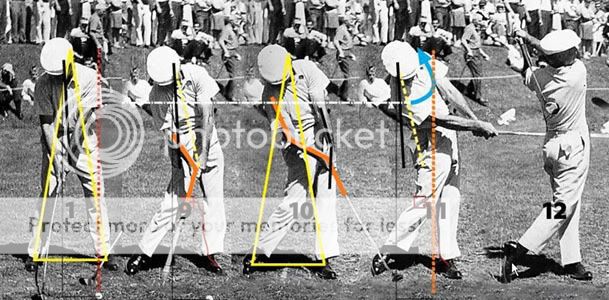
Daryl what do you mean by these lines, none of these are representing the axis of the spine, shoulders and hips are in space.
The hips, shoulders and spine have turned and open left of the target.
These lines are according to the target line.
They aren't representing in reference to the axis of the spine, where the spine is in space.
The center of mass has moved towards the left foot and the shoulders and hips have turn around the axis of the spine left.
these lines aren't indicating or are a good reference to whether or not the hips and shoulders are perpendicular to the spine.
Can you explain what these lines are trying to indicate?
Bucket,
In my reply to Edz will may be shed some light.
We don't every worry about knee flexions etc. how far hips left etc.
Huge secret and key is if you have created the right ground forces this take care of the lower body mechanics, hips speed, how far the hips turn, acceleration and deceleration. sliding and so one.
The theory was created 20 years ago, although taken years to work how on earth to teach someone to how do this. Although was natural. If you train your body how it wants to naturally create speed or anatomically designed to move. This happens for you.
Next toughest part working out how to train the body how to move the way it's designed to.
Years of research and testing.
Last edited by bioengine : 08-14-2009 at 04:07 PM.
Sorry Bio, I should have added comment. The photo's aren't mine. I don't know what the lines represent.
I uploaded the photo sequence to illustrate that Ben Hogan's Hip often led his shoulders well into the Finish. Examples of Hogan were posted illustrating parallel Hips and Shoulders at Impact and I thought that those didn't represent Hogan entirely.
........Took years of research to work out how to train someone to achieve ground forces, research found the body has to be trained to achieve ground forces.
Tell them to imagine breaking down a door with the left shoulder, to feel as if hitting the ball with the back of the left shoulder.
__________________
"Support the On Plane Swinging Force in Balance"
"we have no friends, we have no enemies, we have only teachers"
Simplicity buffs, see 5-0, 1-L, 2-0 A and B 10-2-B, 4-D, 6B-1D, 6-B-3-0-1, 6-C-1, 6-E-2




 Linear Mode


