What the heck is Hook Face ? There's more to this than first meets the eye I believe. Two correct answers perhaps. Multiple answers perhaps . Anybody got some yoda posts on the matter? Mike O made some good observations recently on the matter. Can we try to simplify or would that be wrong? Can it be drawn? Might take two drawings one for each concept ?
What the heck is Hook Face ? There's more to this than first meets the eye I believe. Two correct answers perhaps. Multiple answers perhaps . Anybody got some yoda posts on the matter? Mike O made some good observations recently on the matter. Can we try to simplify or would that be wrong? Can it be drawn? Might take two drawings one for each concept ?
What the heck is the Straight Away position?
Forward shaft lean with head soled square ? Will produce straight away ball flight?
Forward shaft lean with head soled square ? Will produce straight away ball flight?
HB ??
Yes but there's more: Ill try but jump in and correct me please guys.
Version 1 the more static consideration if you will.
-Its progressive as the clubs get shorter of course.
-its designed into clubs by the manufacturer and yet oddly its never mentioned.
-It moves the ball back of low point progressively. Note that ball placement as being related to the left foot is less relevant to the geometry . Note that it is possible to move the ball back vis a vis low point and by narrowing the stance maintain a prescribed ball to left foot relationship. This ball left foot constant is often written about , but seldom actually adhered to by pros. Their logic isnt as good as their instincts which interact with the physics of the matter . PHysics being inalterable . Its not golf physics its just physics.
-each club will now have a unique place where its sits square in its impact fix alignment (which includes a prescribed amount of shaft lean) vis a vis low point. There are differences amongst manufacturers . Trial and error is the only way of identifying the correct placement vis a vis low point. This is the Straightaway Position.
Why do they design clubs this way?
1. Shorter lever lengths switch ends easier, get to their impact fix alignment quicker, easier. Designing the club to sit square in an aft of low point position gives the shorter , faster levers less time ... its offsets the need for the golfer to swing each club differently given this lever length consideration.
2. Also there are benefits to an increased angle of attack on the ball . Hitting down on a ball is easier than the clean pick off which has less margin for error. A ball place back in the stance is a luxury that only the more lofted clubs can afford ... a hooded one iron played back in the stance would not loft the ball very high. And so one irons had little if any hook face as they were played up in the stance and swept off the turf.
3. I dunno.
Version 2. The dynamic consideration .
We need Mike O here. Version 1 and 2 are mentioned by Homer IMO. The amount of mass underneath the sweetspot on the face ..... the pie shaped section on a wedge say that is formed by the leading edge and a horizontal line running through the sweetspot.... given the tendency of the sweetspot to align to the number three pressure point implies a slightly closed club face at impact . A more dynamic form of hook face.
I might have screwed this last one up or done it a major disservice. When I get home Ill research it some more.
................ given the tendency of the sweetspot to align to the number three pressure point implies a slightly closed club face at impact . A more dynamic form of hook face.......................
What the heck is Hook Face ? There's more to this than first meets the eye I believe. Two correct answers perhaps. Multiple answers perhaps . Anybody got some yoda posts on the matter? Mike O made some good observations recently on the matter. Can we try to simplify or would that be wrong? Can it be drawn? Might take two drawings one for each concept ?
What the heck is the Straight Away position?
I'm sure "Mike O" will contribute when he's released from Rehab.
This is important.
Hook Face is built into the design of all golf clubs. Neutral Hookface describes the Standards of the Golf Club. When Aligned to its Lie Angle, Shaft in a Vertical Plane and leading Edge Square to the Target line, a Ball will rebound along the Target Line. And, the Face will predictably Close at a specific ratio. That's the simple part. It's the Alignment relationship between the Longitudinal COG of the Club and the Clubface Alignment. The Club-maker sets Hook-Face at Neutral at Low Point.
What does Hookface Do? It determines how fast the Toe overtakes the Heel of the Club. The shorter the club, the more vertical the Plane, the more vertical plane, the Faster the Rotation. This is the Heart of the Right Forearm Angle of Approach.
How does it do that? Get a "Pitching Wedge." Square the Club at Low Point, then Raise the Handle up about 20 degrees and move closer to the ball. Notice that the Clubface is now aligned to the right of the target but the leading edge remained Square. Rotate the grip Counterclockwise until the face is square to the Target (don't care about the leading Edge). We already know that the Toe and Heel rotate around the COG of the Club but NOW it will do so faster and require less motion than when the club was at its neutral Hookface Alignment. YOU changed the geometry of the golf club to one with a faster closing Clubface.............Play the Ball from Low-Point with all this added Hookface and you'll Hook the Ball off the Planet because the Clubface will have way too much rotation for that Impact Interval Length! But, play the ball 6" back and the widened Angle of Approach is just right for that amount of rotation. We're taking the difference between 1/2 vs. 3/4 degree.
What's the big deal? Because when we play the ball back, and steepen the Plane (Geometry of the Circle), Hinge Action can Sustain the Line of Compression from Impact to Separation.
Ya, we can hit a straight shot when playing the ball back 6".
Play the Ball back,
steepen the Plane by moving the Ball in toward your Stance Line,
Add Hookface,
grip it and rip it.
So, this is a lesson in TGM. Using the Right Forearm Angle of Approach, Geometry of the Circle, Taking advantage of a Golf Clubs inherent Hook Face design, so that Hinge Action can sustain the Line of Compression.
"The Hinge Action of an Angular Motion on an Inclined Plane". It kinda takes on added meaning?
Last Thing
Moving the Ball Back along the Plane Line and adding Hookface is a waste of time unless all you want to do is add divergence. It will do that well too. Creating divergence by moving the ball away from the Clubhead Orbit, then mis-align the Clubface to compensate then spend a year in therapy/Rehab with "Mike O".
I'm sure "Mike O" will contribute when he's released from Rehab.
This is important.
Hook Face is built into the design of all golf clubs. Neutral Hookface describes the Standards of the Golf Club. When Aligned to its Lie Angle, Shaft in a Vertical Plane and leading Edge Square to the Target line, a Ball will rebound along the Target Line. And, the Face will predictably Close at a specific ratio. That's the simple part. It's the Alignment relationship between the Longitudinal COG of the Club and the Clubface Alignment. The Club-maker sets Hook-Face at Neutral at Low Point.
What does Hookface Do? It determines how fast the Toe overtakes the Heel of the Club. The shorter the club, the more vertical the Plane, the more vertical plane, the Faster the Rotation. This is the Heart of the Right Forearm Angle of Approach.
How does it do that? Get a "Pitching Wedge." Square the Club at Low Point, then Raise the Handle up about 20 degrees and move closer to the ball. Notice that the Clubface is now aligned to the right of the target but the leading edge remained Square. Rotate the grip Counterclockwise until the face is square to the Target (don't care about the leading Edge). We already know that the Toe and Heel rotate around the COG of the Club but NOW it will do so faster and require less motion than when the club was at its neutral Hookface Alignment. YOU changed the geometry of the golf club to one with a faster closing Clubface.............Play the Ball from Low-Point with all this added Hookface and you'll Hook the Ball off the Planet because the Clubface will have way too much rotation for that Impact Interval Length! But, play the ball 6" back and the widened Angle of Approach is just right for that amount of rotation. We're taking the difference between 1/2 vs. 3/4 degree.
What's the big deal? Because when we play the ball back, and steepen the Plane (Geometry of the Circle), Hinge Action can Sustain the Line of Compression from Impact to Separation.
Ya, we can hit a straight shot when playing the ball back 6".
Play the Ball back,
steepen the Plane by moving the Ball in toward your Stance Line,
Add Hookface,
grip it and rip it.
So, this is a lesson in TGM. Using the Right Forearm Angle of Approach, Geometry of the Circle, Taking advantage of a Golf Clubs inherent Hook Face design, so that Hinge Action can sustain the Line of Compression.
"The Hinge Action of an Angular Motion on an Inclined Plane". It kinda takes on added meaning?
Last Thing
Moving the Ball Back along the Plane Line and adding Hookface is a waste of time unless all you want to do is add divergence. It will do that well too. Creating divergence by moving the ball away from the Clubhead Orbit, then mis-align the Clubface to compensate then spend a year in therapy/Rehab with "Mike O".
Is this an "TGM "SWEETSPOT" PHYSICS" explanation or another theory that I don't follow well?
The force of the Impact will hold the ball against the face of the orbiting Clubhead and so carry it along the same circular path. This places the ball under the laws of Centrifugal Force. Which requires that the ball leave its circular path at right angles to the radius of that path at the point at which it leaves that path. But the hook-face alignment of the Clubhead – designed to give it the proper relation to the Plane Line – diverts the ball from its true tangential path. This geometric alignment assures full production of straightaway velocity by assuring no glancing action other than for producing backspin. Study 2-J and 2-F.
The second last sentence is the one that causes me some trouble. It will play a big part in whats coming as it relates to what Homer refers to as the Straight Away Position. I dont get it frankly. Would there not be divergence albeit lessened by steeper plane angles . Maybe some body can explain it to me ...
Quote:
The proper horizontal motion of the Clubface controls its alignment during Impact. Only the putter is so constructed as to permit visual alignment. All other Clubs are angled – or hook-faced – in relation to the Clubshaft.
I know Ive read about hook face in other contexts ( a more "dynamic " version if you will ) somewhere in the darn book .... cant find it right now.. Has anyone got em handy?
The second last sentence is the one that causes me some trouble. It will play a big part in whats coming it relates to what Homer refers to as the Straight Away Position. I dont get it frankly. Would there not be divergence albeit lessened by steeper plane angles . Maybe some body can explain it to me ... please.
I know Ive read about hook face in other contexts somewhere in the darn book .... cant find it right now.. Has anyone got em handy?
When the ball is struck before low point the club head and face is pointed down out and forward if not built with hookface. ie. the club head crosses the plane line on the way to low point. This will hit the ball to right field, a little. at the intended point of impact the club head, with hookface, is designed to sit square to the plane line. Therefore, at impact the ball will have a clubface pointed along the plane line/target line not out to right field.
Right field is a tangent at impact.
That is just this bears understanding. But U should pick the understanding U like.


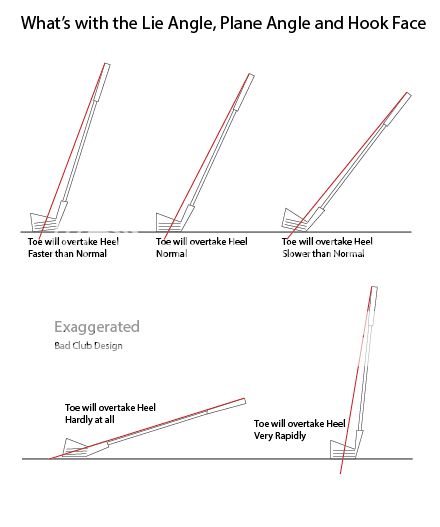
 It kinda takes on added meaning?


 Hybrid Mode

