It's pretty amazing that Hogan had that figured out back in 1948. That Power Golf illustration is by far the first reference I've ever seen to this shaft deflection phenomenon.
Where's the Bear these days? He had some interesting shaft bend profiles from the old TT Shaftlab. Really interesting actually from a TGM perspective. Bend the Aft or bend the top etc.
What's especially interesting is that Mackenzie reports that for every centimeter of forward deflection the shaft also rotates the face closed 0.7 degrees. As if we didnt have enough to be concerned about already.
What's especially interesting is that Mackenzie reports that for every centimeter of forward deflection the shaft also rotates the face closed 0.7 degrees. As if we didnt have enough to be concerned about already.
Which is why Ben Hogan preferred that his shaft flex be "somewhere between a fence post and a telephone pole".
Larry Nelson played Hogan clubs throughout his PGA TOUR career. The shafts were Apex 5s.
Tipped.
These guys didn't want anything influencing that ClubFACE through Impact except their Flat Left Wrist.
Karsten Solheim at Ping was of the same mind. He offered one shaft flex . . .
Stiff.
Kinda reminds you of Henry Ford and his Model T: "You can have any color you want, as long as its black."
Which is why Ben Hogan preferred that his shaft flex be "somewhere between a fence post and a telephone pole".
Larry Nelson played Hogan clubs throughout his PGA TOUR career. The shafts were Apex 5s.
Tipped.
These guys didn't want anything influencing that ClubFACE through Impact except their Flat Left Wrist.
Karsten Solheim at Ping was of the same mind. He offered one shaft flex . . .
Stiff.
Kinda reminds you of Henry Ford and his Model T: "You can have any color you want, as long as its black."
Relax and enjoy yourself this week. Make a great presentation or many!
ICT
__________________
HP, grant me the serenity to accept what I cannot change, the courage to change what I can, and the wisdom to know the difference. Progress and not perfection is the goal every day!
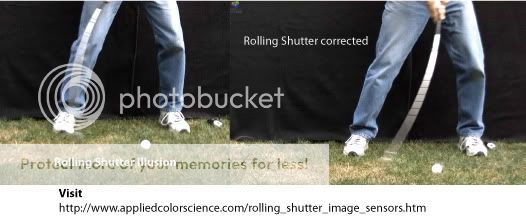
1.) Image sensors with rolling shutter image capture cannot capture an entire image frame instantaneously.
2.) When using a rolling shutter-based image sensor, pay attention to the DIRECTION of the shutter - especially if you want to capture realistic motion. Turn the Camera Upside-down
D I believe the second image is not "rolling shutter corrected" but rather just the camera turned upside down and showing the illusionary effect of the rolling shutter in the opposite direction. Neither photo is accurate.
What does this mean:
-If its blurry dont trust the bend you see...at all.
-you need a faster camera.
Personally, I believe the FEEL of what YODA and HOMER are teaching us in trying to maintain the lag is very real. What MacKenzies photos show as real world may be true, I have no idea, but doesn't do a thing for my swing or my teaching. Trying to maintain the lag helps in the real world, and I don't believe for one second that the scientists are abandoning that feel. They just renamed it torque. I could be wrong, I'm not that bright, but I knows what works for me and my students.
Kevin
__________________
I could be wrong. I have been before, and will be again.




 Linear Mode


