Couple of Homerian terms to go then we can hit some draw shots .
Anyone wanna tackle what Homer meant by Grip Rotation? We're gonna need it.
I think 7-2 said it, in words, about as well as possible. Note-only hitters rotate their grip- TURN THE HANDS TO A NEW POSITION ON THE GRIP. It must be assumked that the hitter is using angled hinge and the swinger4 is using horizontal hinge.
If the ball is moved back , the hitter will hood the clubface to maintain a square leading edge, a draw will result, and if the ball is moved forward the hitter will lay back the clubface to square the leading edge. and a fade i s result. rotate the grip to do this.
The swinger , with horizontal hinge, when the ball moves back it opens the clubface3. Just rotate the plane line to conform to clubface alignment an fade. move ball forward, rotate the plane line to match the leading edge and a draw will result.
Do not move your stance in hitting procedure. the hitter can take a normal address , move the ball back/forward then rotate their grip. The swinger can take normal stance, then open or close their stance which will have the same effect as moving the ball back/forward and will accomplish the plane line rotation at same time.The swinger does move
HB
Last edited by HungryBear : 12-16-2012 at 07:59 PM.
I think 7-2 said it, in words, about as well as possible. Note-only hitters rotate their grip- TURN THE HANDS TO A NEW POSITION ON THE GRIP. It must be assumked that the hitter is using angled hinge and the swinger4 is using horizontal hinge.
If the ball is moved back , the hitter will hood the clubface to maintain a square leading edge, a draw will result, and if the ball is moved forward the hitter will lay back the clubface to square the leading edge. and a fade i s result. rotate the grip to do this.
The swinger , with horizontal hinge, when the ball moves back it opens the clubface3. Just rotate the plane line to conform to clubface alignment an fade. move ball forward, rotate the plane line to match the leading edge and a draw will result.
Do not move your stance in hitting procedure. the hitter can take a normal address , move the ball back/forward then rotate their grip. The swinger can take normal stance, then open or close their stance which will have the same effect as moving the ball back/forward and will accomplish the plane line rotation at same time.The swinger does move
HB
Nice .
Isnt it more correctly Hitters and Hand Manipulated Swingers ? Meaning just about everybody except the True Swinger ... those for whom CF [U]alone[/u] squares the clubface by definition?
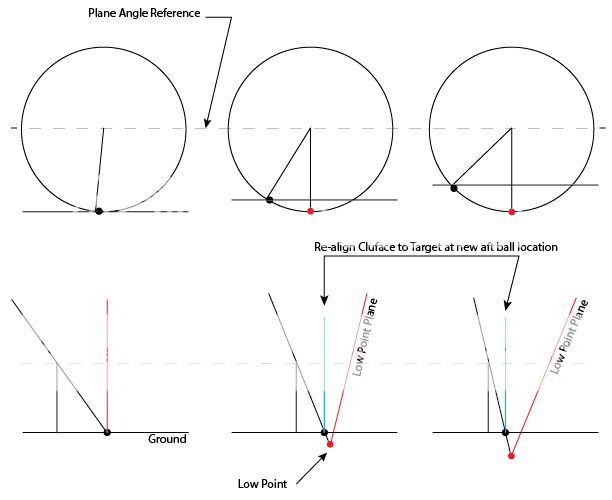
The answer to this question doesnt matter in regard to the geometry at hand .... if when you position your ball "back in your stance" which we now see as being BACK , IN , UP (thank you D) along the golfers view of the circle , THE ARC OF APPROACH you also rotate the face square to the Target Line , Impact Plane Line you have effected GRIP ROTATION according to Homerian definition. (interject please anyone who wants to redefine). Draw shot resulting but in accordance to the amount of OUT associated with path of the clubhead ..... the distance between the IMpact Plane Line and the Low Point Plane Line on the Basic Horizontal Plane given plane angle. And loft etc.
Still talking theoretically here looking at the circle diagrams.
This may seem weird . What about grip spines aligned at 6:00 o'clock on the shaft wouldnt grip rotation move these spines counter clockwise in the hands ? (yes) And is a six iron really designed to be played at Low Point? Homer said no! Enter Hook Face , enter confusion and differences of opinion perhaps ... tbd. I see two schools of thought , perhaps both co existing ... Maybe we dont need to go there ? We could just stick to DIVERGENCE BETWEEN FACE ANGLE AND PATH . Thats the basic basic to common speak "side spin". Uhhh Homer never said "side spin" he referred to it as "tilted backspin" (no caps) .... the ball can only spin around one axis I believe.
Closing in on draw shot tendencies for balls played back in the stance and a sketch there of from the players unique perspective and in accordance to plane angle considerations. A useful visual for the golfer in shot shape training.
I hope that you're keeping in mind that any distance the ball is played aft of Low Point, that a corresponding steepness in Swing Plane must be applied to hit a straight shot.
I hope that you're keeping in mind that any distance the ball is played aft of Low Point, that a corresponding steepness in Swing Plane must be applied.
Ok that would imply a steepening to the clubs lie angle wouldnt it ? A toe down deal ? Why cant you just maintain lie angle ? Hmmm are you talking about the IN of Back , In , Up ? If thats what it is I see it , yes. Interesting.
As the Plane Angle is Steepened (as the Ball is Played back), the Clubface (because of the steeper plane) will produce a push type shot although the leading edge is square to the target. See for yourself. Do all of this at Low Point. Get a Club, square it all up, then raise the grip end but keep the leading edge square. See, the Face points to the Right. Then, re-align the Face by rotating the grip until the face will produce a re-bound down the target line.
But that's the easy part to understand. What we want to know, is how can Hinge Action sustain the line of compression so the ball will fly straight. For that we need to learn how the Right Forearm Angle of Approach, when applied to a steeper Plane Angle, will increase the closing ratio of the clubface.
As you play the ball back, you need a corresponding plane angle steepness adjustment.
Because the steeper plane tilts the Low Point Plane, a clubface adjustment (rotate grip) must be made to align the face to the Target.
Because the Plane is Steeper, the Right Forearm is also Steeper. So, the Right Forearm Angle of Approach will close faster, so Hinge Action can produce and sustain the line of compression.
It's really, simple. This is a big part of Chapter 2.
As the Plane Angle is Steepened (as the Ball is Played back), the Clubface (because of the steeper plane) will produce a push type shot although the leading edge is square to the target.
As you play the ball back, you need a corresponding plane angle steepness adjustment.
Because the steeper plane tilts the Low Point Plane, a clubface adjustment (rotate grip) must be made to align the face to the Target.
Because the Plane is Steeper, the Right Forearm is also Steeper. So, the Right Forearm Angle of Approach will close faster, so Hinge Action can produce and sustain the line of compression.
It's really, simple. This is a big part of Chapter 2.
So with a normal width stance, and the ball played at my belt buckle, I decide to hit a 9 iron and aim 2 inches in front of the ball with Aim Point Technique to hit a shot straight to the pin. Normally, that's what will happen. I did it yesterday with all sorts of clubs. LOL! But let's say it's windy so I want to slide the ball back in my stance. Does the ball move closer to me? Do I hood or close the club face? Am I possibly the slowest golfer on the planet and in need of a new hobby?
ICT
__________________
HP, grant me the serenity to accept what I cannot change, the courage to change what I can, and the wisdom to know the difference. Progress and not perfection is the goal every day!
Ok that would imply a steepening to the clubs lie angle wouldnt it ?
Yes
Originally Posted by O.B.Left
A toe down deal ?
Yes
Originally Posted by O.B.Left
Why cant you just maintain lie angle ?
That will need you to change the Orbit of the Clubhead. It needs a much Flatter Plane and that compounds the problem of "Diversion".
Originally Posted by O.B.Left
Hmmm are you talking about the IN of Back , In , Up ?
Yes, In and Up is back on Orbit. If the Ball is moved back on orbit, its above the ground. Steepen the Plane Angle from the Plane Angle Reference Point until the Ball touches earth. Then you'll see that Low Point hasn't changed its location.
Originally Posted by O.B.Left
If thats what it is I see it , yes. Interesting.
I'm including the quote below because Homer refers to using the "Plane Angle Reference Point".
Quote:
So those aligned between the Elbow and Shoulder Turn Planes have become the most widely accepted, because actually the Toe or Heel can be lifted enough safely accommodate either of the flatter or steeper Plane and therefore any listed Plane Angle reference Point (2-D-0).
I think that one question that were overlooking in this thread is "Why do longer Clubs need to be more open at Impact than shorter Clubs?". Longer clubs have longer impact intervals because of greater clubhead speed. This is directly related to sustaining the line of compression. The right elbow has less bend at Impact with shorter clubs giving much faster closing which is needed with very short impact intervals.
Steepening the Plane offers faster Clubface Closing for shorter Impact Intervals. You must see the Right Forearm Angle of Approach, then you'll visually see this in action.
Homer said (i'm going to paraphrase), that the golf club is designed for the way that "Humans" swing the club. Somewhere along the way we lost that connection. And the connection, I'm sure, is the Right Forearm Angle of Approach and the Geometry of the Circle. I Know what you're thinking, but I'm not being pig headed.
Couple of comments:
1 I do not believe the "practical range" of fore and aft ball positioning for any given club is "wide" enough to trigger these other concerns.
2. please examine Hogan's atance/ball position drawings-page 125, Five Lessons. I can't copy the drawing.
Pay particular attention to:
He moves the ball back for each club by narrowing his stance and opening his stance.
He effectivly rotates his plane line and maintains his target line when he op-ens his stance.
Sugestion - I believe HK has included this info- maybe in bits and pieces- As we find those bits and pieces we should include them here.
HB



 LOL! But let's say it's windy so I want to slide the ball back in my stance. Does the ball move closer to me? Do I hood or close the club face? Am I possibly the slowest golfer on the planet and in need of a new hobby?


 Hybrid Mode

