If you throw a stick using a swing like motion, the part of the stick that has the largest swing radius will start off with greater speed than the part you were holding in your hand. As a consequence the stick will rotate in the air like a rod on a spinning wheel as it flies through the air. Do you agree?
Same thing will happen with the golf ball. The side of the ball that is furthest away from the swing center (hinge axis) will aquire more speed than the part that is acellerated with the shortest swing radius. Because it is under the laws of Centrifugal Force during impact as per your quote.
Its not daryl but...... I'm not sure I (3putt) agree.
If you throw the stick as you describe AND in doing so you(knowingly or unknowingly) apply a force that causes the stick to rotate around an axis internal to the stick, then yes, the stick will continue to rotate once it is separated from your hand.
If you throw the stick and do not introduce any forces other than the centripetal force your arm was already applying to the stick, then every atom in that stick will fly off in a straight line, tangential to the circle it was moving on. I agree there will be an imbalance (as you pointed out the part of the stick further away from the centre of the circle has greater speed) but I think the system will rebalance - some atoms will slow, others speed up,- conserving momentum for the entire system as a whole - and in short order the entire stick will move on a linear path, same as the centre of gravity, with no rotation.
But I am speculating only.
And, though interesting, is this really going to help my golf game?
...
And, though interesting, is this really going to help my golf game?
Hi 3Putt. That is the real question here. All the science BS that is being spewed about right and wrong. Mostly semantics...
Obviously there is stuff out there we can learn from folks with healthy intentions, but we need to separate those who merely want to win debates with science that has no bearing on the game of G.O.L.F.
Kevin
__________________
I could be wrong. I have been before, and will be again.
BerntR, I couldn't agree more with what you're saying. It also goes that the Bottom edge of the Clubface is moving faster than the Top edge and that the inside bottom edge of the clubface will cause more compression than the outer upper edge. And all of this from observing a simple centrifugal force application.
We agree that there are forces during Impact other than Glancing Spin and a little friction.
Glancing Spin doesn't explain why a Draw has more carry than a Fade nor why a 7 iron compressed shot travels farther than a glanced shot having the identical clubhead speed. I can speak from experience that it's 10-15 yards and that's when both shots are straight at the pin.
I can work the ball anyway anytime but I play 95% of my shots dead straight and all of my divots point a hint to the right but I play the Ball forward.
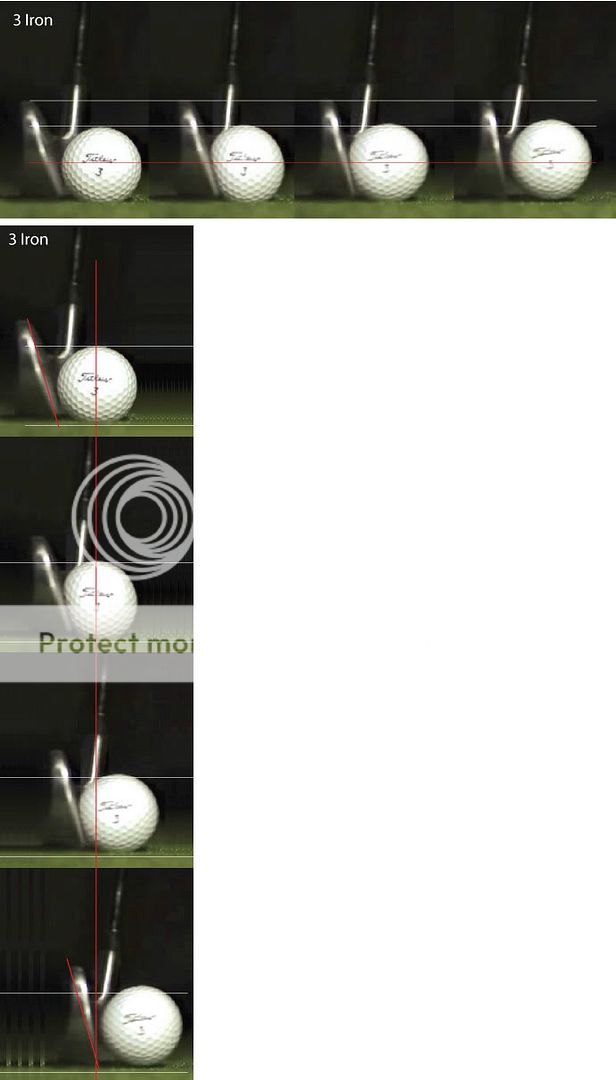
I found a video of a 3 Iron strike a little more than a year ago and I've been studying with lines and different layouts. I think that the picture sequence shows how well the clubhead goes into the ball about a 1/4 inch before the Ball begins to move forward. Then it rebounds. The Clubhead appears to be traveling horizontal to the ground and the Clubface is closing. The Impact appears to slow the Clubhead but not the Hands.
In that case, Daryl, I think it's time for celebration.
I've often had the feeling that I've either learned a lot from you or disagreed whenever we both have participated loudly so to speak. I didn't quite get the "glancing draw" part at first but that's probably because my english isn't 100%
I've seen that picture series of impact before. I think that sorts of evidence is incredible interesting.
I also noted in those pictures that the slowdown of the clubface and the resistance in the hands actually creates a "lay forward" impact condition. There's clearly more shaft lean at separation than at first contact. If anything I would expect that behavior to improve the ball compression even further.
My pictures look just like the video. I'm sure I took the stills from it but they've been in my files so long and I can't find the video. I'll download the file. I also think that the 'toward the heel' strike observation has a lot of validity and that can be easily seen if you have the video and it would also account for the upper toe losing loft.
Those are some wicked off center hits. It's hard to say for sure whether the ball is glancing off the clubface or the clubface is glancing off the ball. I guess it's both.
I would be interested in an analysis which included #2 release.
If #2 has the left wrist at level for impact/low point then the movement of #2 will have the clubhead going down at left shoulder "low point" but the true low point must be after this point- ie. at the point where the tangent to the actual arc equals the downward angle created by #2 release. AND what does this downward motion do? For angled hinging it may hold as normal to the left hand- because the hand is perpendicular to the plane but for horizontal hinging I think it will be parallel to the left hand. As a case study. Can you hit a FULL 64* wedge with horizontal hinging? What say You??
HB
PS. Saw video add where Bobby Clampett says tour pro bottoms at 4 in. beyond ball, 100 shooter bottoms 4 in before ball. each inch forward is 4 strokes off your handicap. That was easy!
Last edited by HungryBear : 10-21-2010 at 02:38 PM.
My pictures look just like the video. I'm sure I took the stills from it but they've been in my files so long and I can't find the video. I'll download the file. I also think that the 'toward the heel' strike observation has a lot of validity and that can be easily seen if you have the video and it would also account for the upper toe losing loft.
Those are some wicked off center hits. It's hard to say for sure whether the ball is glancing off the clubface or the clubface is glancing off the ball. I guess it's both.
Yea, that's a great question. Which is glancing off of which?




 Hybrid Mode

