Boss . . . what he is trying to say is . . . if the ball is taken beyond low point club is traveling back up and in and as a result you should aim right to account for those plane/orbit conditions . . .assuming you are hitting a straight shot . . . vicey vercy for back of low point . . .
7-2 is likely where the d-plane folks would take issue with the Machine I'd say.
As I recall, he referred to being able to explain, paraphrasing now, why "Hogan adjusted his stance for the higher and lower lofted clubs". I recall no reference to Low Point.
But there may have been. Anyway, it's hard to come up with a decent answer when you don't understand the question.
As I recall, he referred to being able to explain, paraphrasing now, why "Hogan adjusted his stance for the higher and lower lofted clubs". I recall no reference to Low Point.
But there may have been. Anyway, it's hard to come up with a decent answer when you don't understand the question.
Can't wait to hear back!
Sorry that it wasn't more clear Lynn. I guess you haven't been totally apprised of what the D-Plane is and how it operates so it would of course be difficult to understand the question.
Essentially IF (and this is a big if) a person catches the ball while the clubhead is starting to travel back up and in past low point, then the path would be leftward. To offset for this one should set up a bit more closed. With short irons the ball is struck further back from low point and therefore the path is traveling out to the right. To compensate for this you need to align to the left.
__________________
The 4 Jobs in golf
1. Environment - Gets in the way
2. Ball - Interacts with the environment
3. Club - Moves the ball in a specific way
4. Golfer - Swings the club I already paid good money for the first 3...
Sorry that it wasn't more clear Lynn. I guess you haven't been totally apprised of what the D-Plane is and how it operates so it would of course be difficult to understand the question.
Essentially IF (and this is a big if) a person catches the ball while the clubhead is starting to travel back up and in past low point, then the path would be leftward. To offset for this one should set up a bit more closed. With short irons the ball is struck further back from low point and therefore the path is traveling out to the right. To compensate for this you need to align to the left.
Why would I need the D Plane to explain this? Sounds like simple geometry to me.
__________________
"The only real shortcuts are more and more know how"...TGM
Sorry that it wasn't more clear Lynn. I guess you haven't been totally apprised of what the D-Plane is and how it operates so it would of course be difficult to understand the question.
Essentially IF (and this is a big if) a person catches the ball while the clubhead is starting to travel back up and in past low point, then the path would be leftward. To offset for this one should set up a bit more closed. With short irons the ball is struck further back from low point and therefore the path is traveling out to the right. To compensate for this you need to align to the left.
You're right: I am a D-Plane novice. I turned off quickly a few years back when a seminar speaker promoting it attempted to "prove" that Impact was really 'Outside-In' and not Inside-Out'.
Given the interest here and elsewhere, I'll learn more about it in the weeks ahead, relate it to the principles that have served me well for more than three decades, then draw my own conclusions. My main motivation for the exercise will be to determine if (and then how) I could use it to improve my teaching and, consequently, the results my students achieve.
Despite my D-Plane ignorance, I will attempt to answer your question. First, a few principles:
1. Unless manipulated in some fashion, Clubshaft length determines when a given Club will reach its Impact condition. Therefore, there is only one ‘Straightaway Point’ built into every golf club, i.e., only one place in the stance where Centrifugal Force alone will align that particular Clubface and Clubshaft correctly for Impact.
2. True Swingers have little choice here: They simply must move the ball backward or forward in the Stance until that precise location is achieved. Otherwise, because Centrifugal Force (unmanipulated) is indifferent to Ball Location, a more forward (of Straightaway Point) ball position will result in a Closed Clubface at Impact (Draws and Hooks), and a more aft location will produce an Open Clubface (Fades and Slices).
3. Manipulated Hands Swingers and Hitters can likewise move the ball up or back in the Stance, but they also have the option of using a single Ball Location and compensating via the Aiming Point Technique (6-E-2). Actually, these players can hit the ball dead straight from any Ball Location (and from any of the nine Plane Line-Stance Line-Target Line Combinations) simply by aligning the Clubface and Clubshaft at Fix (8-2), then returning the Flat Left Wrist to its Vertical-to-the-ground alignment at Impact (as opposed the theoretical configuration per 7-10, i.e., at Low Point).
4. Players employing the Flip Release (10-24-F) must also accommodate the Ball Location requirements dictated by Shaft length, but, since their Release is Body-related (always in the same place with regard to Body position), the Ball-related options (simply moving the ball within the Stance or manipulating the Aiming Point) are not available. Hence, they must ‘effectively’ move the ball without changing the Release point relative to the Body. This can be done only by Opening and Closing the Stance Line for the shorter and longer Clubs respectively.
Now, to your point:
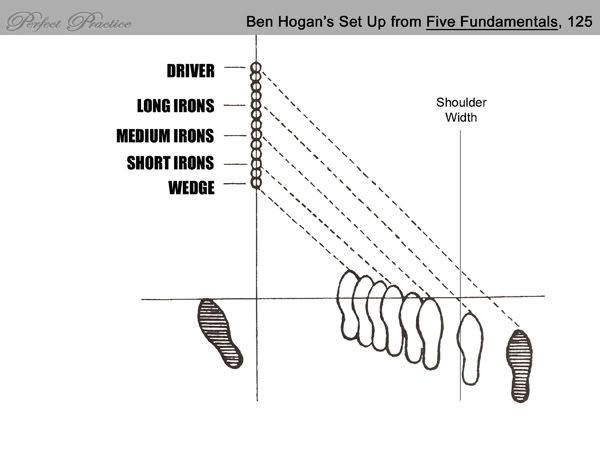
Hogan’sFive Lessons illustrated a constant Ball Location (in relation to the Left Heel) and a varying Stance Line. [Actually, as the Stance narrows, the Ball Location varies considerably in relation to the Center of the Arm Swing, i.e., Left Shoulder.] To the extent he employed a truly constant Ball Location, he compensated (subconsciously) for its single Location using the Aiming Point procedure. There is no alternative: If the Ball is not in the correct place, then you must change where you aim the Thrust.
As a Flat Left Wrist player with a definite Hinge Action and a Clubface aligned appropriately – in other words, a player not at all dependent on the one Straightaway Point of the True Swinger -- Hogan had no need to “align” (as you say) left or right of the Target with his Stance Line to compensate for the varying Clubshaft lengths.
Further, the Stance Line itself governs only the degree of Pivot Motion and its freedom or restriction in either or both directions (10-12-0/A/B/C/D). Opening and Closing the Stance does not “align” the Stroke left or right of the target. This can be accomplished only by Rotating the Plane Line per 10-5-A, -D or -E.
My guess is that, if Hogan were here, he would tell us he was referring to his Stance Line as an automatic governor of his Pivot Motion. In fact, he described exactly that on page 125 of his book. Certainly, at no time did he even begin to suggest that by opening and closing his Stance he was changing his Direction of Aim.
Instead, in assuming the Stance Lines illustrated, he was promoting an unrestricted Backstroke Motion with the longer Clubs (for Power). With the shorter Clubs, his goal was a slightly restricted Backstroke Motion coupled with an unrestricted Follow-Through (for Accuracy). All of which has been known at least since the days of 'Old Tom' Morris.
You're right: I am a D-Plane novice. I turned off quickly a few years back when a seminar speaker promoting it attempted to "prove" that Impact was really 'Outside-In' and not Inside-Out'.
This could be scary depending on angle of attack. If the ball is hit before low point, it will be inside out as you mention. However, if the ball is hit after low point then you will have Outside-in.
Depending on the context could be accurate or not.
If the ball is hit before low point, it will be inside out as you mention. However, if the ball is hit after low point then you will have Outside-in.
Not a 'news flash', nevercrosses. I've been preachin' that for thirty-one years. See 1-L #13 and #15.
Allow me to add a further component in the speaker's passionate argument: A divot. And not just any divot, mind you, but a divot carved Outside-In and to the left of the Target Line!
I'm comin', 'Lizabeth. I'm comin' to join you!
-- Fred Sanford
Sanford and Sons
Now what?
Are we to believe that, assuming a Square Plane Line and a Ball located Up Plane from Low Point, that a Clubhead moving Down an Inclined Plane through Impact to Low Point will take an Outside-In Divot?
Well, that's where, when and why I left 'De Plane'.
As I said in a post above, I now look forward to learning more about it, relating it to the principles that have served me well for three decades and drawing my own conclusions.
Sorry that it wasn't more clear Lynn. I guess you haven't been totally apprised of what the D-Plane is and how it operates so it would of course be difficult to understand the question.
Essentially IF (and this is a big if) a person catches the ball while the clubhead is starting to travel back up and in past low point, then the path would be leftward. To offset for this one should set up a bit more closed. With short irons the ball is struck further back from low point and therefore the path is traveling out to the right. To compensate for this you need to align to the left.
Rofl , You are not as smart as you think Ringer , Hogan has a closed stance with longer clubs BUT since he takes a Divot even with his 3 wood how is he catching it past low point , COMEDY
Not a 'news flash', nevercrosses. I've been preachin' that for thirty-one years. See 1-L #13 and #15.
Allow me to add a further component in the speaker's passionate argument: A divot. And not just any divot, mind you, but a divot carved Outside-In and to the left of the Target Line!
I'm comin', 'Lizabeth. I'm comin' to join you!
-- Fred Sanford
Sanford and Sons
Now what?
Are we to believe that, assuming a Square Plane Line and a Ball located Up Plane from Low Point, that a Clubhead moving Down an Inclined Plane through Impact to Low Point will take an Outside-In Divot?
Well, that's where, when and why I left 'De Plane'.
As I said in a post above, I now look forward to learning more about it, relating it to the principles that have served me well for three decades and drawing my own conclusions.
I hope you enjoy the learning process.
Eventually it will be required knowledge similar to making sure they hold the end with rubber on it.




 Linear Mode


