K now before anybody has bird , those drawings are not to scale . They exaggerate the geometry for illustrative purposes but .... the path of the orbiting clubhead is still circular , elliptical. No flat spots , close but not quite. Theres a difference.
Where am going with the above drawing you might ask? At present we are working towards some basic drawings that will show:
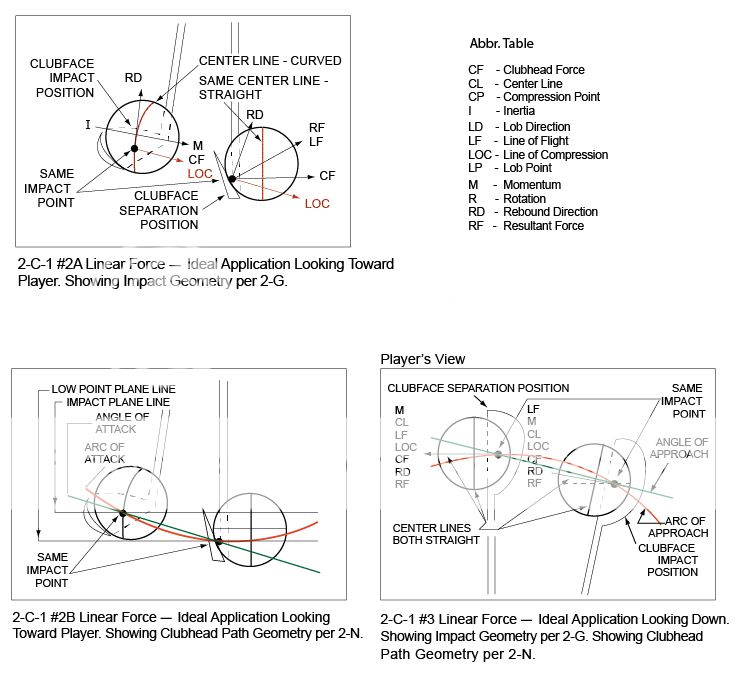
-what the path of the club head should look like when viewed from the players perspective, caddy and down the line.
-how a change in plane angle changes how the circular orbit (of the clubhead /sweetspot) looks from these various perspectives. Most importantly the players point of view . The Arc of Approach . We need to add a pair of eyes to the drawings .... above the plane slightly.
-how the players perspective of the circle can be used as a guide to on-plane clubhead line of flight maintenance. If you know where the clubhead should be you will be less likely to direct it off line due to false logic or mere ignorance.
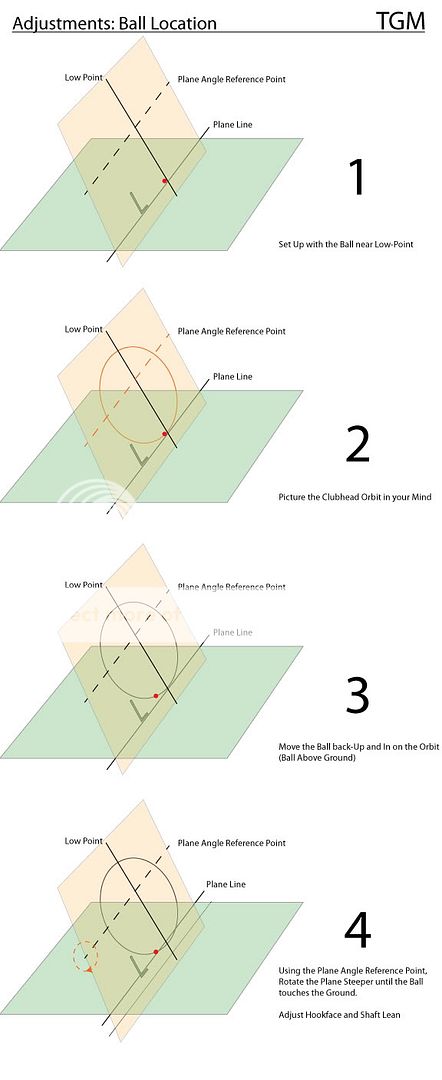
-how changes in plane angle and ball position back of low point increase or decrease the distance between the Impact Plane line and the Low Point Plane Line. With associated changes in ball reaction. Getting closer to shot shaping procedures.
Expand into your ideas beyond the great start on drawings.
Originally Posted by O.B.Left
Guys and Gals
Id like to discuss ball response , shot shaping from a geometric perspective. In light of these various interesting and worthy investigations and the potential for discord, if I may, I'd like to propose a singular rule for our own enjoyment and sanity.
Lets:
1. Pull Homers references to ball response together , verbatim. Its all over the place in the book. What do you guys have saved to your computers?
2. Re Post Yoda's thoughts on the matter. There is one post in particular that we need to dissect carefully. There is clarification needed, perhaps he will help out.
Can U start this answer with the Re. post you mention?
3. Discuss how we use this geometry to shape our shots?
4. Over and above ball response if we go a little further with the drawings we would be knocking on the door to a visual explanation to one of Homers more perplexing (but keerect) statements: "There is no angle of approach to the angle of approach".
The geometry is a macro scale representation of incramental geometry within the impact interval. There is no streight lines on the circle nor fixed angular relationships. I have not studied them but I assume the machines that "calculate" ball flight do exactly that- Take the - take the balls reaction and calculate the geometry and other physical factors necessary to produce that response- Kinda, "Once the answer is given the solution is trivial" Computers and software make it look easy and that is the only "new" in the NEW machines.
I can take us fairly deep into this stuff (I think tbd) but I need your help with the references and further insight. I thank you in advance.
Here's a wiki statement , please make editorial changes guys.
1. The further apart the Impact Plane LIne and the Low Point Plane LIne get on the HORIZONTAL BASIC PLANE the more OUT there is to the clubhead path during the impact interval .
The further apart these two plane lines get on the VERTICAL BASIC PLANE the more DOWN there is to the clubheads path during the impact interval.
So steeper Plane Angles through the impact area impart more DOWN LESS OUT. Flatter plane angles though the ball impart MORE OUT LESS DOWN . This is a "need to know" for shot shaping .
2. The more back of the Low Point the ball is positioned along the circle .... let me change this to the players perspective for more relevance .... The more BACK , IN AND UP the player positions the ball along the ARC OF APPROACH (his unique visual perspective of the circle , orbit ) the more he is moving the IMPACT PLANE LINE further away from the LOW POINT PLANE LINE. As we have established above however the Plane Angle will determine how this ball positioning (machine adjustment if you will) translates into the relative amount of OUT and/or DOWN added. Ball reaction changing accordingly.
As an aside: As we play the ball back in the stance there is more out to the club heads line of flight , more of a draw tendency . This draw tendency is less evident as we move to more lofted clubs . We tend to attribute this entirely to the added loft . Loft is a large factor but consider the steeper plane angle associated with normal wedge play. Less Out more Down . Why do I say "normal" these things are adjustable .... V.J. Trolio for instance has a flop shot technique (an optional one) where he tries to plane the shaft as low as he can get it . Thereby taking out Down as much as he can . He lays the wedge on its back and virtually skids the flange along the ground under the ball. He's wide open with his plane line like this . He's adjusted his Angle of Attack to the flattest he can get it. And you could assume his Arc of Approach , his visual of the clubheads circular ish travel would be more circular. Hmm we need drawings.
Can U start this answer with the Re. post you mention?
I could send it to you via pm if you want. The Yoda post I alluded to throws some concepts around that we're not ready for . One in particular that only a very few will be able to explain for us. We will need help . Im hoping Yoda , Ted , Mike O. and the like (present company not excluded) can jump in and straighten a few things out for us.
I wanna get us all speaking the same lingo , seeing the geometry in same way IF THATS POSSIBLE. * We no doubt will have to agree to disagree on things as we move forward. *But lets move forward.*
This thread could get stalled and never restart ... easily . So I'm trying take a linear approach to its progression. Its a linear approach to the circular/angular nature of the clubheads orbit .... geometry puns are terrible. Still havent defined a lot of concepts necessary to the understanding of the Geometry of the Circle as it relates to shot shaping. Grip Rotation , Hook Face , Plane LIne Rotation, Stance Line vs Plane LIne etc etc etc .
I could send it to you via pm if you want. The Yoda post I alluded to throws some concepts around that we're not ready for . One in particular that only a very few will be able to explain for us. We will need help . Im hoping Yoda , Ted , Mike O. and the like (present company not excluded) can jump in and straighten a few things out for us.
I wanna get us all speaking the same lingo , seeing the geometry in same way IF THATS POSSIBLE. * We no doubt will have to agree to disagree on things as we move forward. *But lets move forward.*
This thread could get stalled and never restart ... easily . So I'm trying take a linear approach to its progression. Its a linear approach to the circular/angular nature of the clubheads orbit .... geometry puns are terrible. Still havent defined a lot of concepts necessary to the understanding of the Geometry of the Circle as it relates to shot shaping. Grip Rotation , Hook Face , Plane LIne Rotation, Stance Line vs Plane LIne etc etc etc .
Imagine looking at this clubhead path from down the line. It wouldnt be flat, no. Close ish though, flatter than most. Plane angle shifting being responsible to large measure . Hogan got a little laid off at times .... some say for a purpose . This was a topic of discussion in Homers GSEM class in 1982. But I digress....
Would this non flatness of an ultimate golfers actual clubhead orbit when viewed from DTL render the flat as a pancake Geometry of the Circle mode of examination irrelevant? IMO no!
I love this animation . Imagine if you looked at a [B]tracer line[/b] of the animations clubhead travel through 3 dimensional space! It'd be unlikely to attribute its Picasso like meanderings to being the product of circle laying flat on an inclined plane , which is shifting up and down (variety of manners possible this is but one). But , Homer and most likely others ahead of his time did.





 Linear Mode


