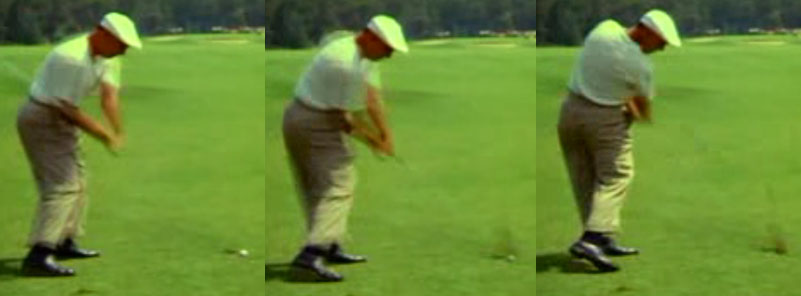
Where should the right shoulder be at impact and release?
Right Shoulder should move in a circle . . . see 2-H below . .
2-H SHOULDER MOTIONS The point may be made that it is impossible to inscribe perfect circles while the center is in motion – that is the turning Shoulder. The straight line requirements of the Compression Point are satisfied as long as both the Vertical and Horizontal Centers move precisely in unison. Direction control remains stable because both Centers are also moving in a circle – that is, the circumference of the Shoulder Turn.
The spine, between the shoulders, is the center of the Shoulder Turn only, not of the Left Arm, except by specific extension of the Swing Radius. Because, Swinging from the Wrists, the Left Shoulder, the Right Elbow, the Waist or the Feet, show it to have just to many exceptions. Though the “Head” Pivot Center is recommended, it is not at all mandatory.
But the Shoulders do have crucial On Plane functions – synchronizing and aligning the Pivot Motion and Thrust with those of the Power Package (Chapter 6). “On Plane” Right Shoulder Motion is possible only by titling its axis – the spine. See 7-14. In this area the Left Shoulder is helpless. The geometry of Shoulder Control deals only with Right Shoulder, for there are no guide lines for Left Shoulder control of the Right Shoulder. Therefore, variations in Right Shoulder location will vary the Left Shoulder location at Impact and, consequently, the Low Point location as well as the Angle of Approach (2-N).
Being a part of the Pivot and the Power Package, the Right Shoulder must reconcile them by moving with the greatest precision for thrust, speed, direction and distance. (7-3) So the Right Shoulder does not flap around haphazardly – it has many responsibilities. And variations in its Impact location will vary the Right Elbow’s Impact Bend and so may alter the Impact alignment of the Clubface. See 6-E and 7-23. The long Backstroke Shoulder Turn produces CIRCLE Path (10-23-E) and ARC of Approach procedures. The short Shoulder Turn produces “LINE” types of Delivery Path (10-23) and “ANGLE” of Approach procedures (2-J-3). So – if the Shoulder Turn is too great and takes the Hands inside the proper Angle of Approach (2-J-3), then you must shift to an Arc of Approach Delivery Line to “clear the Right Hip” (2-J-3). Or get an unwanted Pull. OR A SHANK. Otherwise, the Three Dimensions will become un-correlated including Compression Leakage (2-C-0) and an obvious struggle. As it goes back, so it tends to come down – because of the differences in Loading Characteristics (Components 11, 19, and 22).
Isn't the turned shoulder plane named because the right shoulder gets on plane at the top of the swing and goes down plane as far as possble into impact?
I know tgm isn't one set way, but why would the plane in the amazing changes section always be the turned shoulder plane?
I want the plane that gives me most compression and is easiest for me to get a forward leaning clubshaft at impact.
It is a "set way" in that the basic stroke patterns' component variations are thought to be the best and least compensated. One does not have to comply however as long as you know what you're doing.
Regarding the TSP angle, it's because Homer Kelley thought that the turned shoulder plane was far superior because "any plane shift is dangerous". He associated the elbow plane with pivot-controlled hands and warned against the shoulder turn takeaway as always too flat, or low making a plane shift mandatory, likely unintentional and unsuspected. It is for this reason the right forearm takeaway is preferred, described as mandatory.
The turned shoulder plane is defined as "that reference point reached by the right shoulder after a flat backstroke shoulder turn. With whatever body position (accounting for waist bend) the plane passes through, the right shoulder and hands are precisely AT the right shoulder level at the Top (See Brian Gay's), regardless of plane angle or shoulder turn. But any other shoulder turn can also provide the acceptable reference point."
Shoulder turn and plane angle are two different things. The plane angle is referenced by elbow, hands or various shoulder turns.
The Standard shoulder turn is a flat backstroke and an on-plane downstroke.
In the 7th edition the preferred variation was changed to Rotated shoulder turn, the normal path at right angles to the spine, which can locate a turned shoulder plane angle but doesn't have to. The downstroke may shift to whatever plane angle is chosen.
That looks like what ndwolfe is using.
I think we're struggling a bit with why your hands are too low at impact regardless of plane angle. Not enough axis tilt, right shoulder a little out instead of down. Check the clubshaft at parallel to the ground. It's slightly off plane there. Look to the pivot.
Good looking swing, by the way.
I didn't name names and I thought that it was obvious to anyone that your name doesn't belong on it.
I give you 4 Yodas for your posts in this thread.
O.B "Thank you Daryl, my gosh 4 Yodas, well I dont know what to ........
Kanye West " Excuse me O.B. , Im very happy for you and all and Ill let you talk all you want later BUT.............Beyonce had the best POST of ALL TIME"
Interesting. Brian Gay's shifts his plane angle (minimally) from the TSP to the Elbow Plane but his Right Shoulder continues moving down the TSP. Never thought about this before. So his "shoulder plane" doesnt shift in the down stroke but his plane of motion, the plane his pressure points ride, his sweet spot plane does shift.
O.B "Thank you Daryl, my gosh 4 Yodas, well I dont know what to ........
Kanye West " Excuse me O.B. , Im very happy for you and all and Ill let you talk all you want later BUT.............Beyonce had the best POST of ALL TIME"
I've heard that name "Beyonce" somewhere else. Who is it? What does it mean?






 Linear Mode


