If most tour players are double shifters then why is it that Lynn and Ted always have the TSP drawn in the amazing changes section?
And why in most photo are the hands, right forearm, sweetspot/clubshaft and right shoulder pretty much on it?
They must feel like that is a better downstroke plane, all the way to impact. And I guess they don't think shifting down to the elbow plane is worth while?
Is that the case?
Yes, that's correct.
The preferred plane angle is the turned shoulder plane, however it may be determined by the actual shoulder turn component. The reference point primarily means after a flat shoulder turn but other shoulder turns can be used for the reference point, and it says that if the former can't be reached then a steeper plane angle should be used.
"This plane angle has far better performance characteristics than any other because any plane angle shift is hazardous. This procedure does not refer to the disruptive shoulder turn takeaway."
And the plane angle variation (various shifting) specified is Zero Shift, which means both directions. (Mandatory right forearm takeaway.)
The Standard shoulder turn component is a Flat (as possible) backstroke turn and an on-plane downstroke turn.
It was changed in the 7th edition to Rotated Shoulder Turn (right angles to the spine) and we're discussing if that's possible given a Slide hip turn, because the shoulder turn seems to demand a Shiftless hip turn. The discussion really belongs in the Changes for 7th Edition thread.
When you are saying "flat back" does this mean horizontal to the ground or to the spine?
To the ground, as flat as possible. It won't actually be horizontal to the ground due to spine angle. It would be a flat turn compared to a rotated shoulder turn which is a "normal" at right angles to the spine turn.
To the ground, as flat as possible. It won't actually be horizontal to the ground due to spine angle. It would be a flat turn compared to a rotated shoulder turn which is a "normal" at right angles to the spine turn.
OK after all this which is better for a swinger,flat or rotated?
OK after all this which is better for a swinger,flat or rotated?
No opinion. Preference here seems to be flat, and up to the 7th edition it was.
Reluctant to change.
But I'm not convinced the Rotated Shoulder Turn always requires a shiftless hip turn.
The wording is ambiguous. Especially since the hip turn specified is Slide.
According to rumor, it may be an unintentional change.
My body does not like rotating, at my age, but I could be doin' it wrong.
So I'm hitting, or trying to, with a flat backstroke shoulder turn, on-plane downstroke.
Don't change something that's not broken.
I wouldn't suggest ndwolfe change his, except maybe downstroke and axis tilt.
Perhaps the confusion lies in the belief that there ideally is one singular "Plane" or one fixed Inclined Plane angle? While this may true intellectually and indeed practically for short shots, "The" Inclined Plane can and does Shift or change angles for longer shots. I cant think of golfer who hasnt shifted plane angles for full shots. Given the manner in which we define the plane anyways. (JIm Hardy's definition being a different kettle of fish, the plane of the shoulders vis a vis the left arm being one and the same etc).
From a DTL point of view, the angle formed where the Plane (picture it as a four sided rectangle along which the clubshaft or the more correctly a line between the #3 PP and the Sweetspot, travels at all times) meets the ground (the Base Line, Target LIne) can change. The club's lie angle defines the starting plane angle assuming you dont want to come into the ball toe up or down. The right forearm , or right Forearm Flying Wedge is said to be on this Plane Angle when the Right Elbow is on plane.
So "The" Inclined Plane or "The Plane" does not preclude changes in the plane angle, "shifts".
Also, Per 1-L-18 Machine Concepts. "Changing the Plane Angle has no effect on the Plane Line". Implicit in this is that Tracing the Plane Line accurately is far more critical than complying with a specific pattern of plane shifts. See Trevino, Furyk etc. There used be a really nice animation on this site that described this. If I can find it in my files Ill send it to you. It will make things clear as words sometimes fail us when describing geometry.
Yoda would, I believe, prefer the TSP in Startdown so that the Right Shoulder can get on the Inclined Plane and take the Power Package down that plane towards the ball initially. But this does not imply that he wants the clubshaft, right forearm, hands, #3 pressure point , sweetspot etc to stay on the TSP all the way to Impact. The fog will lift when you can imagine the Inclined Plane's angle changing as it shifts from a higher angle to a lower one. From say the TSP to the Elbow plane. Its the same plane of glass or plasic or whatever with different, shifting angles where it meets the ground. That is "The" Plane.
Further research has allowed me to see that I sometimes use the Hands Only Plane with no shift in total motion. Basically a wedge shot with the blade laid flat on its back, wide open and plane set super low. V.J Trollio invented this shot I believe. It takes almost all of the down out of the three dimensional impact as you scalp the ground on a severely flat Angle of Attack. The hands set below the elbow plane meaning the right forearm is no longer on plane. A super de duper lob shot. The open clubface avoids any lie angle, toe up issues given the difference between lie angle and Inclined Plane angle. A non shifting fixed plane in total motion.
As for using a fixed, non shifting Turned Shoulder Plane for full shots. Assuming the Right Forearm is on Plane at Impact, how do you reconcile the various lie angles through the bag? Would you have to bend each club so it points at the turned shoulder? I still dont see the right shoulder being on this plane at impact. Startdown only.
The Elbow Plane you could use , I think, without lie angle issues but its pretty flat aint it? There may be a specialty shot application for it but I dont see this on tv in total motion, I dont think. Even Hogan wasnt this flat.
Maybe I need more incubation time on this , sorry.
As for using a fixed, non shifting Turned Shoulder Plane for full shots. Assuming the Right Forearm is on Plane at Impact, how do you reconcile the various lie angles through the bag? Would you have to bend each club so it points at the turned shoulder? I still dont see the right shoulder being on this plane at impact. Startdown only.
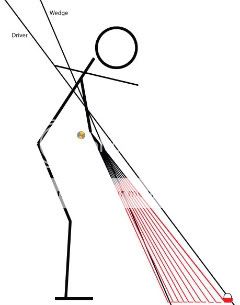
The Turned Shoulder Plane is not a Fixed Plane. It's shallower for the Driver and Steeper for a Wedge. Elbow bend and Upper Arm Angle adjust to accommodate various Club Lengths and Lie Angles as does the Forward Angle of the Right Forearm.
Remember that the Forearm “Traces” the Delivery Line.
I don't want to be Vapid so for those who want to get straight to the Point,
Quote:
So the Right Forearm must leave – and precisely return to – its own Fix Position (7-'8') “Angle of Approach”
(Rigid Power Package)
So, even the Elbow Plane has different Clubshaft Angles (Planes) for Different Clubs depending on Club Length. The Elbow Plane passes through the Waist. The Turned Shoulder Plane Passes through the Center of the Upper Right Arm (about three inches higher). With a Rigid Power Package, anyone who is on the Turned Shoulder Plane at the Top will be on the Turned Shoulder Plane at the Bottom. Those who Straighten the Right Elbow during the Downstroke, will forcibly lower the Hands to the Elbow Plane for Release.
Following is the COMPLETE topic.
Quote:
7-3 STROKES – BASIC Because of the dominant role of Accumulator #3 (6-3-B-0, 2-N, 2-P), Golf Strokes are very dependent on the Right Elbow activity deriving from its location and the nature of the subsequent Right Arm participation. The Elbow must always be someplace and as there are only three definable locations there are three Major Basic Strokes – Punch, Pitch, and Push (10-3).
Right Forearm Position at the Top differs for the Angle and Arc of Approach procedures. So their Elbow location and action differs also. For Hitting (10-19-A), the Right Forearm should be precisely in-line with – and directly opposed to – the motion of the On Plane Loading Action (7-22) of the entire Primary Lever Assembly (6-A) not just the Clubshaft, and this alignment is maintained through Impact (2-J-3, 4-D). For Swinging (10-19-C) the Right Forearm should be precisely in-line with – and directly opposed to – the motion of the On Plane Loading of the Secondary Lever Assembly (the Clubshaft) and this alignment maintained through Impact. In compliance with both 6-B-3-0-1 and 10-11-0-3. With this “in-line” relationship of Loading and Right Forearm, it is absolutely MANDATORY that, Hitting or Swinging, it is the Right Forearm – not just the Right Hand and/or Clubshaft – that must be thrown, or driven, into Impact per 7-2-3. And study 7-11. ALWAYS, for all procedures, the Right Forearm is position “On Plane” – pointing at the Plane Line as the Angle of Attack (2-N). The On Plane Right Forearm shows the precise up-and-down direction it and the Clubshaft must take throughout the Stroke (2-J-3). The “Angle of Approach” position of the Right Forearm shows the precise Cross-Line direction the Forearm must take through Impact. It, thereby, precisely locates the visual Impact Point – where the eye must direct the Pressure Point #3 – the inside-aft quadrant of the Ball. Remember, the Actual Angle of Approach of the Clubhead is determined by Ball Position (2-N) so the Cross Line position of the Right Forearm is ONLY the On Plane Forearm Thrust per 1-L-9/10/11. Even with the Pitch Basic Stroke. So the Right Forearm must leave – and precisely return to – its own Fix Position (7- “Angle of Approach” (regardless of the true Clubhead Angle of Approach) because both procedures will produce identical Clubhead Delivery Lines.
Furthermore, in compliance with 6-B-3-0-1, Bending and Straightening the Right Elbow will RAISE AND LOWER the Left Arm and/or COCK AND UNCOCK the Left Wrist with out Bending, Flattening or Cocking the Right Wrist. Practice this first at Impact Fix. So, the Right Elbow Action either powers and/or controls all three elements of Three Dimensional Impact (6-C-0) per 1-L-9. All this you will come to know as the MAGIC OF THE RIGHT FOREARM.
Nice, 4.5 Yodas (Ill cut one in half). Uh oh here comes Kanye again. "Yo Daryl, Im happy for ya'll an Imna let you finish , but Beyonce had the best 7-3 post of ALL TIME"...........
Anyways:
-by fixed I meant non shifting.
-what is a "rigid" power package? Is this your vapidity or mine? Surely the right elbow bends, it being the stuff (or part of the stuff) of the "magic of the right forearm". But you make an interesting point about elbow straightening in Downstroke and shifts to lower planes.
-re 7-3. Where is the "4:30 line"? This is way off topic I know. I like the logic and geometry of the Angle of Approach as written, "determined by ball position" etc. Maybe I dont understand Lag's geometry, though I do like his writing and his actual swing when playing as opposed to practicing. The Alt Target Line is estimated, averaged out to 11 degrees on Chuck's thing amajig aid. 4;30, I reckon to be 45 degrees no? Surely thats off plane, or cross line at best. I digress.
-Is it really possible to point the butt end of the club at the turned shoulder position with every club in the bag? I will have to do some experimenting. This would make a non shifting swing possible through the entire bag. A "well I begottahel" moment.
The question to be answered is WHEN do you define what plane you are on when the REAL business occurs? Homer said you could clown the backstroke . . . . so you can certainly be "on-plane" in the backstroke right. . . but the IMPERATIVE is the line of compression . . . So when would you say that the plane is defined on the downstroke?


 “Angle of Approach” (regardless of the true Clubhead Angle of Approach) because both procedures will produce identical Clubhead Delivery Lines.


 Linear Mode


