Can someone please explain the application of Acc 2-3,the books states 2 before 3,thats well and good but to me it all has to be done in the one action.At the point in the downswing to impact,I find it impossible to seperate indeed ,thats the basis of my question,in essence,why should we even try,isnt it just as easy to improve that section by treating it as one componant keeping in mind that its the full swing im refering to here.
Please dont just fob this question off by saying something like read the book!,I beleive this is a very if not the most important segment of swing...
Looking forward to valuable input....Thanks in advance
I think the key is the sequence, you can't roll before you unhinge, and yes I've seen people do it!! Especially when you visually confirm the accumulators coming in-line with slow motion training is the sequence important.
__________________ Hitting the Ball is the easiest part of the game-hitting it effectively is the most difficult. Why trust instinct when there is a science."1-G.
I think the transer power of the # 3 is voodoo magic! I have also wondered how it "knows to roll." When I hammer on plane # 3Acc roll seems to be programmed to transfer the velocity # 2 Acc. Kinda like playing hot potato! It is amazingly smooth...and fast. Does it have something to do with divergent vectors? The feeling I have worked hard to cultivate is the left wrist throwing out by the right shoulder once the club head is outside the arc of my hands. In essence this produces the DOWN (on an inclined plane you get OUT for free!) What produces that roll is a mystery to me...all I know is that it is not a manual manipulation on my part! Great question!
I started a similar thread on the topic of PA#3 release in the advanced section.
Okie - Regarding the magic of PA#3's roll action, you wonder what makes the left hand roll into impact.
I suspect that the major factor is the movement of the right palm. At the delivery position. the right elbow is still bent at a right angle and the right palm faces more-or-less in the direction of the ball-target line. Then, during the release swivel phase of the downswing, the right elbow straightens and that causes the right forearm to paddlewheel into impact so that the right forearm is behind the shaft at impact and the right palm faces the target at impact. That means that the right palm moves through a 90 degree rotation during the release swivel phase of the swing, and that phenomenon should roll the left hand over (= release of PA #3). On page 73 of the 7th edition, HK states-: "The "On plane" Right Forearm ALWAYS establishes and maintains the correct clubshaft-left arm angle through release and impact".
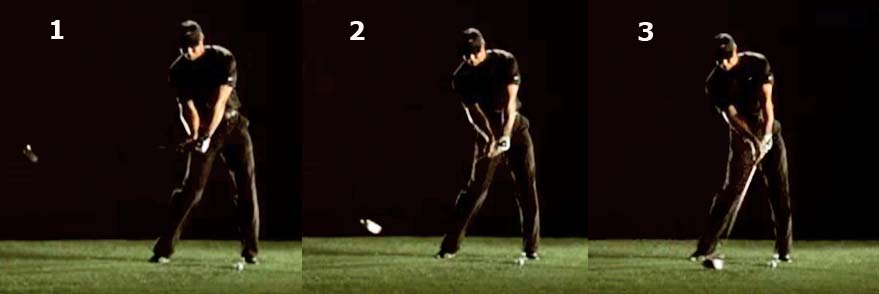
I produced the following series of images to supplement my previous post.
The sequence of the three images shows how the on-plane movement of Tiger Woods' right forearm during the release swivel phase of the swing causes the right palm to rotate into impact - thereby causing the left hand to roll into impact (release of PA#3)
I produced the following series of images to supplement my previous post.
The sequence of the three images shows how the on-plane movement of Tiger Woods' right forearm during the release swivel phase of the swing causes the right palm to rotate into impact - thereby causing the left hand to roll into impact (release of PA#3)
Jeff.
This thread has the potential to be a great thread.
You guys have by far a much greater knowledge of this MACHINE than I and I really value your input,I have asked this question on other sites with very poor response.
I think that this area of the swing is greatly overlooked by so many,most guys are trying to look good in the B/swing and the high finish that they dont pay nearly enough attention to this area.
Jeff,your comments really bring home "the magic of the R /forearm" in my mind,I am putting a lot of attention into learning this section and their componants,but being an average joe Im treating this section as my "station23" not trying to seperate the ACCs #2-#3 but treating them as one for easier understanding(for me)
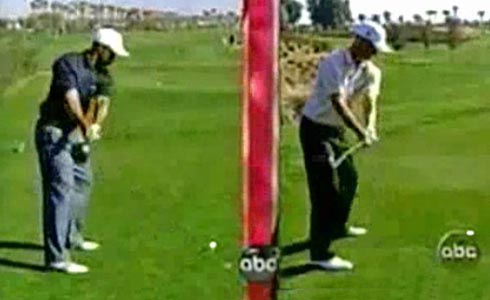
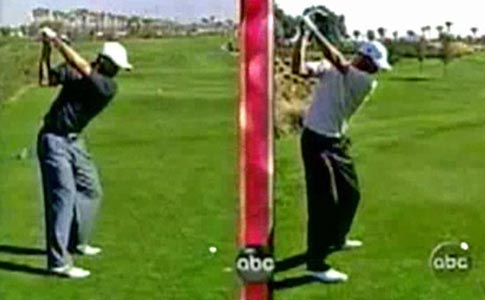
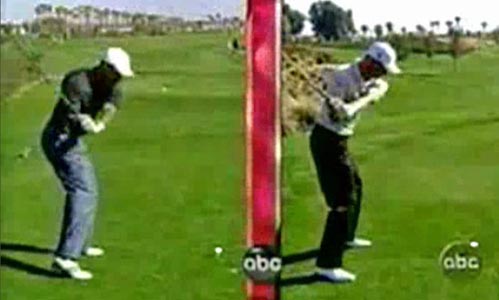
Slightly off topic,the great pics of tiger,if you have a look at the travel of the hands between each thigh plus also the comparitive distance travelled by clubhead in relation to each other is there a corelation with the kinetic chain in golf swing?
Thanks again for great input guys
This thread has the potential to be a great thread.
You guys have by far a much greater knowledge of this MACHINE than I and I really value your input,I have asked this question on other sites with very poor response.
I think that this area of the swing is greatly overlooked by so many,most guys are trying to look good in the B/swing and the high finish that they dont pay nearly enough attention to this area.
Jeff,your comments really bring home "the magic of the R /forearm" in my mind,I am putting a lot of attention into learning this section and their componants,but being an average joe Im treating this section as my "station23" not trying to seperate the ACCs #2-#3 but treating them as one for easier understanding(for me)
Slightly off topic,the great pics of tiger,if you have a look at the travel of the hands between each thigh plus also the comparitive distance travelled by clubhead in relation to each other is there a corelation with the kinetic chain in golf swing?
Thanks again for great input guys
At the risk of upseting anyone you may want to consider the possibilty Tiger is using a 4 b hitting action
Also when you are looking at number 3 accum and its rate of roll out it can vary depending on the arc of the swing and how it can be influenced
I think that PA#2 and PA#3 release near-simultaneously in TW's swing because he has a late release. He gets his right elbow in front of his right hip and he still has a 90 degree angle between the left arm and clubshaft (still has a fully loaded PA#2) at that time point (image 1). Therefore, his PA#3 is releasing (under the control of the on-plane right forearm - as the PA#1 passively releases) while the left wrist uncocks.
By contrast, PA #2 must release well before PA#3 in golfers who use a sweep release or random release - because PA#3 release only occurs during the release swivel phase of the swing (when the right forearm moves on-plane into impact).
You wrote-: "Slightly off topic,the great pics of tiger,if you have a look at the travel of the hands between each thigh plus also the comparitive distance travelled by clubhead in relation to each other is there a corelation with the kinetic chain in golf swing?"
I don't understand your question. Why are you trying to relate the clubhead travel during the release swivel phase of the golf swing to the kinetic chain? What part of the kinetic chain link are you thinking about?
Pistol
I think that PA #2 and PA#3 are releasing near-simultaneously in TW's swing because he has a late release, and not because he is a hitter. I cannot see anything in TW's swing that suggests a hitting action. He has many swing features that suggest a swinging action.
1) He employs a start up takeaway swivel action that causes the back of his left hand to face the ball-target line at the end of the takeaway and the toe of the club points upwards - while hitters resist any startup swivel and keep the clubface looking at the ball during the takeaway.
2) He has an extra 1/4 rotation of the left arm at the end-backswing that gets his clubshaft to be parallel to the ball-target line. Also, the relationship of his right forearm to the left arm flying wedge at the end-backswing fits the pattern of a swinger rather than a hitter.
3) The back of his left hand is parallel to the plane during the mid-swing as his hands slide down the plane.
4) He definitely has a distinct release swivel action where release of PA#2 precedes release of PA#3 (although there is considerable overlap due to his late release action).
Watch this swing video and you can see that PA#2 release precedes left hand rotation (release of PA#3), which occurs in the last part of the late downswing .
I think that PA#2 and PA#3 release near-simultaneously in TW's swing because he has a late release. He gets his right elbow in front of his right hip and he still has a 90 degree angle between the left arm and clubshaft (still has a fully loaded PA#2) at that time point (image 1). Therefore, his PA#3 is releasing (under the control of the on-plane right forearm - as the PA#1 passively releases) while the left wrist uncocks.
By contrast, PA #2 must release well before PA#3 in golfers who use a sweep release or random release - because PA#3 release only occurs during the release swivel phase of the swing (when the right forearm moves on-plane into impact).
You wrote-: "Slightly off topic,the great pics of tiger,if you have a look at the travel of the hands between each thigh plus also the comparitive distance travelled by clubhead in relation to each other is there a corelation with the kinetic chain in golf swing?"
I don't understand your question. Why are you trying to relate the clubhead travel during the release swivel phase of the golf swing to the kinetic chain? What part of the kinetic chain link are you thinking about?
Pistol
I think that PA #2 and PA#3 are releasing near-simultaneously in TW's swing because he has a late release, and not because he is a hitter. I cannot see anything in TW's swing that suggests a hitting action. He has many swing features that suggest a swinging action.
1) He employs a start up takeaway swivel action that causes the back of his left hand to face the ball-target line at the end of the takeaway and the toe of the club points upwards - while hitters resist any startup swivel and keep the clubface looking at the ball during the takeaway.
2) He has an extra 1/4 rotation of the left arm at the end-backswing that gets his clubshaft to be parallel to the ball-target line. Also, the relationship of his right forearm to the left arm flying wedge at the end-backswing fits the pattern of a swinger rather than a hitter.
3) The back of his left hand is parallel to the plane during the mid-swing as his hands slide down the plane.
4) He definitely has a distinct release swivel action where release of PA#2 precedes release of PA#3 (although there is considerable overlap due to his late release action).
Watch this swing video and you can see that PA#2 release precedes left hand rotation (release of PA#3), which occurs in the last part of the late downswing .
Jeff.
jeff you could be right . Im only basing that on what a GSED wrote but anyhow he could be wrong. Maybe you got some stuff figured out better ..pivot must have some influence on the #3 roll out and hinge motion and how long the travel time and rate of clubface motion
I suspect that there is another factor that is responsible for the roll of PA#3 and that it is related to pure physics.
Have you ever watched an Iron Byron-style machine in action? It has a passive universal joint at the peripheral hinge point - where the club is attached to the central arm. That universal joint allows the grip to rotate freely in all directions. During the Iron Byron's release action the club automatically rotates to become square at impact. How is that possible if there is no active force causing rotation of the grip end of the club? I believe that it is likely due to the fact that the COG of the clubhead is not in line with the clubshaft, which means that there is a natural rotary force occurring with respect to the clubhead-around-the-axis-of-the clubshaft that causes the clubhead to automatically rotate to square by impact.


 B. J. Hathaway, G.S.E.B., M.C.I.




 Linear Mode


