Basic understanding of TGM doesn't sound too bad. What does it take to be good enough?
My thoughts are that "good enough" includes being able to translate the theories into a working Golf Swing. I think its possible to see immediate, permanent, significant, and very measurable improvement in a player when he understands the concepts/theories.
Concepts
Geometry of the Circle
Hinge Action
Right Forearm Angle of Approach
Plane Line Tracing
Acceleration Sequence
etc.
The 24 components are basic understanding but I really believe that you don't fully understand or appreciate them without knowledge of the theories.
Daryl: Could you explain for me the underlying fundamentals of the Line of Compression?
Line of Compression:
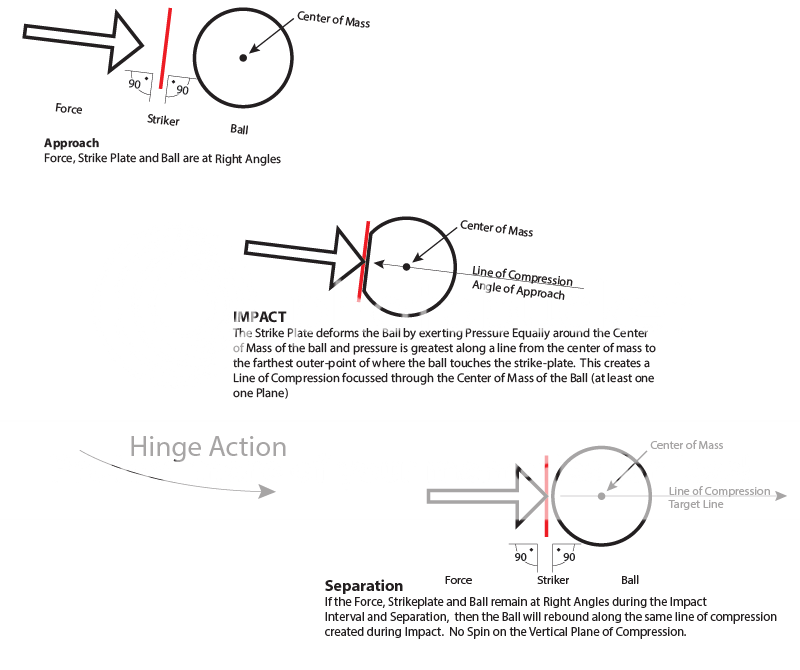
We strike the ball with the force and Strike-Plate square to the Angle of Approach. Then, we use a Hinge Action to:
not disturb the Right Angle relationship of Force, Strike-Plate and Ball
Rotate the Line of Compression to align with the Target at Ball Separation
Another way to understand the Concept of Line of Compression.
If we drop a Ball, then a Force (Gravity) will pull the ball into the Strike-Plate (Sidewalk). If the Strike-plate is square to the force (if the sidewalk is level), during Impact, pressure against the ball will be equally applied around the center of Mass of the ball.
When the Pressure against the ball is greater than the force that deformed the ball, then the Ball will rebound away from the Strike-Plate. If the Strike-Plate, Ball and Force remained at right Angles, then the Ball will rebound along the same line of compression created from Impact.
If you Swivel the Right Wrist Through Impact, then a Straight Line of Compression cannot be created, maintained or manipulated to Align to the Target.
More knowledge:
The Ball is stationary. The Clubface moves into the ball. The Ball will move as soon as it offers greater resistance than the pressure it receives from the clubface force. By the time the ball has moved 1/1000 of an inch, it is moving at the same speed as the Clubface. From the balls point of view, at this point, the Clubface is a stationary object. The Ball puts pressure on the Clubface during rebound. If the shaft isn't pre-stressed or stiff enough for the swing speed, some of the balls compression will wasted in pushing back the clubface during its rebound escape.
A #2 Pressure Point Swinger focuses on Approach Speed while the #3 Pressure Point Swinger has his attention on Separation Speed and uses the #3 Pressure Point to pre-stress the clubshaft to reduce rebound compression loss.




 Linear Mode


