Who are the hater's and what are they saying? Is the direction of the ball at right angles to the face the same as the d-plane? Can you add more to this.
The answer to that question would be YES.
__________________
Life Goal- Developing a new theory of movement based on Brain Science
Interests - Dabbling with insanity
Hobbies- Creating Quality
The "D" Plane is a Term "coined" by T.P. Jorgensen. I don't know if Jorgensen had read the work of Homer Kelley, but Publishing Dates prove that Homer Kelley advanced the science behind the Ball Flight Laws that Golfers use today.
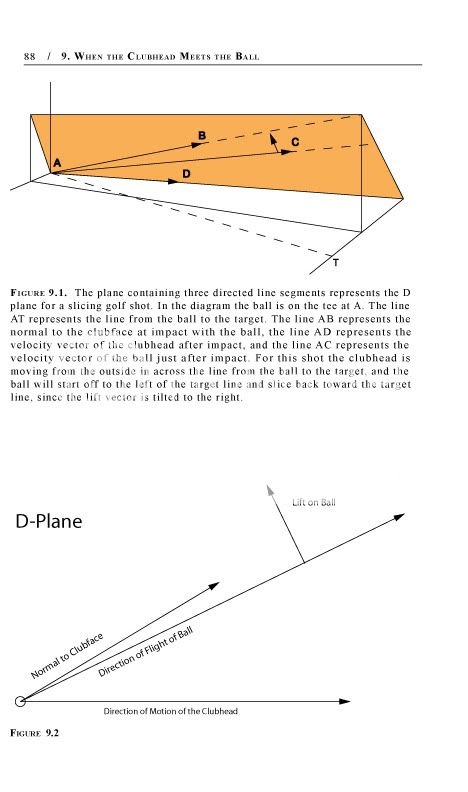
Unfortunately, the "D Plane" theory isn't enough to explain all "Ball Behavior" because it doesn't account for all of the forces acting on the Ball while Homer Kelley's theories supply sufficient information to know that a combination of many forces are actively involved in Ball Behavior.
Lets compare the 'D Plane' theory of "The Physics of Golf" - written in 1999 to "The Golfing Machine" - first published 30 years earlier in 1969.
"The Golfing Machine"
Quote:
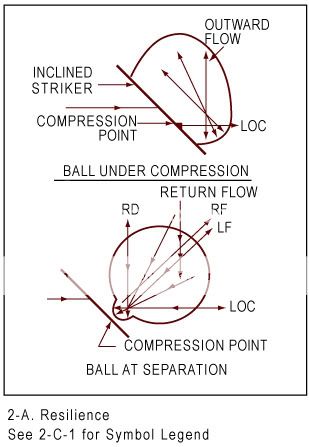
2-A RESILIENCE The response of the ball to different applications of force is the factor that determines how force must be applied to produce a desired result.
Resilience is the key factor in ball response. Neither a rock on a spoonful of clay will act the same as a golf ball. The ball is subjected to a violent deforming compression. The ball is actually distorted, not compressed – except for reduction of one dimension. Rubber is incompressible. Trapped air bubbles can be compressed – but not the rubber itself – it flows. It flows in two directions – but acts like a solid in the third. This third direction is the direction of the compressing force. The momentum of the violent return of flow after impact also distorts the ball by exceeding the normal dimension of the compressed point. The “kick” given to the ball by this action is an important factor in ball response. Roll of the ball on the face of an inclined striker does not account for all the action produced by such an impact, especially in imparting spin to the ball. When the direction of the compressing force does not pass exactly through the center of the ball, a spin will be imparted to the ball. It will rotate on the plane of a line drawn form the line of compression to a parallel center line.
In "Red" in the above quote is the "D-Plane" phenomena.
Quote:
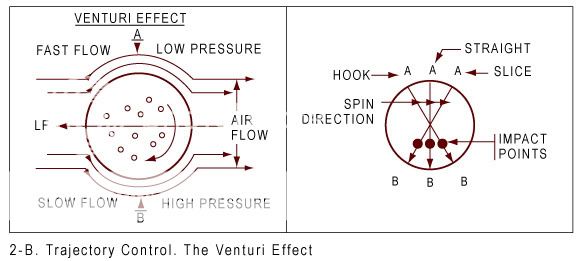
2-B TRAJECTORY CONTROL Clubface loft (2-C-1) and Hinge Action (2-D) determine altitude and backspin and are the basic elements of Ball Control. Also study 9-3. The sketches herein show Force Vectors as directional only, in order to depict how their interplay controls Backspin and the Ball behavior.
A speeding, spinning ball is subject to the Venturi Effect, meaning that an increase in the velocity of a flow of air decreases its cross-sectional pressure. The air passing over (A) that portion of the ball that is turning with the passing air will move faster than the air passing over (B) that portion of the ball that is turning against the passing air. Therefore the air at “A” will exert less pressure than the air at “B” so the ball will be pushed in the direction of “A.” If portion ‘a” is above the center the pressure from “B” will produce vertical lift. If “A” leans to either side of the vertical, the pressure at “B” will produce a sidewise push toward “A.” If “A” is toward the player’s left it will produce a Hook – to his right, a Slice. But the action will be definite – not wavering. Predictable and controllable. The more airspeed, the more effect for any given amount of spin. Without backspin, the ball will wobble along erratically. And the dimpled cover greatly magnifies this wobble control. So it follows, that a ball with “Overspin” has no “Lift” – the “Duck Hook.” A truly well hit ball (Three Dimensional Impact 2-C-0) from any Club will have a higher trajectory than otherwise, simply because the increased velocity and Backspin will lengthen the upward portion of the flight. In addition, when there is Clubface “Layback” during Impact, the additional height will be even more noticeable as the Impact Interval lengthens. And ALWAYS – the more Compression Leakage, the more faulty the Angle of Separation (2-D-0) – that is, lower trajectory and less distance.
All though these TWO quotes from "The Golfing Machine" explain the Science of "Ball Flight" used today, Homer Kelley did not "coin" the Term "D Plane". There is no significance to "coining a term" for this phenomena because the phenomena is variable. Although for Homer Kelley, the phenomena was a matter of fact that couldn't be denied, he would have named dozens of "D Planes" depending on which Force Vector combination's caused which "Ball Flight" effects.
However, Homer Kelley, additionally provided us with the means of Manipulating the "D Plane" with 10-5-0 through 10-5-E.
The problem with the "D Plane" theory as you will see below, is that it doesn't account for all of the Force Vectors applied to a Golf Ball which include but are not limited to "Layback" (Leakage), "Angle of Attack" (Increased Spin"), and the very important "Kick" from the Ball returning to normal after Impact Deformation.
With a Clubface correctly oriented on its vertical Plane at Separation and a Clubhead Path oriented Left of the Target Line (Rotated Plane Line), a Pull will result. If the same geometry above occurred with the Face "Layed Back" at Separation, then a Fade would result because Impact Vector Forces would cause the Axis of the spin producing Lift to rotate to the right.
1-L, 16-20
16. The Plane Line controls the Clubhead Line-Of-Flight. Clubface alignment controls the Ball Line-Of-Flight.
17. The Clubface needs to be square to the Line-Of-Flight only at Point-of-Separation.
18. Changing the Plane Angle has no effect on the Plane Line.
19. Stance Line, Plane Line and Flight Line are normally parallel.
20. For any given Line of Compression (through the ball) every Machine must produce identical Impact Alignments.
"D Plane" Theory
The "Theory" is explained below along with an illustration showing that "Lift" produced by the spinning Ball will be at a right angle the Spin Axis. That's what Homer Kelley said.
I'm pretty sure I can prove my dad's smarter than your dad in the laboratory...
Kevin
My dad was actually a rocket scientist. I always enjoyed saying to him, "what, are you a rocket scientist or something?". He designed missles and torpedoes for the government. So there!
My dad was actually a rocket scientist. I always enjoyed saying to him, "what, are you a rocket scientist or something?". He designed missles and torpedoes for the government. So there!
LOL
I'm still trying to figure out Daryl's post. I know it's right, because Daryl is way smarter than me... Damn, should have paid more attention in Junior High Physics, then I could at least pretend to be a scientist like the other guys...
Kevin
__________________
I could be wrong. I have been before, and will be again.
O.B. call me - get in the car, pick me up in Maine on our way to North Carolina! Other members that would like to join us - please PM me.
Hey man Im out front. See the shagg'n wagen with the Toronto Maple Leaf "the passion that unites us all" logo air brushed on the side. Thats me. Got a captain's chair with your name on it and a cooler full of Molson. Lets ride baby.......where the heck is north Carolina? Is it anywhere near South Carolina?




 Linear Mode


