There is less roll to a horizontal hinge than most might think. The easiest check is to go to the horizontal plane.
At any point in the motion from hip to hip, if you raise the club up to the horizontal plane, the toe should be straight up.
the closing motion, relative to the left shoulder hinge pin, is exactly like a closing door, and a closing door has a smooth, steady rate of closing. It may feel like a quick roll with a snap release down on the angled plane, but the hinge motion - from impact to separation - is as smoothly closing as that door.
Part of the advantage of the pivot causing the throw out and roll is that the pivot acts like the rotor that the door closes around - a smooth rate of closing. Not a swivel as hinge action.
Originally Posted by O.B.Left
Thinking about this some more..........typically, the Hitter's Angled Hinging is a product of his Right Arm Thrust, Zone 2. The Swingers Horizontal a product of CF, Zone 1.
I am a pure hitter now but maybe not in the strictest TGM sense because I don't (at least not yet) adhere to some of the downswing principles described in the book.
I agree with this, I would imagine part of it has to do with the backswing swivel motion, I know mine is extremely limited, I want a no roll feel of the forearms going back with the face shut from P1 to P2 (club parallel position). On the downswing not sure I can even produce a horizontal hinge given how much I fire my right arm, which is also going down and to the left.
I was reading that FLW is an imperative. Now I seen a lot of players that dont have a FLW while chipping and putting such as Ernie Els and Zach Johnson. It seems like to me they have a cup left wrist at impact for some shots of the short game.
This leads me to conclude that Homer's imperatives apply only to full swing?
I was reading that FLW is an imperative. Now I seen a lot of players that dont have a FLW while chipping and putting such as Ernie Els and Zach Johnson. It seems like to me they have a cup left wrist at impact for some shots of the short game.
This leads me to conclude that Homer's imperatives apply only to full swing?
There is always room for personal preference. He may simply be trying to keep his hands close and centered in the body with as little motion as possible. What may be completely within the realm of possibilities for a Pro, because of their practice, playing schedule, experience and experimentation, may be completely out of range for the typical 2 day a week player.
The Imperatives and Essentials allow you to create a 3 dimensional Impact. The Clubhead is moving down, forward and out simultaneously. Thus, you can sustain the Line of Compression while creating different Ball Flights. So, you can control where the ball is going to land.
Freezing the Left Wrist in a Bent Condition through the Impact Interval accentuates one of those dimensions more than the other two. More often than not, it's the Layman's way of executing a half-Angled and Half-Vertical Hinge. Focus on the Clubface alignment at the end of the Stroke. Is it facing more "up"?
While using a Flat Left Wrist, you can control the Clubface motion through the Ball by keeping the Flat Left Wrist perpendicular to an associated Plane. These Alignments are mostly unknown to the Pro's.
For the most part, they've spent their entire lives developing the hand-eye coordination to play with what "feels" right to each of them. It's more practical and beneficial to learn "feel" from "mechanics" rather than "feel" from "ball flight".
I know that sounds confusing, but it will become more clear as you learn more.
I like Miller. I consider him the Arch typical Professional Golfer. He played great golf while on the Tour, and he knows nothing about swing mechanics. He serves as a reminder that knowledge will never completely replace hard work.
A good argument for abandoning all inquiry into the mechanics of the golf stroke!
A good argument for abandoning all inquiry into the mechanics of the golf stroke!
It would be a good argument if you pursue a career in "Golf Announcing".
But what line of reasoning did you use when you took "knowledge will never completely replace hard work" in order to recommend "abandoning all inquiry"?
I was reading that FLW is an imperative. Now I seen a lot of players that dont have a FLW while chipping and putting such as Ernie Els and Zach Johnson. It seems like to me they have a cup left wrist at impact for some shots of the short game.
This leads me to conclude that Homer's imperatives apply only to full swing?
Homer allowed for the equivalent of the FLW. Setup with a bent left wrist and maintain the bent left wrist through impact. Perfectly acceptable for low power - short shots and putting.
Can you really swing with passive arms and have any serious power?
Yes,
I sometimes use it as a "go to" shot every now and then when I struggle with the swing plane. I get about the same distance but perhaps not quite as powerful trajectory. And not the sense of control as with more engaged arms & hands.
He's got a point re: shaft exit (Miller's view would be a bent plane line), but keep in mind the shaft is NOT the plane unless the #3 accumulator is zero'd out. In Allenby's case, it is closer to zero'd than most.
Ed could you explain why the shaft is not the plane in this instance? And if not, what references the plane?
Ed could you explain why the shaft is not the plane in this instance? And if not, what references the plane?
Thanks
Dennis
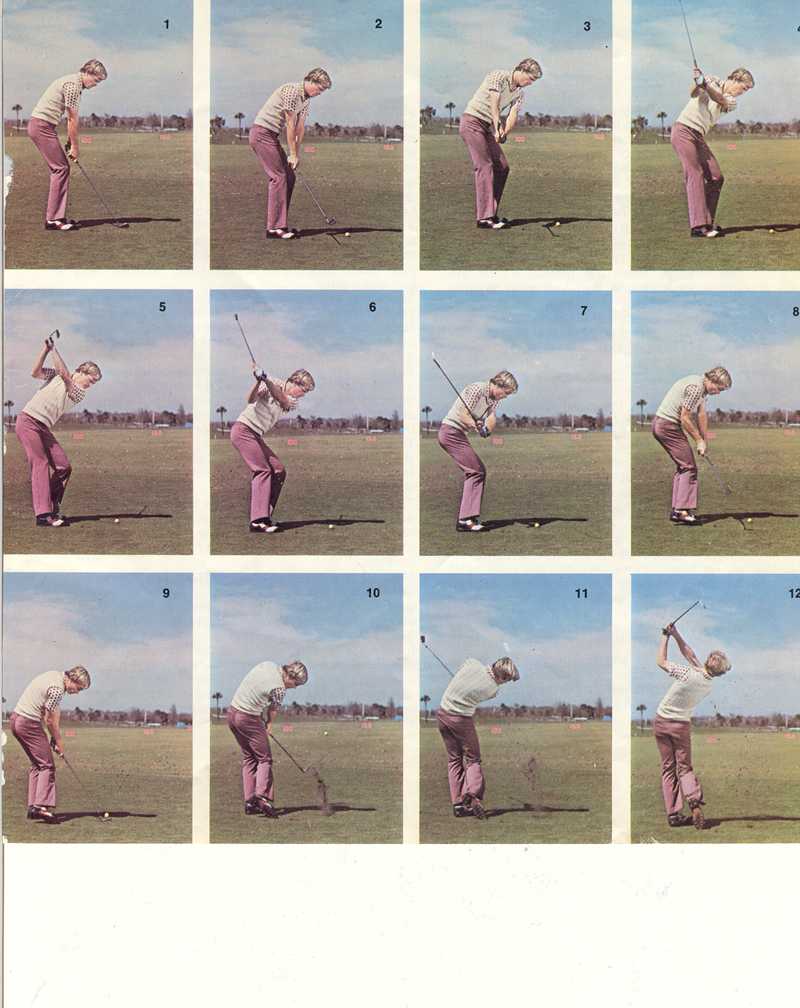
Miller looks pretty much "dead nutz" (as he likes to say) on plane . . . see frames 7 and 11 . . . beautiful . . . Look at the face in 11 . . . no wonder he could hit it so straight indaday. but I'm not sure if Ed was referring to Miller's motion or Allenby's . . .
__________________
Aloha Mr. Hand
Behold my hands; reach hither thy hand
Last edited by 12 piece bucket : 05-25-2010 at 08:40 AM.




 Linear Mode


