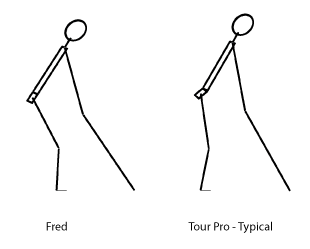
I searched the 6th Edition and the word P-o-s-t-u-r-e doesn't exist. More or less I was looking for Hip Motion, Knee Bend and Weight Shift. While viewing the Address Posture of Pro's, I kind-of abstracted the one below. In contrast to the Posture named "Fred", the Pro's look a little forward leaning.
I typically tend toward "Fred". Which do you prefer?
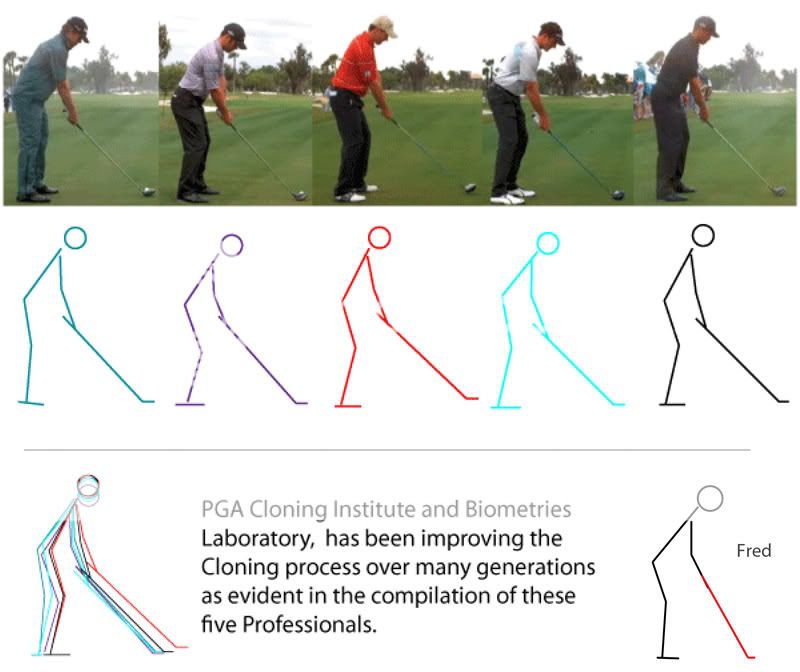
These five professionals provide a new composite. I've been wondering how posture is related (if) to a golfers overall method of increasing clubhead speed and/or power. Balance? Or could posture be related to their Start-up Take-away?
How Many On-Plane Right Forearms Do you See?
How Many Golf Clubs are on an Elbow Plane At Address?
These five professionals provide a new composite. I've been wondering how posture is related (if) to a golfers overall method of increasing clubhead speed and/or power. Balance? Or could posture be related to their Start-up Take-away?
How Many On-Plane Right Forearms Do you See?
How Many Golf Clubs are on an Elbow Plane At Address?
Mr. Kelley seemed to have a bit of a different view of the Elbow Plane in the earlier editions. I think it's in the 3rd that he says the Elbow Plane has an advantage because the club is moving at 90 degrees to the axis of rotation.
Some of this waist bend stuff has to do with the shot at hand. Also, not sure that it's good to have the image of the spine as a "rod" stick straight . . .. cuz it ain't. However I think there is an advantage to considering an axis of rotation that the spine, hips, knees and shoulder comply with. For the head to stay steady the hips and spine have to do some bending and unbending.
Also . . . from an optics stand point . . . chin down . . . not up.
Hank Haney would LOVE the before pic . . . . bet her eyeballs were tired after around with the chin up that much . . . Nice work! That big bobbin' dip that Eldrick does may be so he can see the dang ball.
Mr. Kelley seemed to have a bit of a different view of the Elbow Plane in the earlier editions. I think it's in the 3rd that he says the Elbow Plane has an advantage because the club is moving at 90 degrees to the axis of rotation.
Some of this waist bend stuff has to do with the shot at hand. Also, not sure that it's good to have the image of the spine as a "rod" stick straight . . .. cuz it ain't. However I think there is an advantage to considering an axis of rotation that the spine, hips, knees and shoulder comply with. For the head to stay steady the hips and spine have to do some bending and unbending.
Also . . . from an optics stand point . . . chin down . . . not up.
Why can't I find anyone who sets up on the turned shoulder plane
per 10-6-b #1???? The benefits would be a shiftless swing.
Why can't I find anyone who sets up on the turned shoulder plane
per 10-6-b #1???? The benefits would be a shiftless swing.
Photo 10-6-B #1 requires a "steeper-than-normal Elbow Plane" (7-23 / 6th edition) with a "reaching out of the arms" and a Left Hand Grip in the cup of the hand (instead of the normal under-the-heel of the hand). Or, an Uncocked (versus Level) Left Wrist. All of which borders on the "ungolf-like" (3-F-6).
All this can work well for the short shots and their steeper Planes. But, for the longer Strokes, a more normal On-Elbow-Plane Right Forearm at Address and the natural progression to the Turned Shoulder Plane in the Backstroke (Single Shift / 10-7-B) is more natural.
Stand in a Plane Board set to a Turned Shoulder Plane, and you will instantly understand.
[quote=Daryl;64527]These five professionals provide a new composite. I've been wondering how posture is related (if) to a golfers overall method of increasing clubhead speed and/or power. Balance? Or could posture be related to their Start-up Take-away?
How Many On-Plane Right Forearms Do you See?
How Many Golf Clubs are on an Elbow Plane At Address? [/QUOTE
OK look at these very very good golfers in their address postures..........which one has to move their HEAD the most to get their right forearm and clubshaft on the same plane? This is a Zone 1 problem.





 Hybrid Mode

