These were made by Hunter and approved by Lynn (Yoda).
Hunter made a valuable contribution to the site and golfdom with his Hitting and Swinging Stickmen and the concepts they convey. They are completely his work, unedited (or "approved") by me, and they stand on their own considerable merit. Any questions as to their accuracy should be directed to him. They are a product of his own effort to 'get it right,' and I am sure he would welcome critical comment.
Hunter made a valuable contribution to the site and golfdom with his Hitting and Swinging Stickmen and the concepts they conveyed. However, at no time were they submitted to me for "approval" and 'sign-off.' They are completely his work, unedited by me, and they stand on their own considerable merit.
Yoda, sorry about that. By "approval", I meant your praise of his work.
For example:
Originally Posted by Yoda
I'll repeat what I said about the Hitting Stickman:
Wow!
Great stuff, Rob. This is work unprecedented in the history of The Golfing Machine.
Hagen taught Hogan to test his understanding of the Golf Stroke by drawing stickmen.
Front View and Down the Line, Rob has tested his understanding -- Hitting and Swinging -- and has earned Three Thumbs Up!
Originally Posted by Yoda
His Swinging and Hitting Stickmen are a terrific addition to the Body of Knowledge that is The Golfing Machine.
Tongzilla if you can agree with 2 undisputable facts you'll get it....
1) the left shoulder, arm and clubshaft are inline by going to an uncocked position (zero no.3 acc angle) ?
hence the left shoulder is onplane
2) the pivot center that controls shoulder motions is above plane?
Now, explain how since the answer to both these questions is yes - how the left shoulder can be onplane, the stationary center that controls the shoulder motions is above the plane and then still have right shoulder onplane at followthrough ?
Its just basic logic...
I mean have you thought this through. Memorising passages (although they are a good start) won't get you anywhere unless you actually challenge yourself and your assumptions. If you are truely observational, Hunter didn't draw it directly on the inclined plane - he drew it with the right shoulder offplane slightly at followthrough because he couldn't draw it onplane and keep the center above plane....
The way I see it now when looking at the golfing machine - I do my own research into particular areas and without fail, if it is correctly done - everytime it agrees and clarifies Homer Kelley's work and it allows you to appreciate it in greater depth...
BUt in the look look look picture posted above, if the shoulder s were not represented as straight, but instead as a curved or slight 'v' shape then both shoulders could be onplane. Now maybe it is not what actualy happens in the swing, but it is not a law of logic that both can't be onplane unless you assume a straight line across the shoulders.
BUt in the look look look picture posted above, if the shoulder s were not represented as straight, but instead as a curved or slight 'v' shape then both shoulders could be onplane. Now maybe it is not what actualy happens in the swing, but it is not a law of logic that both can't be onplane unless you assume a straight line across the shoulders.
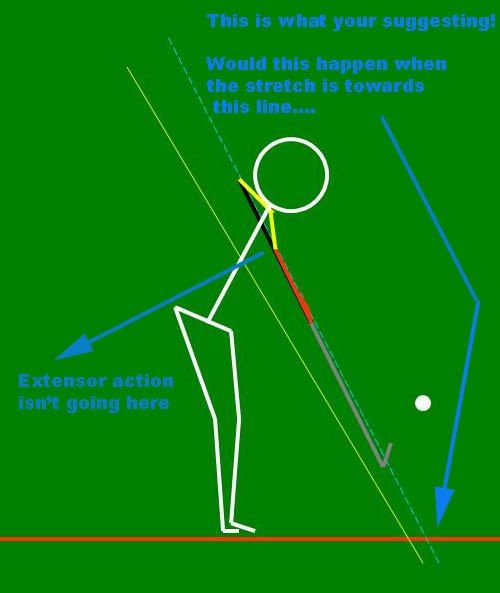
Nope, extensor action causes the shoulder flexability to be stretched towards the plane line. Thus the right shoulder is not somehow being stretched backwards towards the inclined plane that it is required to leave at followthrough, its being stretched towards the base of the inclined plane. So the shoulder flexability isn't an arguement. I mean just picture it in your mind what that would look like - anyone with a slight imagination can see thats not whats happening and your arguement is propesterous.
BUt in the look look look picture posted above, if the shoulder s were not represented as straight, but instead as a curved or slight 'v' shape then both shoulders could be onplane. Now maybe it is not what actualy happens in the swing, but it is not a law of logic that both can't be onplane unless you assume a straight line across the shoulders.
I mean look....
Ungolf-like wouldn't you say ?
not only that, its unhuman and it ain't happening...lol
I mean really, is this what you and tongzilla recommend as the most important alignments?
Try to give some good advice...and this is what I get ;(
Originally Posted by tongzilla
I'll take the bait for the first part of your question.
Flat Left Wrist from Start Up to Follow Through
Right Forearm and Clubshaft Tracing the Straight Plane Line during Release
The perpendicular relationship of the Flying Wedges: the Flat Left Wrist and Level Right Wrist
An "On Plane" Right Shoulder from Start Down to Follow Through to give the right amount of Axis Tilt and Hip Slide
All Pivot Components moving parallel to your selected Delivery Line (usually the Plane Line) at Start Down
A fixed Pivot Center
A 10-2-B Grip with no wobble in Clubshaft attachment during the entire motion
I stand by my post. Lekommend asked what the most important alignments are in a Golf Stroke, and I gave it a shot. I don't understand why people try so hard to discredit what I say. I think the advice I gave is good advice, so why try to make it sound so bad? I said "On Plane", not On Plane (and no, I didn't just edit it), because I realised at the time of writing that you don't have to use the Turned Shoulder Plane at Impact. Look at 10-13-D #3, the photo with the caption, "End of Follow Through". What do you guys think that arrow in the photo is pointing at? Yes, that's right, it's pointing at the Right Shoulder socket. Oh, look, it just so happens that the tip of the arrow also points at the Inclined Plane. But it doesn't mean your Right Shoulder always has to be on the same Plane as the Clubshaft at Follow Through (or even Impact). Just look at the down-the-line angle of Lee Trevino at Impact (12 PIECE BUCKET, need your here. Please post that photo (or the whole sequence) here for our reference. Thanks!). He clearly uses the Elbow Plane, and note how far "above plane" his Right Shoulder is. But the important thing is that his Right Shoulder isn't coming from the outside -- it's still going Down and Out relative to the Plane Line (which is Open in that sequence). He's even hitting a classic "Trevino Fade" there.
So that's that. I really don't have the time nor inclination to argue any more about this point.
I may be missing the point but it looks like both shoulders of the stickman (in both examples) are on plane through to the end of impact. Seems ideal to me.




 Linear Mode


