The second and third picture (from the left) are both correct. Just different body types and/or different amount of Axis Tilt.
So it's OK to have a straight trail arm at Impact? Assuming an almost straight arm, what, if any, is the impact of having the Follow Through at such a short distance from impact?
Quote:
You always want the entire Right Forearm (which includes the Right Elbow) to be On Plane at Impact giving you maximum support and minimizing Impact deceleration during this violent collision. This will almost certainly mean having the Right Shoulder slightly above Plane. There is absolutely no problem with that (10-13-D).
This is what I've been after, thankyou. I'll take the always for whats it's worth I've read that one of the reasons that the TSP is so good is because the trail shoulder can provide support to the clubshaft. At what point does that occur, for how long and what is the benefit in terms of actual performance? My guess is it begins supporting at Start Down, continues to do so for as long as the shoudler remains on plane (usually as far as Release?) and I've no idea to what extent it improves consistancy, compression etc etc. Maybe it just helps a little in keeping the club on plane at Start Down
Quote:
The red line represents the Turned Shoulder Plane, which was drawn through the Right Shoulder joint when Lynn was at the Top. The tiny blue dot represents his Right Shoulder, which is clearly above Plane.
Interested in the location of your blue dot Tong. Is it always the bottom edge of the shoulder that TGM marks as the shoulder? Can you tell I'm no anatomy expert? Did you take into account the camera angle when you drew that TSP? I've got that clip and if I draw the line where you have it it is WELL below the shoulder at the Top. What am I missing?
Last edited by nevermind : 02-24-2006 at 10:44 PM.
Without giving up on having the above questions answered, I've got some more.
Questions so far have been in relation to a golfer with a zero shift downstroke on the TSP, now for one where the golfer shifts the clubshaft down to a flatter plane during the Downstroke. In that case, how long should you aim to keep the trail shoulder moving down plane(TSP)? Without a clue on the "how long", my guess is that golfers shifting down to a flatter clubshaft plane are likely to keep the trail shoulder going downplane(TSP) further into the Downstroke than those with the club on the TSP. Is that way off?
This is my understanding as it stands, still some work to be done. Ready to admit I'm prolly a long way from having a firm grasp on this.
When using the TSP on the Downstroke, you will almost certainly have the trail shoulder moving above plane before impact. That allows (or is it just coincidence?) the trail forearm to be on plane at impact without having a straight trail arm.
When using a flatter clubshaft plane, you can have the shoulder move down plane(TSP) all the way to impact and beyond and still have the trail forearm on plane with the shaft at impact with some elbow bend.
Without giving up on having the above questions answered, I've got some more.
Questions so far have been in relation to a golfer with a zero shift downstroke on the TSP, now for one where the golfer shifts the clubshaft down to a flatter plane during the Downstroke. In that case, how long should you aim to keep the trail shoulder moving down plane(TSP)? Without a clue on the "how long", my guess is that golfers shifting down to a flatter clubshaft plane are likely to keep the trail shoulder going downplane(TSP) further into the Downstroke than those with the club on the TSP. Is that way off?
This is my understanding as it stands, still some work to be done. Ready to admit I'm prolly a long way from having a firm grasp on this.
When using the TSP on the Downstroke, you will almost certainly have the trail shoulder moving above plane before impact. That allows (or is it just coincidence?) the trail forearm to be on plane at impact without having a straight trail arm.
When using a flatter clubshaft plane, you can have the shoulder move down plane(TSP) all the way to impact and beyond and still have the trail forearm on plane with the shaft at impact with some elbow bend.
When using a flatter Plane Angle, it's alright to have your Right Shoulder above Plane. Just make sure it's moving roughly parallel to your selected Clubshaft Plane. Your Right Shoulder should never be below Plane.
So it's OK to have a straight trail arm at Impact? Assuming an almost straight arm, what, if any, is the impact of having the Follow Through at such a short distance from impact?
No, you don't want to have a straight right arm before or during Impact unless you're striving for a "soft" Impact. Aim to have your Right Arm slightly bent (use some common sense here!). If it's bent too much, then maximum Clubhead Speed for that Stroke will not have been reached. If it's almost straight, you risk going into Angular Deceleration. So you want a bit of leeway.
Also, none of this matters if you don’t have your Right Forearm return to its Right Forearm Angle of Approach. That’s the by far the important thing. And it should determine the amount of bend you need. If in doubt, you want to build your pattern such that you can return to your Right Forearm Angle of Approach in the most consistent and powerful way as possible.
Originally Posted by nevermind
Interested in the location of your blue dot Tong. Is it always the bottom edge of the shoulder that TGM marks as the shoulder? Can you tell I'm no anatomy expert? Did you take into account the camera angle when you drew that TSP? I've got that clip and if I draw the line where you have it it is WELL below the shoulder at the Top. What am I missing?
I used the right shoulder joint to draw my dot. I didn't take into account the camera angle. I don't know how to do this, but if you can overlap the frame where Yoda is at the Top with the frame at Impact, it would be helpful.
I know I have left some questions unanswered because I just ain't got the time! I'm sure there are others out there who can help -- show yourselves!
I've added stickman No.4 because when I look at swings people have labelled as using the TSP that's what I sometimes see.
Originally Posted by tongzilla
No, you don't want to have a straight right arm before or during Impact unless you're striving for a "soft" Impact. Aim to have your Right Arm slightly bent (use some common sense here!). If it's bent too much, then maximum Clubhead Speed for that Stroke will not have been reached. If it's almost straight, you risk going into Angular Deceleration. So you want a bit of leeway.
Oh, when you said the second and third stickman were correct I figured you realised I drew stickman no.3 with a straight trail arm Anyway, cool info there Tong. I kept seeing the tiny amount of elbow bend people on the TSP often had and thought to myself surely more would be better. But if I've understood, now I know that so long as you avoid a straight arm, any elbow bend is sufficient.
Quote:
Also, none of this matters if you don’t have your Right Forearm return to its Right Forearm Angle of Approach. That’s the by far the important thing. And it should determine the amount of bend you need. If in doubt, you want to build your pattern such that you can return to your Right Forearm Angle of Approach in the most consistent and powerful way as possible.
Thanks I'll stew on that for a little while.
Quote:
I used the right shoulder joint to draw my dot. I didn't take into account the camera angle. I don't know how to do this, but if you can overlap the frame where Yoda is at the Top with the frame at Impact, it would be helpful.
It's just that to a layman (well me) the shoulder joint looks like one big circle, and it's hard to fathom why you guys choose one point though that circle over another. Doesn't matter I guess, usually the line people draw for the TSP goes throught the same spot in my imagined circle (lower portion)... it's just that you missed my circle entirely in that photo.
I don't know how to overlap frames either, but are you telling me that you can draw the line where you have it and when you move the clip frame by frame just before the end of the backstroke and just into the downstroke it looks like the shoulder is on that line? When I look at that clip and draw the TSP where I see it, I see alignments much more like stickman No.4 than No.2
Quote:
When using a flatter Plane Angle, it's alright to have your Right Shoulder above Plane. Just make sure it's moving roughly parallel to your selected Clubshaft Plane.
Hmmm, OK. So the same as when using the TSP, it's Ok for the shoulder to move above plane, so long as there is still some down to go with the out and forward. Would you want to turn parallel right from the get go or would you have a plane shift(of the shoulders) from the TSP to this parallel plane at some point after the Start Down?
What about this quote, "The Right Shoulder should move toward Impact on the preselected Downstroke Clubshaft Plane. If it can't quite reach that Plane, then it's better to use a steeper Plane." I've had trouble with this quote for a long time and never get far, like when do you have a preselected clubshaft plane and when don't you? Is it only relevant to the very beginning of the downstroke? I now know that "toward impact" does not neccessarily mean all the way to impact and beyond, and in the case of the TSP is will not be all the way. But your also saying that when using a flatter clubshaft plane, instead of using a steeper shoulder turn(TSP), you can use a plane of the same anlge as the clubshafts but with a different baseline?
Sorry for harping on you Tong, I struggle with only a couple of variables, so I can't converse with Annikan[wink], Yoda is too busy answering other posts[mad/sad] and proly nobody else can make sense of my dribble, looks like your my man [mix b/w green smilie, purple embarassed and the sun glasses dude]
Hmmm, OK. So the same as when using the TSP, it's Ok for the shoulder to move above plane, so long as there is still some down to go with the out and forward. Would you want to turn parallel right from the get go or would you have a plane shift(of the shoulders) from the TSP to this parallel plane at some point after the Start Down?
The Right Shoulder should move directly towards the Ball during Start Down. Keep your Head still, and your Axis will Tilt as a result. As the Downstroke proceeds, it may not be possible to keep your Right Shoulder on the Clubshaft Plane, so it can use a steeper plane.
Originally Posted by nevermind
What about this quote, "The Right Shoulder should move toward Impact on the preselected Downstroke Clubshaft Plane. If it can't quite reach that Plane, then it's better to use a steeper Plane." I've had trouble with this quote for a long time and never get far, like when do you have a preselected clubshaft plane and when don't you?
The preselected Downstroke Clubshaft Plane is the Clubshaft Plane at Startdown. So if your Clubhshaft shifts to a less steep Plane during Downstroke, your Right Shoulder would be above Plane by Impact.
Originally Posted by nevermind
Is it only relevant to the very beginning of the downstroke? I now know that "toward impact" does not neccessarily mean all the way to impact and beyond, and in the case of the TSP is will not be all the way. But your also saying that when using a flatter clubshaft plane, instead of using a steeper shoulder turn(TSP), you can use a plane of the same anlge as the clubshafts but with a different baseline?
The Clubshaft always Trace the Striaght Plane Line, in other words it should be On Plane regardless of Plane Angle. This is not true with the Right Shoulder, especially after Startdown.
Bottom line: at Startdown, the Clubshaft should be pointing at the Plane Line, and consequently, the Hands should be On Plane, and the Right Shoulder should also be aligned with the Inclined Plane (On Plane). You check this by seeing if the Clubshaft 'intersects' the Right Shoulder joint at Startdown, rather than going above or below it. Camera angle is paramount.
nice post Tong, that was very clear even for me. One question , you mentioned that moving the right shoulder down a plane roughly parallel to the clubshaft plane is an option when that plane is flatter than the TSP, does that mean that after startdown, the shoulder will actually shift from the TSP to this parallel plane, then work down that plane? Is that something you can conciously control? Would you teach that to someone if they weren't already doing it? Or is it really common and basically everyone who's shoulder turn becomes flatter after start down is moving down a plane roughly parallel to their shaft plane?
Can't help but feel that the blue line is a more accurate depiction of the TSP. When the clip is forwarded to impact the alignments look very much like stickman No.4. What do you think?
Forgot to add, I love this footage of Lynn and watch it maybe more than anything else. Thanks LBG


 I've read that one of the reasons that the TSP is so good is because the trail shoulder can provide support to the clubshaft. At what point does that occur, for how long and what is the benefit in terms of actual performance? My guess is it begins supporting at Start Down, continues to do so for as long as the shoudler remains on plane (usually as far as Release?) and I've no idea to what extent it improves consistancy, compression etc etc. Maybe it just helps a little in keeping the club on plane at Start Down
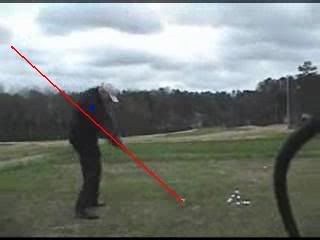
 Did you take into account the camera angle when you drew that TSP? I've got that clip and if I draw the line where you have it it is WELL below the shoulder at the Top. What am I missing?


 I'll stew on that for a little while.


 Hybrid Mode


