
|
Hinge Training Device
The Hinge will be located at the Left Shoulder. But if this is annoying, use shorter dowels and locate the Hinge near the normal location of the Left Wrist. During training exercises, the Left Hand will hold onto the Long Dowel and help stabilize the Long Dowel during operation.
The Alignment of the Paddlewheel Motion of the Right Forearm Wedge will determine the Alignment of the Hinge (i.e. Angled, Horizontal). If the Right Forearm/Hand Paddlewheels about an axis perpendicular to the Horizontal Plane, then the Hinge Pin will be Perpendicular to the Horizontal Plane. Horizontal Hinging. If the Right Forearm/Hand Paddlewheels about an axis perpendicular to the Angled Plane, then the Hinge Pin will be Perpendicular to the Angled Plane. Angled Hinging. ----------------------------------------------------------------------------------------- Hinge Training for the Right Hand Paddlewheel Motion The following Illustrations show a device using two dowels and a simple clamp Hinge. The Longer Dowel (Axis Dowel) is held Perpendicular to the Associated Plane of your Hinge preference. The Short Dowel (Paddlewheel Dowel), is connected to the Axis Dowel. This device is used to learn the "Paddlewheel Motion" of the Right Hand/Forearm during the Stroke from Release to Follow-through. The Paddlewheel Dowel rotates around the Axis Dowel. The design confines the Right Hand and Forearm to Paddlewheel Motion. Unfortunately, it lacks a Swivel Mechanism so Swingers will need to grip the short dowel with the right Hand pre-swiveled (nearly under the shaft with the #3 PP pressure at the Top of the Knuckle and Thrust moving Downplane to the Aiming Point). I think that this device would be best used while practicing the "Basic Motion" Curriculum. The Axis Dowel is located near the Center of your Torso at the beginning of Release and remains perpendicular to its Associated Plane while rotating as it travels with the right Arm/Hand through the Interval. At Impact Location, the Axis Dowel will have moved laterally and become opposite the Left Shoulder. Hitters using the Angled Axis Dowel will need to shorten it to clear the Body during the Drill Stroke. 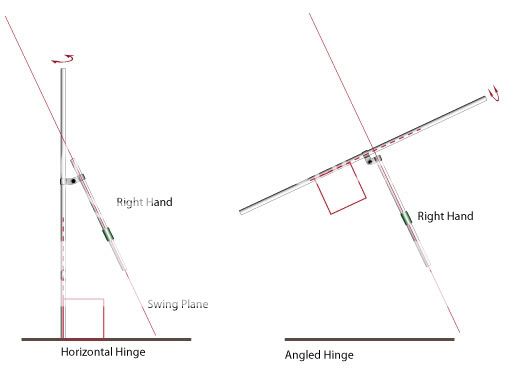 Hinge Close-Up View 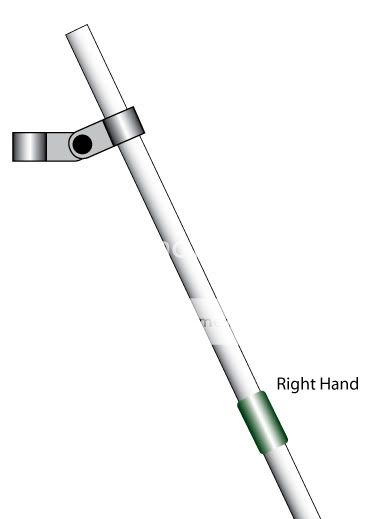 |
This sounds important Daryl.
Quote:
I cannot see the pictures, though! YBGF |
Cannot see the pictures?
Anyway, this thing taught me the difference between the #3 PP staying on Top of the Shaft at Impact or moving to the Aft Side of the Shaft for Impact. I found out that to keep the Pressure on the Top of the Shaft, you have to Rotate the Hand a certain way although it doesn't feel like a rotation. Not Rotating in any way, moves the the Pressure to the Aft Side. |
Looks interesting Daryl. Not quite picturing how you would use it, any pics of you using it?
Alex |
I now see the picture, D, but do I get the picture?
Quote:
I also see why the elbow plane works going down the plane and how you could get the idea that hitting with the right shoulder dragging down the Power Package could work, too. I'm going to bed, nice clear geometric image, D! ICT |
When you have a minute just try it. Use one Dowel and a Long Iron.
Hold the Dowel at its half way point, in your Left Hand, and Place the Grip of the Club on the Side of it (On Plane Clubshaft) and wrap your Left Thumb around it. Your Left Hand will hold the Dowel and the End of the Grip by Clamping them together so that the Dowel rotates as the Club goes through the Impact Interval. Use your Right Hand by Griping the Club with the Grip running up the Lifeline of your Right Hand and the Right Hand under the Shaft, with a Bent and Level Right Wrist. Just go slow back and forth. The Right Forearm (and Hand) is the Paddlewheel and the Dowel is an Axel. The Axis of the Dowel is Perpendicular to the Horizontal Plane. The Right Forearm Wedge moves simultaneously as you stroke back and forth. The Right Elbow, Forearm, Hand, Clubshaft and Clubhead; all Rotate around the Hinge Located at your Left Shoulder. |
Quote:
I'm headed to the basement to try it. |
| All times are GMT -4. The time now is 09:24 AM. |