
|
Geometry of the circle and how it applies to shot shaping .
Guys and Gals
Id like to discuss ball response , shot shaping from a geometric perspective. Ive posted this in the Lab to encourage free expression and extrapolation beyond what Homer alluded to in his book. But lets stick to Homerian based , backed up with quotes extrapolations. IMO Homer wasnt the first to attack ball reaction in golf through the looking glass provided by geometry . Others of course have addressed the subject from other angles ; a physics perspective and/or with radar data etc. Each with their own benefits perhaps. In light of these various interesting and worthy investigations and the potential for discord, if I may, I'd like to propose a singular rule for our own enjoyment and sanity. RULE #1. Lets leave discord of any nature and those other forms of investigation aside and stick to the geometry of the circle alone. Please. Lets: 1. Pull Homers references to ball response together , verbatim. Its all over the place in the book. What do you guys have saved to your computers? 2. Re Post Yoda's thoughts on the matter. There is one post in particular that we need to dissect carefully. There is clarification needed, perhaps he will help out. 3. Discuss how we use this geometry to shape our shots? 4. Try to doodle some drawings that would better explain the geometry Homer was referring to . Geometry being best understood in drawings rather than words after all. A major factor in why the book is so dang obtuse IMO. Imagine high school geometry class in words only! Over and above ball response if we go a little further with the drawings we would be knocking on the door to a visual explanation to one of Homers more perplexing (but keerect) statements: "There is no angle of approach to the angle of approach". I can take us fairly deep into this stuff (I think tbd) but I need your help with the references and further insight. I thank you in advance. |
First thing.
The actual , in the field , clubhead orbit , given the moving centre and lever contraction and extension does not describe a perfect circle . But the geometry of the circle still holds as a model for investigation. If this is still problematic then consider this : nearing the impact area (where the rubber hits the road) the orbit is at its most circular nature given lever extension. Still not perfectly circular but darn close. Also the geometry of the ellipse is born of the geometry of the circle. I know that some have used this against homer in the past but i wont mention that as it would be a violation of rule #1 and Id have to ask myself to delete or edit my own post. |
You can not draw a perfect circle without a steady constant centre. And a fixed radius.
|
THE GOLFING MACHINE
PAGE VII PREFACE: INTRODUCTION TO THE BOOK "......................The Golf Stroke involves mainly, two basic elements – the Geometry of the Circle and the Physics of Rotation. " |
2-D-0 DIRECTIONAL FACTORS
Quote:
 |
Awesome thanks for playing along Daryl
What do you say we call the target line in your drawing the LOW POINT PLANE LINE . It is one and the same as the target line in your drawing given that geometry/ball placement at low point, but the target line and the low plane line diverge as the ball moves back , up and in along the arc of approach. Eh? We're getting ahead of ourselves maybe but what do you think D? |
Ok, true. It's a Vertical Plane.
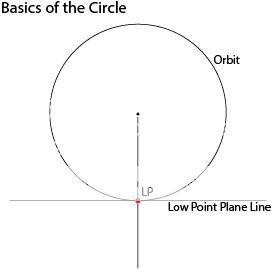 |
Quote:
Quote from D above-then the direction imparted at any one point of the arc will always be the same for “centered” (Sweet Spot) Impact (2-F). 2-D-O - Par.2 "the Angular Motion in a Golf Stroke is compounded by its dual Center. One Center is for Clubhead as a whole, and the other Center is for Clubface position." note- great care is also/always needed in application of HK 's use of Cap's, "quotes" and Ital. HB |
First question
From the above:
That being said- It would be that the golfer could strike the ball at any point on the "circles" with the same results relative to the tangent to the circle at the point struck. ?? Which then leads me to the 2 thoughts. 1. Is the circle shape important beyond practical use? 2. Is anything important beyond alignment of the clubface relative to the direct of the clubface at impact? HB |
Great question.
In the mean time, before we try try to draw the club face lets nail a few more things in the basic drawing. -add a stick man golfer guy, with the centre of the radius at his left shoulder and a head. -have him address a ball back of low point and draw the Impact Plane Line . -note the increased Angle of Attack. This is still in a purely vertical plane as D noted above . Things start to get interesting when you lay the whole shebang on an inclined plane with the guys head and eyes (the golfers perspective per 2-C whatever) above the plane . There are unique perspectives to most of Homers definitions that must be recognized . IMO this is the key to being able to understand Homerian geometry speak , words. You must be able to mentally jump from one perspective to another . Golfers view , caddy , down the line , true path of the clubhead even. Vagueness on this breeds misunderstanding when communicating. It is so easy to get mixed up on this and when communicating geometry in words. Easy for folks to use the same words but with vastly different "perspectives", definitions. Once cracked , what at first seems like Homerian code language becomes profoundly useful. You could call up Yoda long distance and clearly , precisely discuss the mechanics necessary for the progression your own procedure for instance. As he did with Homer .... many times. Guys this geometric perspective is also a language . This thread could get interesting if its possible for us speak the same language. Much of our discussions around here get bogged down in the mud of differences in definition. Not saying Im any better or worse just saying. Who knows maybe Mike O. will come on down with some stuff that shocks the world . Double D 's just itching to unleash a whirlwind of drawings I bet. Lets get the language straight and then roll with it. Not saying the whole book will come together ... I still think Homer was nuts. As are we probably. |
Quote:
Quote:
The Club is designed with length and lie angle and loft. The loft plane is a vertical plane. Rebound will be at right angles to the face. When this geometry (Shaft in a vertical plane at the correct lie angle) intersects the bottom of the circle, we have Low Point. That alignment at separation causes the rebound to occur along the Target line (clubface alignment). |
Quote:
Then later an extension of the radious because of the uncocklin of the left wrist? Am I getting way ahead of the basics U want to start at? If so Ignor this for awhils. hb |
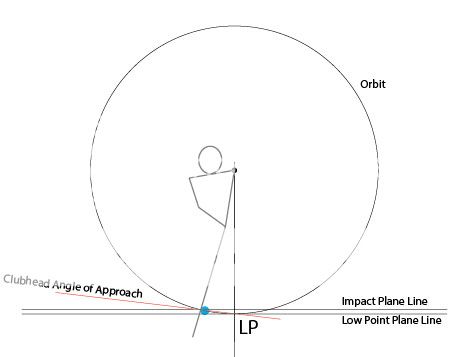 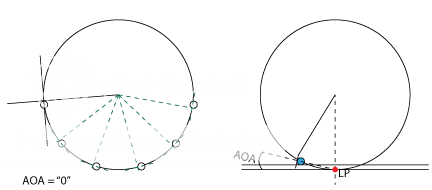  |
1 Attachment(s)
Here's an old doodle of mine. Guys submit drawings you did on a napkin or toilet paper or whatever if you want. Take a photo of it on your phone and post it !!!
Rule #2 Unused toilet paper only! This is for all those Viking fans out there. |
not sure why i cant post pics anymore. Im doing something wrong fer sure.
|
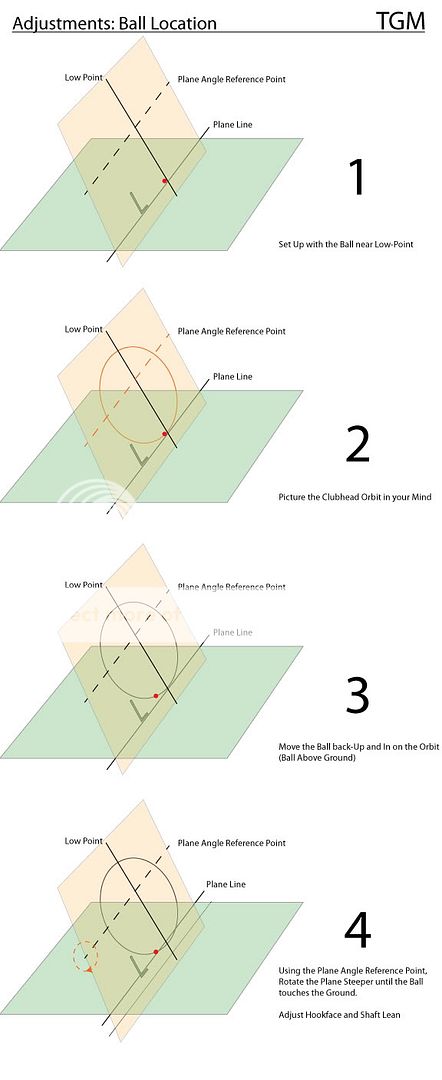 |
Quote:
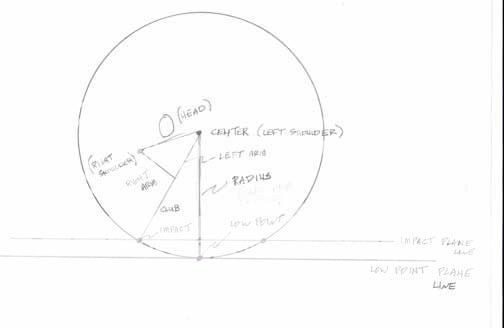 |
Quote:
D lets discuss this bizz later ok. Dont want to get bogged down on this . Not saying your wrong. We could do a separate thread if you want to address it right now. Lets talk Arc of Approach PROCEDURE here on this thread anyways before we jump into IMO THE most complex aspects of the geometry...... Angle of Approach PROCEDURE. |
CHAPTER 2 STATEMENT OF PRINCIPLE continued
PAGE 33 THE FLAIL 2-K GENERATION OF ANGULAR MOTION "THE GEOMETRY OF THE CIRCLE IS PLANE GEOMETRY (2 DIMENSIONAL - 4-D-0) AND CONSISTS OF THE CIRCUMFERENCE (AND ARCS), RADIUS, RADIANS, DIAMETER, TANGENTS, CHORDS, PLANE, AND PLANE LINE. ONLY THE CIRCUMFERENCE IS NOT A STRAIGHT LINE AND IT IS DESCRIBED BY A RADIUS MOVING AROUND A CENTER ........" This last bit "only the circumference is not a straight line".... sounds simple enough but it is interesting given that most new golfers and a lot of old time golfers too in their despair or merely operating under false logic try to cover the plane line or target line instead of tracing , pointing at it. Its as if we want to find a straight line to guide us and there is one but we attempt to make what should be a more circular orbit natured geometry linear . Like pool or billiards. Different tools / implements , different associated geometries. Contrast the hammer throw and the spear chuck. The golf club , which can whack a ball a long way mandates a circular geometry. IMO. |
Quote:
The basic drawings are a model only . They're two dimensional , dont have any levers etc. Very un human like . No wrist cock , no #3 angle . Very flat . BUT IT REVEALS A GEOMETRY A WAY OF PERCEIVING THE CORRECT ATTITUDE THE CLUBHEAD SHOULD TAKE THROUGH THE BALL . Something that just doesnt seem to be apparent even to the best of golfers . The best merely operate in a manner inconsistent with they might perceive or write about. Weird but not uncommon or new by any means. Yoda once relayed that Byron Nelson who was conceptually operating under a false logic of straight back and straight through (Im leaving face considerations out but he also had that wrong) intentionally left photos of his own action out of his book. His own swing was contradicting his logic.... Nothing against Lord Byron , I deeply admire the guy and his swing. My gosh his swing! My point is only that the geometry , the circular nature of the club head orbit , especially when its leaned onto an inclined plane is difficult to find . Its not difficult geometry to understand , but its not our first consideration when trying to figure out why that ball doesnt want to behave. We tend to look for a more linear explanation of things . "Square to Square" and the golf magazines of the 70s were a high water mark for this sort of thing. But the false logic of it , if you will, has been around for probably as long as the game has been played. Kids dont seem to be subject to it , they just do without much thought to things . You cant go by what a lot of pro's say they are doing. (Especially Moe IMO, never trust a Canadian especially one from Ontario). Look at the pictures . This very thing cost Homer the better part of his first decade or so of research. |
Quote:
It makes me sad to see these illustrations where the left shoulder is modeled as a swing center. What happened to the stationary head? Or do you advocate an arms only swing? - because that is the only way you can keep the head quiet and the left shoulder as the swing center. Or have you already forgotten about the "steady constant center" that OB introduced in his 3rd post in this thread and thus, allow the "center" to move around? This illustration is so wrong in so many ways. |
Quote:
We can draw / model (moving) centres , levers etc if you want. Or try to anyways . Ive got some doodles I could share. Maybe others do to. The effects of delayed release of #2 on the Angle of Attack etc etc. What centres are being moved about at what point in the swing etc etc etc. BTW I never intended the drawing to suggest that the left shoulder is the "swing centre". In real life. Most often it isnt ! It can be as you allude to, but isnt for full swings. For full shots the left shoulder is the center of the Arm Swing the head or more correctly a spot between the shoulders is the centre of the Pivot . They are both in play , their sequencing or non is a topic for discussion IMO. The Primary Lever is the Radius of the swing ... assuming your not Right Arm swinging. I personally use a two bent arms, stiff wristed chipping method (Runyan , Seve style) that IMO is centred around the spot between the shoulders. Its a pure pivot stroke . One Accumulator. There's video of Seve online talking about the progression from chipping to pitching ...... "now we go to the straight left arm". To my mind that means he's introduced the left shoulder as centre of his straight left arm's motion. Nice way to work things. That guy dug it out of the sand. Also there are more centers than just the pivot and arm .... mulitple levers , multiple centres. The 2D model is not intended to address the issues presented by the multiple levers of the human body. It merely shows the geometry of a circle . All models are somewhat flawed agreed . The machine of 1-L is subject to same. Centres can and do move in real life. With implications to low point , divot etc. etc etc. |
Quote:
Are you suggesting that anywhere on the circle the ball is struck before Low Point, that the shaft needs to be at right angles to a line ............ I mean, we have added "Hook-face" to divert the ball from its true tangential path. Besides, anytime the primary lever is Turned, the shaft would not be at right angles ........ Help me out here. The bottom drawing shows that the clubshaft is not at right angles until Low Point because the Left Wrist is uncocking and the Primary Lever has not become Vertical. The Top drawing represents a shaft-only orbiting around a circle and because its center of rotation is the center of the circle, the tangent will always be at right angles to it. 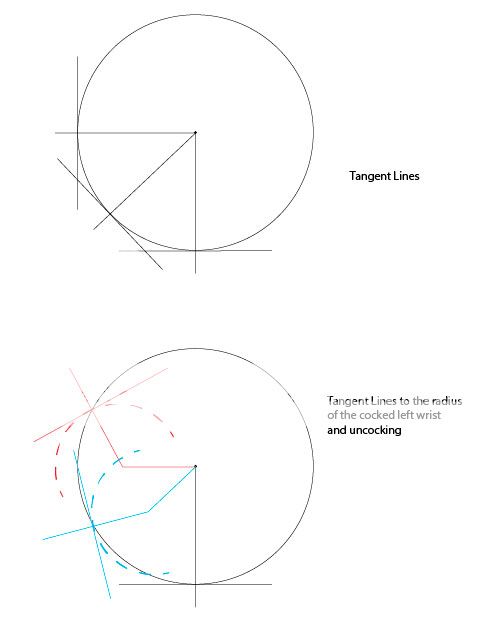 |
Quote:
The second drawing would not occur fo simultaneous release and angled hinge. And it will not occur with my understand of sequential release, but that is another problem for later.?? HB |
Quote:
Lets consider the Arc of Attack (Homer style) , from the sixth. Quote:
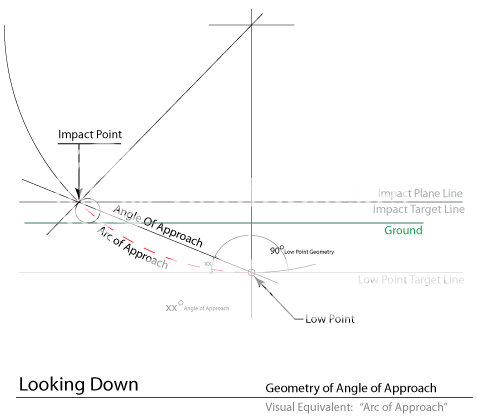
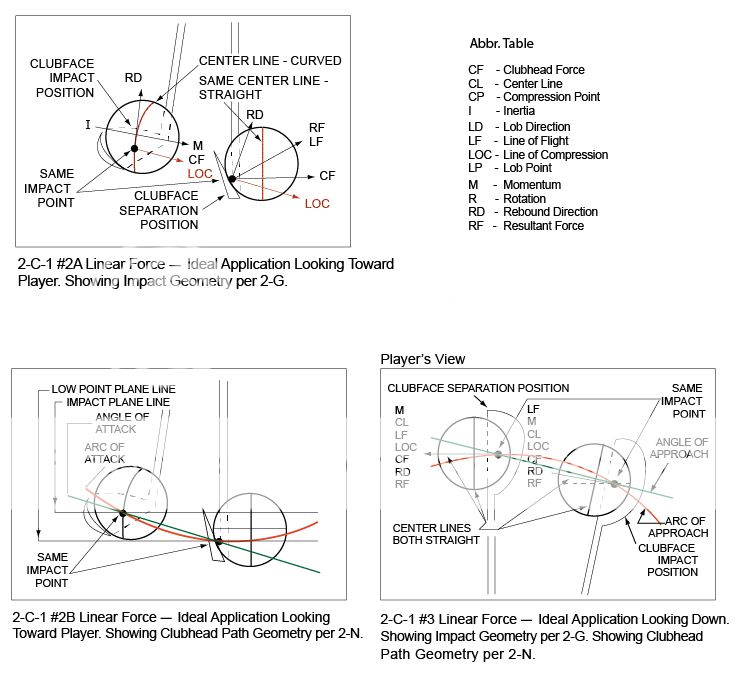
Would not the Angle of Attack be a straight line drawn between two points. Impact and separation Im thinking. Thats all the balls knows right. So ya tangential to the orbit but pointing down more for balls played back. See drawing 2-C-1 #2B and note the perspective from which the Angle of Attack is drawn , is visible , measurable say from caddy view , "LOOKING TOWARDS THE PLAYER". Like looking at an airplanes angle of attack ... you dont see it from above the airplane, you see it from the side. Like measuring the pitch on a roof or the rise and run on a set of stairs. Looking from the side or in golf terms caddy view. Homer didnt talk in number of degrees or anything but angles do have degrees. Angle of Attack is measurable. The Arc of Attack is a view of the clubhead (sweet pot) path from a certain perspective. The Angle of Attack is a measurement of the clubheads rate of decent. The club does not actually travel the straight line Angle of Attack. It stays on the circular orbit. Angle of Attack , Arc of Attack y'all . D, you do you have that 2-C drawing? OK now drawings will help us see this but jumping ahead for moment.....for those who might be getting bored. Other perspectives , the players own for instance , of the same clubhead / sweetpot path are labelled with different names. See drawing 2-C-1 #3 FROM THE PLAYERS PERSPECTIVE. Note how the Sweetspot Path is now called the Arc of Approach. Different labels for different perspectives of the very same sweetspot path through 3 dimensional space. Arc of Approach y'all. But i digress. Getting back to what the heck this might mean to the guy on the tee, did Homer say anything about Angle of Attack and backspin? |
Hungry Bear, I agree that the Primary Lever always maintains a radial alignment but when its not vertical, regardless of release, although the arm, if extended may always have a tangent line and be at right angles to the arm, the secondary lever will not. Not because its cocked, but because its not at right angles to the swing plane
does that make sense? |
 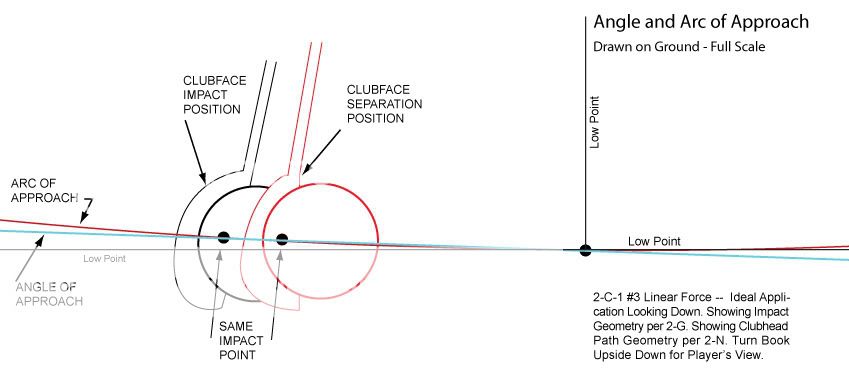 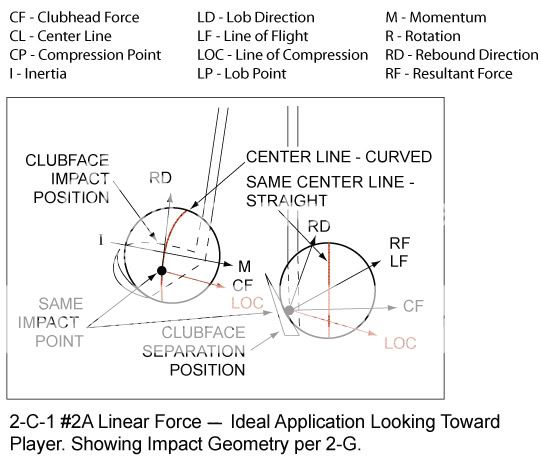 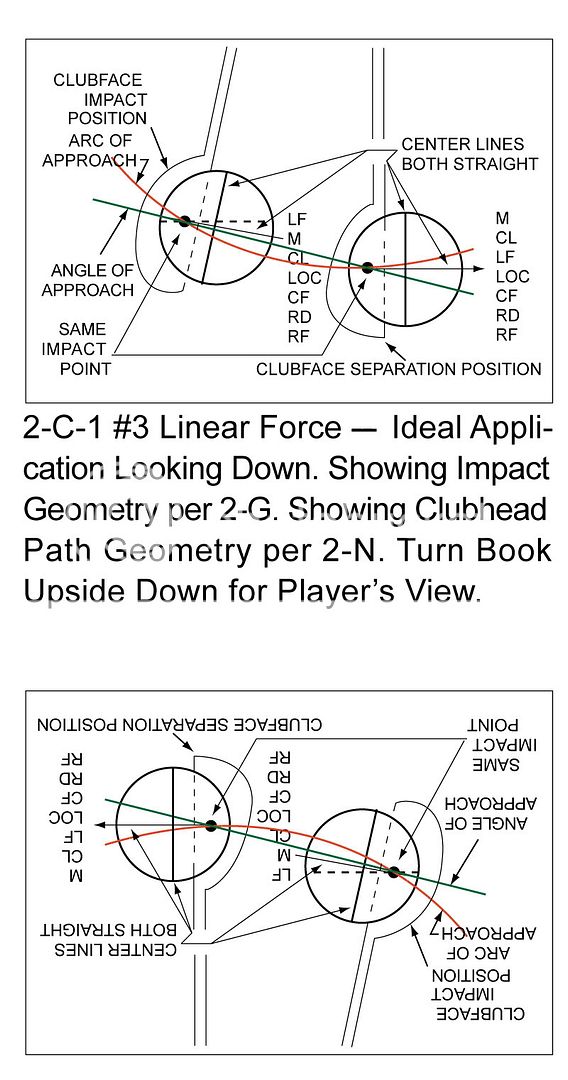 |
Awesome but we need 2-C-1 #2B. You got that one? And of special note 2-C-1 #3 is looking down from the players view . Not birds eye. There is a difference. Then we'd have caddy view and players view of the sweetspot path or clubhead path if you prefer.
The second drawing , is that yours? Thanks D. |
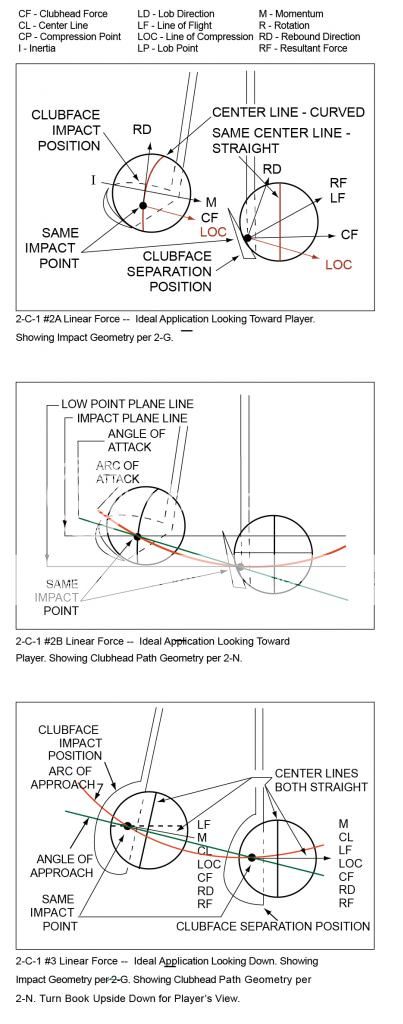 |
Thanks D can you turn 2-C-1 #3 upside down please and put it beside 2-C-1 B #2. Thats the pairing I find interesting for seeing the path.
Man your drawings are good. Ill come in with some doodles tomorrow to show things on the inclined plane from DTL. |
K now before anybody has bird , those drawings are not to scale . They exaggerate the geometry for illustrative purposes but .... the path of the orbiting clubhead is still circular , elliptical. No flat spots , close but not quite. Theres a difference.
|
 |
1 Attachment(s)
Quote:
Attachment 2927 |
Where am going with the above drawing you might ask? At present we are working towards some basic drawings that will show:
-what the path of the club head should look like when viewed from the players perspective, caddy and down the line. -how a change in plane angle changes how the circular orbit (of the clubhead /sweetspot) looks from these various perspectives. Most importantly the players point of view . The Arc of Approach . We need to add a pair of eyes to the drawings .... above the plane slightly. -how the players perspective of the circle can be used as a guide to on-plane clubhead line of flight maintenance. If you know where the clubhead should be you will be less likely to direct it off line due to false logic or mere ignorance. -how changes in plane angle and ball position back of low point increase or decrease the distance between the Impact Plane line and the Low Point Plane Line. With associated changes in ball reaction. Getting closer to shot shaping procedures. |
Time to return to post #1
Expand into your ideas beyond the great start on drawings. Quote:
|
Here's a wiki statement , please make editorial changes guys.
1. The further apart the Impact Plane LIne and the Low Point Plane LIne get on the HORIZONTAL BASIC PLANE the more OUT there is to the clubhead path during the impact interval . The further apart these two plane lines get on the VERTICAL BASIC PLANE the more DOWN there is to the clubheads path during the impact interval. So steeper Plane Angles through the impact area impart more DOWN LESS OUT. Flatter plane angles though the ball impart MORE OUT LESS DOWN . This is a "need to know" for shot shaping . 2. The more back of the Low Point the ball is positioned along the circle .... let me change this to the players perspective for more relevance .... The more BACK , IN AND UP the player positions the ball along the ARC OF APPROACH (his unique visual perspective of the circle , orbit ) the more he is moving the IMPACT PLANE LINE further away from the LOW POINT PLANE LINE. As we have established above however the Plane Angle will determine how this ball positioning (machine adjustment if you will) translates into the relative amount of OUT and/or DOWN added. Ball reaction changing accordingly. As an aside: As we play the ball back in the stance there is more out to the club heads line of flight , more of a draw tendency . This draw tendency is less evident as we move to more lofted clubs . We tend to attribute this entirely to the added loft . Loft is a large factor but consider the steeper plane angle associated with normal wedge play. Less Out more Down . Why do I say "normal" these things are adjustable .... V.J. Trolio for instance has a flop shot technique (an optional one) where he tries to plane the shaft as low as he can get it . Thereby taking out Down as much as he can . He lays the wedge on its back and virtually skids the flange along the ground under the ball. He's wide open with his plane line like this . He's adjusted his Angle of Attack to the flattest he can get it. And you could assume his Arc of Approach , his visual of the clubheads circular ish travel would be more circular. Hmm we need drawings. |
From HB
Quote:
I wanna get us all speaking the same lingo , seeing the geometry in same way IF THATS POSSIBLE. * We no doubt will have to agree to disagree on things as we move forward. *But lets move forward.* This thread could get stalled and never restart ... easily . So I'm trying take a linear approach to its progression. Its a linear approach to the circular/angular nature of the clubheads orbit .... geometry puns are terrible. Still havent defined a lot of concepts necessary to the understanding of the Geometry of the Circle as it relates to shot shaping. Grip Rotation , Hook Face , Plane LIne Rotation, Stance Line vs Plane LIne etc etc etc . |
Quote:
hb |
2 Attachment(s)
Attachment 2930
Imagine looking at this clubhead path from down the line. It wouldnt be flat, no. Close ish though, flatter than most. Plane angle shifting being responsible to large measure . Hogan got a little laid off at times .... some say for a purpose . This was a topic of discussion in Homers GSEM class in 1982. But I digress.... Would this non flatness of an ultimate golfers actual clubhead orbit when viewed from DTL render the flat as a pancake Geometry of the Circle mode of examination irrelevant? IMO no! Attachment 2931 I love this animation . Imagine if you looked at a [B]tracer line[/b] of the animations clubhead travel through 3 dimensional space! It'd be unlikely to attribute its Picasso like meanderings to being the product of circle laying flat on an inclined plane , which is shifting up and down (variety of manners possible this is but one). But , Homer and most likely others ahead of his time did. |
Quote:
" Luzer , party of one . Luzer, your table is ready". |
| All times are GMT -4. The time now is 09:27 PM. |