
|
Geometry of the Circle
Quote:
Of interest is that when the Ball is played 6 inches aft of Low-Point (about the Left ear) with a wedge, the divot would be almost excessive. Use a Tee. For O.B. Left..... If Separation Occurs at Low-Point, then, without a Tee, the Club would strike the ground before Impact.  |
Nice drawings.
I guess there are at least one or two ways to hitting a low wedge without digging deep. Anyone care to outline them? |
double rainbow
Awesome drawings D, really.
My thoughts: -Seeing these drawings to scale is very interesting isnt it. Homer's drawings were not to scale Im thinking for illustrative purposes maybe? - I've wondered about playing the ball back with a wedge....6 inches back doesnt seem excessive to my mind, but without coming up prematurely that implies a 12" inch divot doesnt it. I could see that on super soft , wet soggy turf maybe but not otherwise. So do we not play it that far back, come up early or perhaps deflect out of , off the tera firma? I dunno. -you are assuming the low point plane line to be defined by the sweetspot rather than the bottom of the club. It doesnt change your findings at all but it would illustrate the depth the clubhead would descend to beneath the ground at low point for balls played back in the stance and determine the length of divot too, I think. -I wished you'd posted this in my thread but maybe its run it course anyways.............. here's whats bugging me. Homer in his drawing 2-C-1-3 drew the Angle of Approach as straight line from impact to separation. Separation appearing to be at low point. But in 2-J-3 he describes in words, the Angle as running from Impact to Low Point. So taking him on his words of 2-J-3, how would drawing 2-C-1-3 change if separation is back of low point, as it often is? The LOC will not be both pointing at the hole and pointing down the Arc of Approach for instance as the Arc will be out to the right. The Arc and the Angle will not intersect at Separation. What does it all mean? We need a new 2-C-1-3 for balls back in the stance. Great stuff D thanks |
Nice drawings.
A non-important question. All being equal in the 2 wedges drawings. Would not impact point on the balls be different due to ball placement? I think I see a difference but not sure. And is that measurable? |
With a wedge, the divot is longer but that is what a clubs design bounce is for - stopping the entire hole to China.
|
Quote:
Quote:
2. We can move this thread to your thread if you like. 3. Dear O.B. Left; The Clubface is hooked to divert forces from going out to right field. But you brought up 2 very Important Points. The Angle of Approach is "Plane Angle" from the Impact Point to Low-Point and it should be represented with a "Looking Down" Drawing as in 2-C-1 #3. If you Draw the "Angle of Approach" in a Down-the-Line-View, as in 2-C-1#1, it "is" the Sweetspot Plane Angle - i.e. it is lying flat against the Sweetspot Plane. Therefore it is always intersecting. See the Illustration below. The Sweetspot Plane "is" the Angle of Approach: the Green Line  The 2nd Point is that the "Point of Impact and the Point of Separation" must be the same. Imagine this, as sickening as it is...... 12 Piece Bucket is on his first date. He tries to kiss her good night. He puts his hands on the side of her head like a clamp to stop her from pulling away (he learned from experience). So that as much and often as she struggles, his lips will touch hers and at separation his lips will still be touching hers when he lets go. Now imagine if, during her struggle, her head rotated up the face of the inclined striker. At separation, his lips would be touching her "forehead" (lob shot). That's why we must "Hinge" through the Impact Interval. We must have Impact Point and Separation Point, the same point on the Ball. We do not want the ball to Roll up the face of the Inclined Striker. This is for Maximum Compression. See the quote below. Quote:
So, I think that we should tell the "D Plane" people that their goal is to make the ball "ROLL" up the Clubface as much as possible to keep the spin axis horizontal to the ground thereby eliminating side-spin and increasing backspin for more lift and carry. Then hit up with the Driver and learn to hit up with the wedges too. |
Quote:
|
China ?
I am confused. All of us in the states know that if you dig down into the earth forever you end up in China, but I didn't think if Australians did the same thing they would end up there. I am going to find a globe and figure that out for golfguru.
And I think you got it confused with bucket. He is so cute that the girl would be holding his head not the reverse.! |
Quote:
|
Quote:
Quote:
Quote:
D, did you do that drawing of 2-C-1 #1 Nice reproduction with colour too. Are you interested in trying 2-C-1-#3 but with the ball back of low point? If so it'd be nice to include a plane line and its direction vis a vis the target. Quote:
Totally agree with everything about Bucket......sickening man. Get the heck out there billy goat , hop the fence .... Quote:
"The ball should always be struck prior to the low point of the Down-stroke, even when using a Driver, except under special conditions or to produce a special effect, which is a separate area of consideration." This is gonna be a good thread, Daryl, 'specially with those D plane guys around to "straighten us out", so to speak. Im glad we have Trackman to discuss too. We're on the verge of "adding more detail", via additional information and questions of all kinds. More detail, more precision, more birdies. Thanks for the photo of Homer's garage. Cant believe its unchanged. |
2-C-1#3 is a tiny draw.
The ball takes on a side spin that equals the RPM of the horizontal hinge. You can see the ball take on a spin in all thee drawings at page 17 in the 6th edition. |
Quote:
You appear to be wise in the ways of physics. If you can explain the mechanism, I'd appreciate it. Thanks 3putt |
2-D-0 DIRECTIONAL FACTORS
Quote:
|
3putt,
Here's my simple view of this. It is clear from the drawings in 2C that the ball rotates during contact. It is a physical fact that this rotation will proceed until the ball is exposed to a force that stops the rotation. I can't see any force present that would do work the ball clock wise here and stop the side spin. Except perhaps the wind drag that will reduce this minute sidespin during the air time. I think Daryl's quote must be read in the context of the relationship between centrifugal force and inertia. When the ball leaves the club, the centrifugal force is shut down and the ball proceeds in the direction it had at separation. I don't think that quote is ment to address side spin. |
Bernt, my take on this is that as long as the clubface carries the ball then it's not producing a glancing side spin.
|
Daryl,
If you throw a stick using a swing like motion, the part of the stick that has the largest swing radius will start off with greater speed than the part you were holding in your hand. As a consequence the stick will rotate in the air like a rod on a spinning wheel as it flies through the air. Do you agree? Same thing will happen with the golf ball. The side of the ball that is furthest away from the swing center (hinge axis) will aquire more speed than the part that is acellerated with the shortest swing radius. Because it is under the laws of Centrifugal Force during impact as per your quote. |
Quote:
If you throw the stick as you describe AND in doing so you(knowingly or unknowingly) apply a force that causes the stick to rotate around an axis internal to the stick, then yes, the stick will continue to rotate once it is separated from your hand. If you throw the stick and do not introduce any forces other than the centripetal force your arm was already applying to the stick, then every atom in that stick will fly off in a straight line, tangential to the circle it was moving on. I agree there will be an imbalance (as you pointed out the part of the stick further away from the centre of the circle has greater speed) but I think the system will rebalance - some atoms will slow, others speed up,- conserving momentum for the entire system as a whole - and in short order the entire stick will move on a linear path, same as the centre of gravity, with no rotation. But I am speculating only. And, though interesting, is this really going to help my golf game? |
Quote:
Obviously there is stuff out there we can learn from folks with healthy intentions, but we need to separate those who merely want to win debates with science that has no bearing on the game of G.O.L.F. Kevin |
BerntR, I couldn't agree more with what you're saying. It also goes that the Bottom edge of the Clubface is moving faster than the Top edge and that the inside bottom edge of the clubface will cause more compression than the outer upper edge. And all of this from observing a simple centrifugal force application.
We agree that there are forces during Impact other than Glancing Spin and a little friction. Glancing Spin doesn't explain why a Draw has more carry than a Fade nor why a 7 iron compressed shot travels farther than a glanced shot having the identical clubhead speed. I can speak from experience that it's 10-15 yards and that's when both shots are straight at the pin. I can work the ball anyway anytime but I play 95% of my shots dead straight and all of my divots point a hint to the right but I play the Ball forward. I found a video of a 3 Iron strike a little more than a year ago and I've been studying with lines and different layouts. I think that the picture sequence shows how well the clubhead goes into the ball about a 1/4 inch before the Ball begins to move forward. Then it rebounds. The Clubhead appears to be traveling horizontal to the ground and the Clubface is closing. The Impact appears to slow the Clubhead but not the Hands. 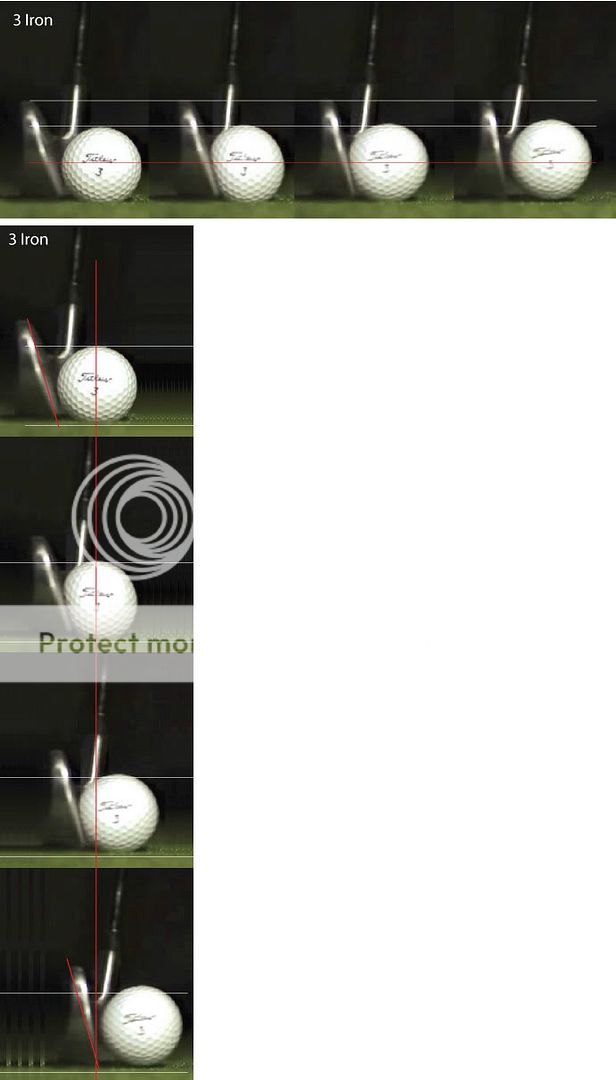 |
In that case, Daryl, I think it's time for celebration. :dance:
I've often had the feeling that I've either learned a lot from you or disagreed whenever we both have participated loudly so to speak. I didn't quite get the "glancing draw" part at first but that's probably because my english isn't 100% I've seen that picture series of impact before. I think that sorts of evidence is incredible interesting. I also noted in those pictures that the slowdown of the clubface and the resistance in the hands actually creates a "lay forward" impact condition. There's clearly more shaft lean at separation than at first contact. If anything I would expect that behavior to improve the ball compression even further. |
What a great discussion here. I'm really enjoying it.
I really liked those pictures of the three iron and they reminded me of video. Is this video where those pictures were taken from? It sure looks like it. http://www.youtube.com/watch?v=6dG9hb3_blo It's pretty clear watching this video that when impact is not perfect, the head twists like crazy. Dollars to donuts that 3 iron shot was hit on the heel based on the rapid "closing" of the face just beyond impact. Based on the description of the video, the 3 iron shot was right before the driver swings which begins at the 33 second mark. Thoughts? |
My pictures look just like the video. I'm sure I took the stills from it but they've been in my files so long and I can't find the video. I'll download the file. I also think that the 'toward the heel' strike observation has a lot of validity and that can be easily seen if you have the video and it would also account for the upper toe losing loft.
Those are some wicked off center hits. It's hard to say for sure whether the ball is glancing off the clubface or the clubface is glancing off the ball. I guess it's both. |
additional analysis??
I would be interested in an analysis which included #2 release.
If #2 has the left wrist at level for impact/low point then the movement of #2 will have the clubhead going down at left shoulder "low point" but the true low point must be after this point- ie. at the point where the tangent to the actual arc equals the downward angle created by #2 release. AND what does this downward motion do? For angled hinging it may hold as normal to the left hand- because the hand is perpendicular to the plane but for horizontal hinging I think it will be parallel to the left hand. As a case study. Can you hit a FULL 64* wedge with horizontal hinging? What say You?? HB PS. Saw video add where Bobby Clampett says tour pro bottoms at 4 in. beyond ball, 100 shooter bottoms 4 in before ball. each inch forward is 4 strokes off your handicap. That was easy! |
HB
PS. Saw video add where Bobby Clampett says tour pro bottoms at 4 in. beyond ball, 100 shooter bottoms 4 in before ball. each inch forward is 4 strokes off your handicap. That was easy![/quote] Based on my own experience, I would certainly agree. |
Quote:
Sure looks like the club is losing the battle. :) |
| All times are GMT -4. The time now is 09:08 AM. |