
|
starting down for swingers
Hi folks,
My first post. I am a serious low handicap golfer finally looking to take my game to the next level and get back to being a competitive golfer. i have had lots of lessons from distinguished teachers but only recently have found my way working with an authorized Golfing Machine instructor. I do have one question about which I am not sure I have found an answer. From the top/end to start the downswing as a swinger I of course bump the left hip and sit down and tilt simultaneously. I don't do anything with my arms. My right shoulder drops on plane and begins to point along the plane line. so far so good. What I don't get is the connection between this 'move' which seems right and two other ideas that don't seem compatible with it. The first is the idea of a quick move to start the downswing which appears both in TGM and in Lynn Blake's video. The second and related idea is that the right shoulder creates a flywheel movement which helps the inert left arm separate from PP#4 and releases the associated power accumulator. I think of a flywheel as an outward motion, yet the right shoulder motion i am taught is both slow and down. I need some clarification including whether these two conceptions which seem conflicting to me are in fact compatible. Thanks, Jules |
clarification
I hope my question was clear enough. First when I say I have had lots of lessons with distinguished teachers, I mean since the age of 12 when I took up the game over 40 years ago; and I mean to emphasize the fact that for the first time only now am I beginning really to understand the golf swing and to implement that understanding into my playing (hopefully), thanks to TGM (which I had read on my own in the 70s to no avail I fear, and again with even less comprehension in the 80s) :-) I am genuinely puzzled about the movements of the right shoulder at the start of the downswing. I have always thought of its movement as reactive to the movement of the left side weight transfer and the pivot, which isn't to say that i haven't screwed it up more often than not. But I am confused about how it can be responsive, passive, leaving the arms behind on the start down, its direction down and its movement slow on the one hand and the source of a flywheel action and quick on the other. Any help will be helpful. I have a penchant for analysis and so any analytic discussion of this will be warmly appreciated.
I am sorry as well that I have not scoured the website/forum fully and may well have missed a prior discussion of this issue; if so, I would appreciate anyone simply directing me to prior discussions. Thanks again for your kindness. Jules |
Hi JulesC,
I say welcome even though I'm not one of the hosts:) The shoulder turn is ideally flat through the back stroke. On the down stroke the right shoulder should be turned on the swing plane, initially aiming at the ball. Of course this requires some work from hips, knees and feet so you get the appropriate forward and turn hip motion. The fast transition you mention refers to 10-20-C Shoulder Turn Throw. Sharp initial accceleration of the Shoulder Turn against the #4 PP loading of the Left Arm automatically throws the Left Arm off the chest when the Pivot acceleration subsides. Whether you get a fast transition will to a large degree depend on how soon your lower body starts the downswing. The fast loading action happens partly because the lower body starts the downswing before the arms and hands have fully completed it. You have probably realized that TGM is a very right sided approach to the game. A lot attention is paid to the right side even for a pure swing. And not without plenty of good reason I might add. |
Hi Jules,
I'm going to wait for the experts on "swinging" to answer, I just wanted to say welcome to the board. I hope you love it here as much as we do! :golf: Kevin |
Thank you both. I fully expect to find the forum as enjoyable as it is educational.
Jules |
The Magic Move....Right Shoulder Going Down
Quote:
DG |
I basically agree with DG, but Hip Action does have a direct influence on the shoulder turn. Whether it is an area that needs attention depends on how well it works and how automatic it has become:
10-15 Hip action 10-15-A: Standard The Hips initiate and lead throughout - pulling the Shoulders in both directions 10-15-B: Delayed /..../ The hips then take over and lead and power the Downstroke Shoulder turn /....../ Then of course you have Short and Zero (C & D) that doesn't lead the shoulder turn in the down stroke but they are hardly relevant in full motion. |
Quote:
Kevin |
Quote:
|
1 Attachment(s)
Ogrady was one of Homer's most fervent pupils (although he maintains TGM has tragic flaws) Speaking of controversies...the right shoulder business will get some people fired up! DG, correct me if I am wrong but TT felt that lowering the right shoulder would cause the axis of the spine to tilt and that it would clear the right hip as an effect. But the general TGM consensus is that shifting the hips laterally will tilt the axis of the spine and clear the right hip. Like many I have hit thousands of balls toying with this stuff. Like everything else you find what works for you and try to describe what you think you are doing as close to what you are actually doing. To this end TGM is without peer. Having said that this is what I think: I think that the hips initiate, but I feel as though my right shoulder comes hurtling down the face of the plane. When I think hips I hit it crap...when I think right shoulder I hit it well. Looking at my swing on video there is no doubt that my lower half moves first. In this pic I was focused on two things from a feel point of few. Extensor action and my right shoulder moving assertively down plane at the ball. The EA was there but as I mentioned in another post my right arm straightened a bit prematurely and I hit a solid pull-draw (carried about 20 yards shorter than usual due to the slighly closed face...but ran out nicely!)
I do not want to start another what tilts the axis war, or what starts the downswing but rather mention that the most enduring swing thought that I have ever had (other than "Don't choke you bastard!")is "Drive the right shoulder down until you hit dirt...then drive some more...you bastard!"My axis tilts, the right hip issue the right shoulder and elbow an invitation to proceed. Passing point: Getting my head more centered at address helped a lot. I used to set up with my head hanging over my right knee. This would result in too much axis tilt. |
Quote:
To get the feel of really 'throwing' the arms off the chest, make some swings focusing on the right shoulder moving aggressivly toward the ball, while having 'rag limp' arms. You can simulate the feel of PP#4 loading on the horizontal plane, throwing a frisbee. You can get a great feel for it if you have someone hold your hand as you try to turn back through/throw, even better to do this with a club and have someone pull the club at halfway down. Stretch bands on the horizontal plane work great as well. Another thing to keep in mind is that the more you have your weight fully on the left leg before the hips turn, the more fully you can load #4 (or at least it sure feels that way in my case). |
remaining a bit puzzled. Here's why. I am not worried about extent of axis tilt or what creates it, or whether the right shoulder moves downplane as a result of shift to left, a pivot or initiated prior to both. My concern is a bit different. First, I don't understand the invocation in TGM that the movement of the right shoulder for the swinger is quick which is the opposite of what it is for a hitter, which is slow. Secondly, it is supposed to be a quick/flywheel kind of action that throws the club out ultimately by blasting the left arm off the chest, etc. I don't see this movement as of a piece with moving the right shoulder down the plane. the flywheel motion seems to me to me to have an outward vector not a downward one. So these two features of the conventional wisdom of the TGM as well as LB's characterization of teh right shoulder differences in swinging and hitting seem at odds with the thought that however initiated the right shoulder moves slowly and down on to the plane-- which is the image LB uses when he describes the right shoulder relationship to the plane line through the use of the rifle illustration.
As I said I am analytical to a fault no doubt and I can't move on without some clarification of whether these thoughts are compatible or not; and if not, which is the better understanding of TGM Thanks again, Jules |
Quote:
Think of the flywheel as a 'pulling' force, the torso pulling the left arm (pressure point #4, the left arm/chest connection). It is the primary force for a swinger. It isn't a purely horizontal 'spin' like a frisbee, because you are operating on an angled plane (roof). The right shoulder going down plane is what keeps the force on that angled plane, rather than spinning on a horizontal plane (which is what most high handicap folks do, an over the top, off plane, spin) |
Quote:
And . . . pretty sexy picture there too big boyeeee! Can you put up the whole sequence? To your point . . . there are TWO was that one could tilt one's tea cup . . . . get the spine leaning via moving the head BACK (right shoulder would have a down component and not enough OUT) . . . or tilt the spiney spine via the HIPS going forward . . . (I do . . . spin shoulders THEN tilt back . . . no good). Now you said you hit a pull draw b/c you ran outta right arm . . . why do you think you done that thare? There is a link to lag pressure, club shaft and club face control (right arm control as well) via the pivot train. I like your lines pretty good here . . . right leg straighty . . . left knee still bent nicely . . . shoulder ain't spinnin' early . . . pretty good bossmagnus! For a compare to "perfection" . . . . You is . . . slightly less left knee bendy . . . slightly more tilty at this point . . . and Hogan is swinging a driver here too . . . Sooooooo . . . . IF and I say IF . . . you wanna change things a bit . . . more closed coming down . . . more knee bend left knee which translates in to more hip slant . . . which would translate in to more lag and a sharper angle of attack . . . and less face pullieeez. Also . . . from DTL . . . How does the face look? Can't quite tell here . . .but could be slightly shutty? that could result in your pull draw pretty quick too. but all that being said . . . you look pretty HAWT at this point. Me likey. Let's see the the whole thang. 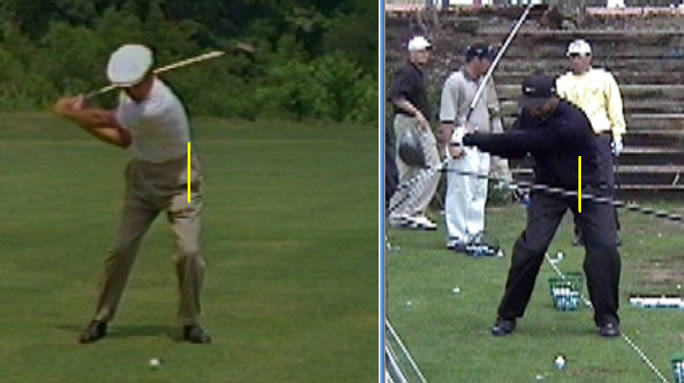 Come back . . . |
Off topic perhaps....
Interesting to study tigers position right there. It looks like he uses both feet to turn his hips - to a larger extent than the two others. His body seems to be working in three planes at the same time it seems: Shifting weight forward, rotating the hips on a flat-inclined plane and rotatin the shoulders on a steep plane. Some very advanced pivot work going on in that body. |
The Whole Book
Quote:
It appears to me a lot golfers try to interpret TGM through Hogan's swing and instruction, I believe Homer said he used Sam Snead's book (How to Play Golf) and Hogan's book (Power Golf) for the pictures not the written instruction, Homer believed most of what was written was incorrect. I'll listen to Tom Tomasello's instruction about TGM any day...I don't know of anybody who had as much detailed knowledge of Homer's work as Tom Tomasello...especially the Hundred of hours of audio tape that Tommy had with Homer, I got to believe Tommy went through the WHOLE book with Homer (just like he went through the whole book with his students)...even the 7th edition revisions. DG |
Thanks. very helpful. Still there is the issue of whether in fact the first move of the right shoulder is 'quick' or rather that it does not have to be slow (as it must be for the hitter). And the first direction the right shoulder takes (as a result of the left hip bump) is down and if that is right it is not a flywheel action of any sort, or so it seems to me. The flywheel action occurs as a result of the pivot action I take it and that comes after the weight shift. So it seems to me there are two moves that the right shoulder makes -- one in response to the hip bump (right shoulder down, also causing the axis tilt); the second is the flywheel as a result of the pivot/rotation. So even if the flywheel is quick motion it does not happen first. The right shoulder drops on plane first and does not spin -- though I recall seeing Lynn Blake referring the right shoulder spinning at the start of the downswing (in a swinger). I thought I saw that in one of his videos and I recall reading in TGM that the right shoulder moves quickly in a swinger at the start of the downswing; and that is the source of my confusion. For it seems to me that if the downswing starts from the ground up, the first move of the right shoulder is down the plane; and only then can there be any 'spinning' at all.
Am I mistaken? I am open to learning that I have this all wrong. I am one of those golfers who isn't happy just having good swings; I have to feel I have good swings for the right reason; and I have to understand that I am doing it correctly. I am sure that this is a minority view as for most people good shots are reward enough. I wish I had more good shots of course, but I crave full understanding (or as close as I can get) :-) |
Gem Mining
Jules,
Try the search function. There's a lot of gold nuggets here. Here's a sample: http://www.lynnblakegolf.com/forum/s...ead.php?t=877& http://www.lynnblakegolf.com/forum/s...ad.php?t=5955& http://www.lynnblakegolf.com/forum/s...ad.php?t=2797& http://www.lynnblakegolf.com/forum/s...ad.php?t=2249& |
Take a look at Ricky Fowler for the 'quick' move, and the lag that results.
Very Hogan like IMO, perhaps one of the few ever on tour to swing like him. The moves are one in the same, right shoulder down plane, the change of direction loading PP#4, the quicker the change, the more #4 is loaded. |
Quote:
After what you did to that poor goat?!!:crybaby: Thanks for the analysis. An old dude comes up to me one day and says "I like your swing. Can I take a few pics?" Ordinarily that is enough to thrown down and go to fighting, but he had this high tech looking camera. Long story short he took a few pics. He sent me a bunch of proof sheets. I have not gone through them all. I do not think there are many more of this particular shot. I agree with what you say. Face is a little shutty. Also what is happening here is that I am losing my spine angle a bit. I started off a little slumped (shoulder turn was too steep)so I flattened my approach by standing up and laying the shaft down. Solution: better posture with more knee bend. I still think that my major fault here is essentially a pivot stall. My right shoulder stops the right elbow straightens, thankfully not too soon as to cause a radical flattening of the right wrist:naughty: When we thaw out here I will put up grainier before and after shots. My impact alignments have improved. |
Quote:
Hey Jules Perhaps this will help, perhaps not. -The "Axis" of Axis Tilt is the Shoulder Axis. Keeping the Head Centered a Sliding of the HIps will tilt the Axis. Meaning the Right Shoulder is lowered. A great thing especially if you are employing a Turned Shoulder Plane. The right shoulder does not "make" this move itself, on its own power. This Hip Slide by the way is a great way to stop the backward motion of the Hands and Arms. Hogan did it really early in Backswing by about the time his left arm was parallel to the ground or so. As in all Pivot Components in regard to 6M1 there is a little slack to be taken up before one Component can actually move the following component. A little muscular stretching prior to shortening. -8-7 Startdown is the period or Shoulder Acceleration , 8-8 Downstroke is the period of Hand Acceleration , 8-9 Release is the period of Clubhead Acceleration , 8-10 Impact is the period of Ball Acceleration as defined by Homer. Therefor the Axis Tilt if it is employed at all, is prior to Startdown by definition as it does not accelerate the Right Shoulder towards Impact. -The only thing in Homers world that is quick is the swingers instant initial hip (turn) acceleration and the resulting drive of the right shoulder down plane. As Lynn says "The Right Shoulder, spins , spins, spins like a fly wheel". Which courtesy of the #3 Pressure Point acting in its directional/aiming function, Hands to Pivot, is aligned to the Delivery Line not parallel to the ground like the normal flywheel you mention. Otherwise the Right Shoulder would not be traveling the Inclined Plane which is the entire objective of the Turned Shoulder Plane procedure. This spinning, rotational action of the Right Shoulder creates a CF induced automatic Throwout of the Left Arm (the period of Hand Acceleration) and then in turn the Club (the period of Clubhead Acceleration). We're talking swinging, Automatic Release and full power swings here. Less initial Hip Acceleration means less Loading, less Lag Pressure. And its Lag Pressure that regulates distance. Hogan with a half wedge did not spin his hips or right shoulder as quickly as he did with a driver for instance. -The Hitter assuming a Three Barrel procedure (who doesnt employ his Right Shoulder like above), who stops at Top and therefore with less Shoulder Turn than those who stop at End, in Startdown leaves his Right Shoulder back, somewhat, as he thrusts his #1 , his active right arm extension. He is using his Right Shoulder as a, somewhat, non accelerating backstop to drive off of , like a launch pad for a rocket, say. Ill defer to Luke or somebody else as to whether a 4 Barrel Hitter typically employs a slowish startdown. The Remax Long Drive guys dont but they dont even look for those shots, let alone have to play them. Im betting a 4B that is playing for score is typically slowish in Startdown for timing and execution reasons. But packing a real whollap at the bottom. Ob |
Quote:
|
The Road to Success is Paved with Good Intentions
Quote:
When the player’s intention is to hit at the ball, the Pivot stops moving, the right arm (third side of the triangle assembly) straightens too soon, and low point bottoms out before the club gets to the ball. If you tried to break a board that way, you may as well call the emergency room and tell them to expect you shortly. The computer between the ears won't allow you to continue to hit the ground behind the ball so a) the center must move away from the ball (getting to really know your Goat) or b) excessive Throwaway is employed. Takes a few old golf clubs and hurl them down the range when no one is around and there is nothing that can break behind you as Jack Burke Sr. and more recently Fred Shoemaker use as a corner stone to their teaching. If you have a video camera, record your motion. You will be amazed when your intention changes from "at" to "through". Your Pivot keeps moving, your Right Arm remains bent at Impact, your acceleration improves and you now comply with 1-L-15. All this just because you changed your intent. |
2 Attachment(s)
Great stuff Drew! I have been mulling over posture-related stuff recently. I think I straighten my spine on the downstroke as a compensation for a spine angle that is too steep to begin with. Rereading Hogan's Five Modern Fundamentals I was taken back by the method hogan used to organize himself at address.
1. Stand erect. 2. Lower arms 3. Flex knees while keeping the spine erect 4. Bow head from the neck without hunching the shoulders. The spine angle in his case is created by the out of line condition that exists between a straight spine and flexed knees. Between the straight spine and flexed knees you cannot help but have a flat shoulder and hip turn, right? My point is that perhaps I am better served with a more "upright" torso posture as opposed to increasing the bend coming down? On the pics of Hogan the degree of waistbend from a 7 iron to a driver is negligible. Not something I notices before. The amount of knee bend (obscured by tailored pants) and neck bend is what makes it look different at first glance. A lot of tour types stand tall. |
"Way on down! Where the music plays"
Quote:
Nice stuff Drewit. The concept of Thrusting all the way Down and Out, cross line to Both Arms Straight, Follow Through is lost on a lot of people I think. At best most people start steering the Thrust towards the hole at Low Point at worst from End. Folks there is more down and out to be had post Low Point even when the Hands and Clubhead are traveling Up and In! See 1-L-15. Although it even states "but the Thrust continues Down Plane during Follow Through"!! Drew, I love that bit about the intention of hitting at the ball and how it effects the pivot. The club throwing thing. Got to try that sometime. |
Good Questions And Replies
I Like The Search Function Also.
Try Crank The Gyroscope And Spin The Flywheel |
Quote:
|
Put it in reverse!
A great exercise is to start from the follow through, and then move the club in reverse to impact by bending the right elbow. Check out how much right elbow bend you have at impact on your way to both arms straight. Arms straight is easy, arms straight at follow through is knowledge-based and therefore trickier.
|
Quote:
Thanks Okie, I've got a new great drill. :salut: Kevin |
No original thought here!
Kev,
It is pretty much the same drill that Yoda does with locating the right shoulder downplane in order to achieve the requisite amount of follow through. He demos this on Disc 3 of Alignment Golf. The deeper (for the lack of a better term) the follow through the more the right shoulder is located down the face of the plane, thereby preventing the right arm from running out like Bucket's does in a slap fight! |
Quote:
http://www.youtube.com/watch?v=rIBHn...eature=related |
Is it waist bend, or knee bend? I agree that increasing waistbend is better than standing up through the ball. But my twisted logic is that being too bent over tends to promote coming out of your spine angle, especially if you are on a flatter plane.
|
Quote:
|
Mere Flesh and Blood!
We will forgive The Hawk for being human...ish! :laughing9 I think Trevino had loads of waist bend. I have learned more from Lee Buck than anyone.
|
Quote:
        |
And now from the what I'm thinking about these days is relevant to everything file...
Buck, Okie et all, those first two photos of Hogan and Lee Buck..................I see a ton of loading at the #4 pp, 4 being the Master Accumulator, "the Rotor is the motor" (just made that up) and would you agree that 6M1 is a turning thing?........... That makes the ball flight sing......bound by wild desire............I fell in to a ring of fire.........
OK the nurse just came by with the meds and they're kick'n in hard but stick with me here while Im still lucid ish........Trevino is a hitter in most peoples books BUT he's got a whole lot of turn'n goin on. Like, goodaness gracious...... And see how he takes that right shoulder "to the end of the road". Hitters with pivot stalls.... my aunt Fanny! |
Quote:
If you look at the first to pics . . . I would submit to you that it AIN'T going on a whole lot relatively at that point. At that point you is seeing a WHOLE WHOLE WHOLE LOTTA SLIDIN' GOING ON. The shoulders are closed . . . reference the position of the left arm in relation to the "stance line" . . . that arm ain't in line with (covering) the stance line at that point. Now . . . also consider that Lee Buck plays from an OPEN stance too . . . so that's a double or triple does of "arm in". These two cats slide forward better'n anybody to ever lace 'em up. Now . . . do they turn and turn and turn a bunch . . . yes sir . . . but it's LATE. ON THE LINE . . . . .  IN SIDE THE LINE . . . . Within the components what do you see that would cause the difference in the position of the left arm? The other thing I'd draw attention in those first to pics is the FACE . . . OPEN FACE vs. SHUT FACE. The 3rd set . . . look at Mr. Hogan's face . . . see how it AIN'T CROSSED OVER??? . . . . two of the most ak-uuuuur-it to set it on a peg . . . and their club face is huuuuush husssssssh husssssh quiet . . . . hmmmmmmmmmmmmmmmmmmmmm. |
1 Attachment(s)
Quote:
Buck, agreed.......Slide with a Delayed Turn. Its a magic move for me but some times I get slidin and just keep on go'n. Slide with a Delayed Turn yes but for crying out loud by all means Turn and hard. Im working on the Pivot Stall by turning the left foot out some Hogan style and some secret elxirs I got while at the swamp and in St Simons Island Georgia. For me the stall and the goat hump all relate to hitting off of mats during the winter I think but thats another story. Here's a photo of some work Im doin in the backyard. Told my wife I was goin out to shovel some snow...........with a two iron. No ball there but Im getting to look more like that when confronted by the ball. I realize Im being a bit like the girl who posts only her absolute best photos to her facebook page here. Only an hour or so of photoshop work there, nothing too drastic. I hate my thighs. A recent revelation from LUke, in regard to Rear End (did Homer use caps for this component?).... Plane Line encroachment ("R.E.P.L.E") is that in the absence of Turning, the weight sometimes remains over the Ball of the Left Foot or worse still the toes. If you then try to Pivot over the Ball instead of the weighted Heal.........R,E,P,L,E.............like Tammy Wynett is singing it, Brosuph. Think about it from a birdseye perspective. Specially if you are Sliding along the alternate plane line or a 10-5-E or an Angle of Approach. Sorry I know this is a Swingers Startdown thread but Im multi tasking for the Hitting impaired. There, in those circumstances anywyas, the goat hump is a foot balance point thing that works its way up the 6M1 pathway, if you will? You Slide, weight moves from right heal to left ball, the c.o.g. moves towards the target line, then the Hips instead of turning and pulling the weight to the heal stall, stop rotating and the dang c.o.g. remains over the balls of the left foot (or toes if you're drifting), in the downstroke the brain senses the sweetspot is moving outside the ball and directs the head and shoulders to pull back in an effort to re establish the proper Left Shoulder to golf ball Radius. Geometry of the Circle and a ground, up "encroachment" reaction. Holla back on that one. Hope Luke doesnt mind me making a mash of his stuff! Ill take a stab at your questions...... - Mr. Squat didnt slide as much as the Hawk? -Lee's face is shut. His left hand is arched too. 10-2-D grip. Now if he is using the Angle of Approach and Angled Hinging that shut face would serve him well. Other than that I got nothin. -the "third set" , you mean DTL Hogan and Lee? Clubfaces toe up? Hard to see Trevinos clubface but it aint Angled there I dont think, but on the other hand, its the left hand that really matters and given his super strong grip his left hand will not be as rolled over as the face appears for sure..................Hmmm both those guys hated going left. What is your observation there Dr Bucket? http://www.lynnblakegolf.com/forum/a...d=126549148 9 |
Quote:
   Take a look at the tilt in your shoulders . . . know you're trying to miss the ground so that could be it . . . and not sure if that's the same swing or not but if you look at your garage doe . . . looks like your head is tilting back? Keep your right shoulder higher longer as you go forward? |
the Hogan pics are a great example of the hips 'dragging' the power package into the delivery position.
the hands/left arm are not 'pulling', the hips are pulling. The feel is exactly like dragging a wet mop. It has been said many times, but it is a critical feel for a swinger's start down. drag the wet mop don't 'pull' the arms the arms are pulled, by the lower body, and once the weight is over the left leg, you can use those hips as much as you want to.... drag the wet mop... wrap a wet towel on the clubhead, tie a bag of range balls to the clubhead, tie an elastic band or bungie cord to the clubhead, but get that feel the entire club should feel heavy, dragged through by the pivot It is the only way to ensure max lag pressure and a heavy impact for swinger |
| All times are GMT -4. The time now is 09:09 AM. |