
|
Basic Motion
I know that Basic Motion is not given the credit that it deserves. But, a little work can translate into major differences. The swing on the left is Total Motion, when he arrived. The swing on the left is a shorter stroke, after some work on Basic Motion. Homer thought that Basic Motion would be "bigger than the book". I'm inclined to agree.
     |
Ah, for those who wish the book was more simple, that kind of sums it up.
|
Basic motion is a training pattern. It teaches "Primary Lever" Flat Left Wrist and Hinging, Stationary Head, etc. (although Hinging is always Angled)
These things must be learned someway and somehow and Basic Motion is the Tool best suited for the job. Graduate asap. Practice it often. |
Impressive!!!
|
Yodasluke,over what period was this session-1hour? and did you advocate swing or hit?
the difference is immense and very impressive |
Very nice transformation!!!
|
Quote:
Hinging does not always have to be angled for Basic Motion. It is up to the player to decide what hinging they would like to employ two feet back and through....which creates the desired effect on the golf balls travel. Sorting Through the Instructor's Textbook. B-Ray |
In Alignment Golf, VJ is going through the array of hinge actions and accumulators within basic motion. Look, Look, Look...
We will forever be attending the school of basic motion. Kevin |
Notice that Ted said " a shorter stroke after some work on Basic Motion". The swing on the right is really "Acquired Motion" isnt it? And a very fine example.
Not trying to be a bigger doofus than I already am but thought Id mention that for the folks just starting to work on Basic. Its a painfully small motion with the full depth of the practice field in front of you. Which is why Yoda and Luke prefer to teach it around a putting green. |
Couple questions for the masses...
1. When doing basic motion, is there one club or another that is best to use? 2. Moving to acquired should you be using the same club? 3. I would love to hear from Yoda's Luke what were some of the general advice you gave to help the student get into these positions. The student had about the worst flip you can have on the left, on the right you would assume he was a very good player without knowing anything about his game. |
Quote:
A lot of non TGM teachers preach that to obtain a flat left wrist, you must do it with the pivot. In this case the student has flattened his left wrist while at the same time using zero pivot exactly as Mr. Kelley suggested. I have to believe when he moves to acquired motion with the addition of a little shoulder turn, he will have an even easier time maintaining these alignments. I need to quit cheating and zero out my pivot for basic motion. If this gent can do it... Kevin |
Quote:
|
Quote:
Hey, is putting Basic? Never thought about that before. Oh oh, where's my book? |
Quote:
Hinge Action isn't longitudinal spin. Page 28 Quote:
|
I'll have to go read the book but "all Lag Loading and Hinge Action"..... there should maybe an "s" on the end of "Action" to help clarify things maybe.
".......have Angled Hinging Travel....." To me meaning that with the #3 Angle zeroed via gripping it in the life line and bringing the club and left arm inline from DTL, ie flattening out or zeroing the #3 angle at the left wrist.......any of the three Hinge Actions will have the corresponding TRAVEL normally associated with Angled Hinge Action. Which is zero. Zero out the #3 Angle to zero out the associated clubhead Travel. Zeroing out " roll power". A power regulation or metering consideration, machine adjustment. I never did know why I gripped the putter like that. Its interesting to me that a lot of us adopted that grip without knowledge of Homer's #3 Power Accumulator, its travel, its power and the benefits to zeroing it out when facing delicate little shots where distance control is key. You can also further regulate the send associated with any particular lag pressure by gripping down on the club too......shortening the lever. Intentional mis hit off the toe for those tricky little downhill putts etc. These are power regulation things. |
Quote:
|
the practice green
Quote:
P.S. I did get a laugh out of the "painfully small" part. :) |
Quote:
The pain was all mine as you and Yoda were watching me try to get the thing down to 2' x 2' as I recall. Basic Motion is not easy. |
ok, went out to do some work, think this is aquired? Its a gap wedge. Here is the video and images.
http://www.youtube.com/watch?v=mXqahnizuAE any comments? 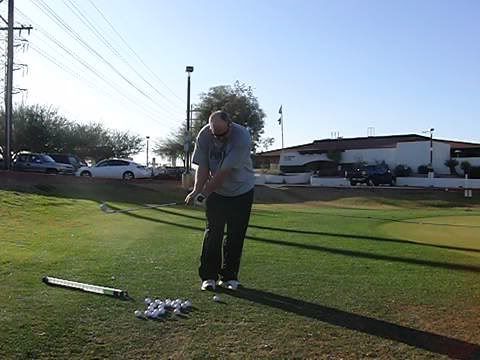 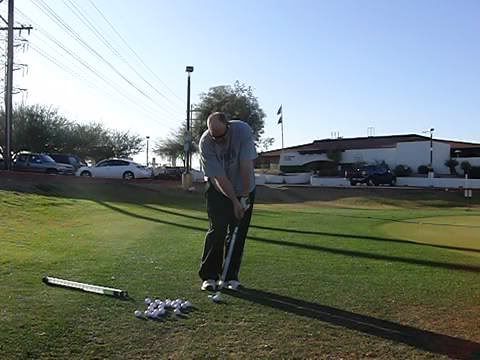 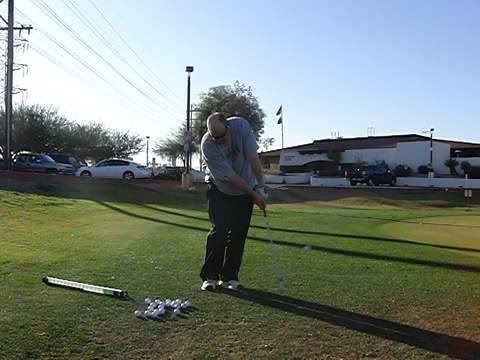 |
Greg,
In my opinion you can go a little further back for acquired motion: Quote:
Kevin |
I think the light bulb is going off a little. The key for me while working on this basic motion was gradual acceleration of the club head with deliberate motion of the hands. In the past I would "shove" my hands to the aiming point with horrendous results. If I work the hands to my aiming point as described I can feel a effortless "unwinding" of the club head into impact. It will be interesting now that I know the "feel" I want with my hands how this translates to longer clubs and swings.
|
Quote:
Research the "Three Stations", Address, Top and Finish notice that it doesnt include Impact. "Let the Motion make the shot". "Steering". This is great stuff only owned by digging it out of the dirt in Basic and Acquired. |
Lynn told us a while back that Homer thought The Basic Motion Curriculum of 12-5 would be his greatest contribution to golf. For those of you that dont own the book for fear its too confusing, buy it and skip to 12-5. It is a "non technical, simplified ", step by step approach to improvement that starts with simple little shots and then adds component variations bit by bit until you are in Total Motion.
Its a recipe for learning which references and catalogues the required components. Like an abridged digest, a "cheat sheet" or whatever. There are three lists: Basic Motion, Acquired Motion and Total Motion. They're too long to write out here but its all right there in the yellow book, for those who want to get better. Its also a great way to warm up, even for some guys who make millions of dollars a year playing the game. |
Its interesting now that I have a better grasp at what I need to be doing some of the of the other instruction makes more sense now, such as the tracing.
I just hit some balls and all I can say is the hits felt "heavy", great divots. |
Hotlanta...not so much
Quote:
The pictures look good. |
Darryl,
You are correct per page 28 of the 7th edition when the #3 accumulator is zeroed out in basic motion the clubhead travel and rythym will be that of an angled hinge. However the hinge action can still be horizontal with the toe of the club pointing along the plane line, angled about 45 degrees across the plane line, or vertical about 90 degrees across the plane line with the clubface looking at the sky and alway with a flat left wrist vertical to it's associated plane as stated in paragraph 2 on page 28. Hinge action by definition is holding the flat left wrist vertical to one of the three basic planes and it can be varied in basic motion to achieve a desired result. Sorting Through the Duffer's Bible. B-Ray |
Quote:
|
Quote:
If you zero #3, all hinge action effectively becomes angled hinge action in rhythm, but you can certainly do all three hinges with zero #3. |
Quote:
You made duplicate "Hinge Motion" by zeroing #3 but you cannot duplicate "Hinge Action" using this procedure. Quote:
It may look like a duck, walk like a Duck and quack like a duck. But it might only be "Daffy Duck".  Quote:
Oh? I forgot. What is the Title to 2-G? Could someone look that up? I don't have my book in front of me at the moment. Oh wait, I remember...."Hinge Motion" :laughing9 |
This has resolved me to do a lot of basic motion work during the rest of the winter.
1) Is it more important to work on the 2 feet back, 2 feet through or should there also be a target? 2) Is it advisable to use the Taly when practicing the basic motion? 3) As before, is there any club more preferred to work with? 4) Amazingly the limited practice facilities at my club do include any area big enough to work on basic motion. Is it a case of getting a big pile of balls and working away for 30 minutes or so or is a more structured from more appropraite? Thanks in advance. |
Daryl,
We may be beating Daffy Duck to Deaf or Death, but where in the book does it say Hinge Action requires #3? 10-10-0 is titled Hinge Actions (Hinging) In all the pictures associated with Hinging/Hinge Actions the Hinge is mounted on the left shoulder, not the left wrist. These are the three motions we are talking about Horizontal, Angled, Vertical regardless of maximum #3 or zero #3. Sorting Through the Golf Nut's Catalog. B-Ray |
Quote:
Quote:
|
Great thread,
Yoda descibed my stroke with the hands too low as a "sea of compensation" :eyes: Feels really weird with the on-plane right forearm at fix. But also extremely solid through the ball. So now I am practicing basic motion in the garden. A little turf, a club and three balls is all that's needed. Question: What are the quality criteria as far as ball striking goes in basic motion? I try to approach this as I would approach the short game. Solid ball contact, trajectory & distance control. With proper stroke execution. Just want to know if I have the right focus here. Maybe I should just pay attention to alignments an disregard the result? |
Quote:
I like the "maybe I should" part...forget the ball. Is my Left Wrist Flat? Am I pointing at the Plane Line? Did I arrive at the Both Arms Straight Position? |
Thanks Ted,
Actually, the "sea of compensation" comment made a big difference to my motivation. A few years ago when I took lessons (sometimes frequently) I became used to hear that I was doing fine. It worked for quick fixes but not for building a proper stroke. And certainly not for self correction while playing. I guess the pros lowered their expectations because I'm a bit like Homer was. I need explicit & precise knowledge. The thing I am sensing now while working on getting the right forearm on plane is that the lower the forearm is at fix compared to the inclined plane, the longer the right elbow will be below the inclined plane in the down stroke - and the longer I can drive effectively with my right hand. Does that make sense? There is a substantial risk that I will keep drifting towards the old low hands' fix. But there is also a risk that I overdo the changes if I put my mind into not drifting back. For a perfect impact fix: What should the (mirror) image of the right forearm on plane look like down the line? Should the clubshaft be parallell to the center of the forearm or should it point at the inside of the elbow joint or what? I hope I'm not the only one who wants to know this. |
1 Attachment(s)
Bernt,
I hope you don't mind my continued interruption, but I feel passionate about this. In my 40+ years of playing golf, NOTHING has had such a profound impact on my ball striking and understanding of alignments than the level left wrist and right forearm on plane has. NOTHING. Hard work? You bet Hard habits to break? You bet Worth the time and energy? Every minute I found this picture in Yoda's archives. Don't over-think this, just try to mirror this "feel" at first. Kevin |
mirror parallax
Quote:
Quote:
The best-case scenario is a video camera, a computer with software, and a monitor near the ball. This would eliminate the mirror parallax. In the mirror, the eyes are off Plane, making it difficult to draw conclusions. |
BG Address Position For Lefties
1 Attachment(s)
Quote:
:salut: |
Quote:
Why do you assume hinge action OR motion means anything other than compression (chapter 2)? Clubface control. I don't care if you use your elbow or your toes to hold the club, if you impact the ball, from impact to separation, there is a hinge action - the type of action determines the efficiency of compression. Closing only - horizontal Closing and layback - angled layback only - vertical It has nothing at all to do with the amount of #3, it is all about how the ball and clubface come into contact, compress or leak, and separate. While it may be best monitored via the left wrist - it is, and always will be, chapter 2. The ball only knows what the club tells it. |
Quote:
I had to go out in the garden and try a few strokes. Your description fits perfectly with what I always do. I've done it on purpose for years and it has become second nature. With all clubs but the putter. It is buried in my golfing soul to so. Probably a compensation from the early days where my left side had a tendency to quit. I am as lefty as they come and it is almost a miracle that my right side is able to hold on to the club as well as it is. I was able to hit the ball about 165 yards or so with a 5 iron in my first season - with a follow thru of about 5 inches towards the target and 2-3 inches towards china. Anyway, after reading your post I was able to take a stance with a level right forearm. I've always braced the left side with my right arm. And I have done it by pushing from the right shoulder. By thinking of the "arm" I needed to low point it just felt right to ease up the right shoulder. The left side feels a lot looser now and in a state of relatively flimsy way, but for the first time that I can remember I can feel balanced and relaxed with a level right forearm at address. Heck, I could even "see" the shot. So I had to do a couple of strokes too. And I could feel extra power through the ball. Didn't have to do more than two to be absolutely certain that I'm on to something that is important and for real. Now where are those revelation smileys when you need them? Yoda, Many thanks for the Brian Gay mirror image Yoda. I think it is time for me to change my screen saver.:-) Even with a new level right forearm I still have got my right elbow somehow covered by the right hip. But now that I am able to level my right forearm without feeling like a battle of opposing forces on the inside maybe I can do something about that too. It's not that I haven't been aware that my setup and stance have been odd. It's just that I have never been able to do what the good players do and still be able to hit the ball. This is possibly the best diagnostic piece of golfing advice ever that has made it all the way into my stubborn, need-to-understand-everything head. You cleared the path with your shotgun diagnosis, Yoda. I hope you take it as a compliment cause I wouldn't have accepted it on face value from many people in the world. And your post just nailed it YodasLuke. I have a feeling that this was a huge milestone for me. And I am very grateful and in the mood for celebration. :occasion: |
| All times are GMT -4. The time now is 11:05 PM. |