
|
Clubshaft orbit through the impact zone
It is my understanding that the clubshaft should always remain on-plane when it is swinging through the impact zone (which I will loosely describe as being between the third parallel and fourth parallel) and I am under the impression that this rule applies equally to swingers versus hitters.
The orbit that the clubhead will transcribe during its passage through the impact zone will be circular, and the size of the circular orbit must be related to the angle of the inclined plane - being smaller for a shallower inclined plane (eg. elbow plane), and larger for a steeper inclined plane (turned shoulder plane). The hands will also move inside more quickly if the circular orbit is smaller - eg. Hogan's swing where his clubshaft is slightly below the elbow plane (closer to the hand plane) during its passage through the impact zone - and that it is not dependent on whether a golfer is a swinger or a hitter. Do you agree, or disagree? Jeff. |
Jeff. I am confused. When you say "the clubhead will transcribe during its passage through the impact zone will be circular" what is your vantage point?
|
jeez, all this so you can go back to ISG and shout "you're wrong" at people.
:rolleyes: |
Toolish
I presume that we agree that the clubhead never travels in a straight line and that its path is always circular. Here is a tracing of Kevin Na's clubhead arc through the impact zone. 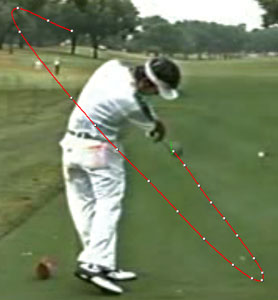 Although the clubhead arc is circular as the golfer traces a SPL, the clubshaft lies against the surface of the inclined plane as it travels through the impact zone - as seen from a DTL view. In that sense, the clubshaft must stay on-plane against the surface of the selected inclined plane (eg. elbow plane) during its passage through the impact zone. Jeff. |
Quote:
This "Golf for Jeff" forum allows any LBG forum member to post their opinions regarding golf mechanics/biomechanics/geometry/physics without fear of censorship - in contrast to ISG which doesn't allow contrary minority opinions that are unpopular. I will only censor comments that are overt ad hominem attacks. There will no flame wars in this forum as long as I am moderator. You, or any other LBG member, are fully entitled to prove me (or another forum member) wrong on any golf swing issue as long as the post doesn't contain unnecessary ad hominem insults. In fact, very vigorous debate is highly encouraged in this forum as long as the poster doesn't indulge in non-decorous behavior that degrades the "quality" of this LBG forum. Jeff. |
no, shank you
Quote:
“2-F… Regardless of where the Clubshaft and Clubhead are joined together, it always feels as if they are joined at the Sweet Spot – the longitudinal center of gravity, the line of the pull of Centrifugal Force. So there is a “Clubshaft” Plane and a “Sweet Spot,” or “Swing”, Plane. But herein, unless otherwise noted, “Plane Angle” and “Plane Line” always refer to the Center of Gravity application. Study 2-N. Except during Impact, the Clubshaft can travel on, or to- and – from, either Plane because the Clubshaft rotation must be around the Sweet Spot – not vice versa. So Clubhead “Feel” is Clubhead Lag Pressure (6-C) and is a Golfing Imperative. (2-0). If Lag Pressure is lost the Hands tend to start the hosel (instead of the Sweet Spot) toward Impact – that mysterious “Shank.” When in doubt, “Turn” the Clubface so both the Clubshaft and Sweet Spot will be on the same plane at Start Down. Both Planes always pass through the Lag Pressure Point. Study 6-C-2-A.” |
YodasLuke
I think that the difference between the clubshaft line and the imaginary straight line between PP#3 and the sweetspot is comparatively very small, and I am happy to reword my question to fit your requirement "that the sweetspot plane should be constant through the impact zone". The only point that I am attempting to make is that a golfer should continuously trace a SPL through the impact zone - and that includes the post-impact period - and that the resultant hand arc shape will depend on the angle of the inclined plane. Jeff. |
The hand arc will also depend on release type, no?
|
Toolish
It is not clear to me why you would think that the hand arc path near impact and post-impact would depend on release type. My main interest, in posing this question, is whether the hand arc post-impact is relatively "fixed" for a good golfer who stays on-plane - because his hands have to move along an overall arc that depends on the angle of his selected inclined plane through the impact zone and the "fact" that he needs to continuously trace a SPL while his hands move through the impact zone. Jeff. |
clarity
Quote:
Quote:
|
Yodas Luke
I agree with you - being exact is important. I appreciate your "corrective" comments. That's what's so nice about LBG-website's different forums - many forum members think deeply about the golf swing in an attempt to understand it "correctly" and understanding it "correctly" requires paying strict attention to all the complex details. It would have been much better if I used the word "hand" instead of "clubshaft" in my title, because I was really interesting in addressing the issue of movement of the hands post-impact. Jeff. |
ISG readers just got sick of the "he said you said" where it was not appropriate to the majority of those reading in that forum. So Jeff was asked nicely to take his ball elsewhere. He did not, so now he is indeed barred. Sadly the cheers were loud.
|
What's on plane?
Jeff, keep on going.....
There are clubshaft, center of mass for the club-COM and sweetspot. Under centrifugal acceleration, from what I gather so far, I think the grip-end of the clubshaft points to the COM and the line linking them lies in a plane. Shouldn't this be the optimal condition ... least swing effort? I also believe now that at impact, the sweetspot on the clubhead lies in front of the COM. Is it on the same orbit as the COM? Should it be in the same orbit in a well-designed golf club? |
#3 Pp
Quote:
|
chbkk
It is my understanding that Homer's on-plane concept is a general concept designed to keep the clubshaft on-plane throughout the entire swing and not specifically targeted to keeping the clubshaft (or sweetspot) on-plane in the immmediate vicinity of the impact zone. I think that if a golfer gets his clubshaft on-plane throughout his entire swing, then he has developed an idealised clubhead arc that will in-to-square-to-in and that will enable him to square the clubface at impact. Here is my idea of an idealised clubshaft on-plane swing - Anthony Kim's swing. http://www.youtube.com/watch?v=ZJyqplX4sRc The issue of the clubhead swivelling into impact is a separate issue. I actually think that it happens automatically. Have you watched an Iron Byron machine in action? It has a universal joint that is totally passive. The clubhead swivels automatically to allow the clubface to become square at impact. There is no device in that macahine that actively causes the clubface to become square at impact. I think that many golfers (swingers) shank the ball because they have stiff wrists which prevents the automatic release swivel action from happening naturally. Jeff. |
Deja vu
Quote:
Quote:
If you're the guy looking on the same plane as the fragments of debris that create the rings of Saturn, you'd insist you were looking at things traveling in straight lines. If your eyes move off of that plane, you'd insist you were looking at circles. I would spend a lifetime in 2-J-1, 2-J-2, and 2-J-3. |
Yodas Luke
I have a different perspective of an observer's observation conclusions of Saturn's rings - presuming that the observer stands sufficiently far away from Saturn. Regarding Saturn's debris, if one was on-plane with the moving debris, one wouldn't think that the debris moves in a straight line if one had binocular vision. One would see that the debris was moving in a circular path along the surface of an an imaginary plane that was straight-in-line with the observer's position. If one was standing off to the side, one would still see debris moving in a circular manner, and one would be able to imagine its circular orbit being along an orbital plane that is angled relative to the observer's position. When watching someone twirling a stone attached to a string in a circle around his head, I would never perceive the stone to be traveling in a straight line - no matter what the angle of the observation point relative to the orbiting object's orbital plane. Jeff. |
presumptions
Quote:
So, a claim of an On Plane motion with a camera that is not On Plane is a guess, no matter how 'educated' the guess. If someone challenged your claim that Kim was On Plane and required proof, you would place the camera On Plane to provide proof. |
Quote:
|
Luke
Lensing issues aside where is it best to position a camera for a down the line swing? On the base line, opposite the hands or? Thanks OB |
Jeff, you said "The issue of the clubhead swivelling into impact is a separate issue. I actually think that it happens automatically. Have you watched an Iron Byron machine in action? It has a universal joint that is totally passive. The clubhead swivels automatically to allow the clubface to become square at impact. There is no device in that macahine that actively causes the clubface to become square at impact. "
For Iron Byron, I have tried to find more information through google without success. I would love to hear how the clubhead can do a 180 degree swivel unpowered (i.e. only by inertial forces). I can learn something here. Thanks in advance. |
I thought Iron byron had stiff 'wrists' and Pingman had the more flexible joint there?
|
the camera's eye
Quote:
I've heard some suggest that the camera should be placed at shoulder height. Those that use this height suggest that it comes closer to the teacher's eye level view. It's my opinion that it's less important what the club is doing at Top or End. I feel it's more important to see what the club is doing from Release through Impact. I have also heard suggestions that the camera should be placed on the base line. The only way this would be possible would be to have the camera's eye looking through the back of the ball. I've never seen it done this way. Another way would be to have the camera follow the club up and down the Plane. I have no idea what this would cost, as you'd have to have some way to match the Acceleration Rate of each player. You'll notice that many of the videos that we see, as in Kim's video, are taken by a cameraman that has the camera on his shoulder. Additionally, he's standing off Plane. This is fine for TV, but it's not good for analysis. As you've seen in some of the 3-D pics that I've placed on this site, you can place the camera's eye in many places. This technology is obviously the future. But, I'm going to wait until it's less than $250,000. For now, I'll have to remain in the Dark Ages, using video. |
Thanks Luke
I have never thought of moving it off the elbow plane to adjust to the players chosen backswing plane or downswing plane. Makes perfect sense. Sorry for thread jacking but while we are talking planes: The Butch Harmon laser trainers have one light pointing out the grip end and another one pointing from approximately the #3 to the sweet spot (coincidence rather than TGM compliance probably). With constant back and forth swinging you can get the two ends to trace a straightish line from horizon to horizon along the target line , albeit with some wobbling as the sweet spot laser rotates off the inclined plane to the sweet spot plane. Do you know of another or maybe better way of practicing plane compliance? If so please share it. I have the Harmon lasers and find them to be very helpful although my neighbours must be wondering what the heck is going on in the dark of my living room. They can shine out the windows and on to trees etc. OB |
Quote:
|
Toolish
I should have stated Iron Byron-type machines. I have never seen the original Iron Byron machine. I have only seen one version of that type of club-testing machine at our local golf practice facility. It is a very advanced machine, which they call Robo-Fit. It has an universal joint that allows the clubshaft to rotate about its axis. chbkk I don't have a conclusive answer as to how the clubhead swivels automatically in an Iron Byron-type machine that has an universal joint. I have previously thought that it relates to the COG of the clubhead's mass relative to the hosel, and I have presumed that the offset COG of the clubhead causes the clubhead to swivel around the clubshaft's axis. If you establish a conclusive explanation, please let us know. Here is a link to the company that makes the machine. http://www.golflabs.com/home.html Here is a link to a comment about the wrist joint http://www.golflabs.com/robot_sales_2.html I wonder if nmgolfer can work this problem out mathematically. Jeff |
making glue
Quote:
The Clubshaft is not the axis of rotation. It is the club's COG that is the axis of rotation. It's a stumbling block that is supported by the use of a Plane board. Many times, I've used the example of a lathe. A baseball bat is symmetrical, and it's made on a lathe. When the bat is finished, it can be spun at any speed (RPM's) and it doesn't wobble. A golf club is not symmetrical. If you place the golf club on the lathe and use the shaft as its axis of rotation, you need to seek cover when it's spun at high speed. On the other hand, if you use the club's COG (a line from the #3 Pressure Point to the Sweet Spot) as the axis of rotation, you can stand and watch. There's no danger of the club flying off the lathe. Using the Clubshaft as the axis or rotation is not logical. If we assume that your argument above is true, you would assume the force that would quickly swivel the Clubhead around the Clubshaft would be a divergent force vector. The resulting wobble would pull the Clubshaft off of the Plane Line that you were attempting to trace. It results in scattered force vectors, and a less than perfect application for compression. It is the club's COG that must trace a straight Plane Line, not the Clubshaft. Are we even remotely in agreement? |
Geared swivel of swing machine
Jeff.
Thanks for the links. Not universal joint though. It looks like synchronized shaft rotation with uncocking action through gears. Wish I could have similar arrangement on my wrists. :p |
Yodas Luke
I can understand the concept of using PP#3 to aim the sweetspot of the clubhead at the base of the inclined plane as one traces a SPL. However, I have a hard time understanding how the hosel rotates around the sweetspot-to-grip axis - especially with respect to the Robot-Fit golf club testing machine. I would like to read your explanation of how the clubface passively rotates to square by impact in that machine. Jeff. |
Quote:
http://www.golflabs.com/Images/tse_4.jpg I talked to Paul Wilson of Swing Machine Golf who has seen up close (and met the designer of) Iron Byron and he says it too has gears to close the club face 90deg in the downswing. They did because its part of the deceleration mechanism (shafts were breaking post impact without gears controlling the decel) and because Bryon Nelson did it. He said they all do (swing machines) so I guess *(and it looks like in the video it must)* pingman does as well. I see no reason why the club face would open/close on its own as a result of interial forces. |
painting and robots
Quote:
An analogy that I use is painting a line with a wide paintbrush. Start painting a thin line with the wide brush. As you continue the line, start twisting the brush so that the line becomes wider. Finish the line with the line becoming thinner. The center of the brush (the Sweet Spot) traveled on the same line. The top and bottom of the brush (the toe and heel) rotated around the center, and they travel from on-to-off-to-on the line. Secondly, as far as the robot goes, it's been so long since I've given a robot a lesson that I can't remember what it does. :naughty: All kidding aside, I made a phone call to a friend that works for a company that has one. I'll ask him about it as soon as he calls me back. |
Yodas Luke
I can understand what you state about the hosel rotating counterclockwise around the sweetspot axis when the clubface closes - from a conceptual perspective. However, it doesn't "feel" like the hosel is rotating around counterclockwise when I swing through impact - even though I can understand the concept. I can easily understand the painting brush analogy because the handle is in the center of the brush, and the brush ends are rotating around the sweetspot which is inline with the handle - because in that situation the handle stays centralised while the brush twists. I find it harder to mentally picture the situation if the handle is at one end of the brush and there is a straight line relationship between the grip end of the handle and the one endpoint where the handle attaches to the extreme end of the brush - because the handle will have to twist with that end of the brush. Jeff. |
a paint roller
Quote:
Have you seen a lathe in action, and do you get that analogy? |
Nope...
The CG of the club (any club) is not on the sweet spot ... its at a point in space. But the club face sweet spot is connected to the hands via the hossel and shaft not some imaginary line connecting it. If it were not constrained by hands gripping the shaft connected to the hossel, the face would want to open (not close) on the downswing as the inertia caused it to want to line up with hossel on the plane.
|
Quote:
thanks (ok i admit, i shanked a few last outing...need help!!! :crybaby: |
Jeff....
Hold a golf club between the tips of your fingers at the end of the grip so the club dangles vertically. Now twist it in your fingers, note how the shaft moves around the COG of the club, not the head moving around the hosel. A robot with fully flexible wrist joints won't know where the shaft is...it will know where it (the robot) mounts to (grips) the club, and where the COG is. As the club is swung then the plane through the COG will be what the robot can "sense" as centrifugal force will not be pulling down the shaft, but rather through the COG. |
bar trick
1 Attachment(s)
Quote:
The COG of the fork and spoon is not inside the fork or spoon. But, we can identify that the Z axis of the COG runs through the edge of the glass, where the toothpick rests. I'm sure that this is the point that you're making. But, it's a nice trick to leave the waitress. It's a real head scratcher. :shock: There can be a rotational center that runs through the COG, and this is what we're seeking. We're looking on the Z axis, as a center of rotation could be found on other axes. The Clubshaft cannot be a center of rotation, since there is nothing on the underside of the hosel to counterbalance the Clubhead. |
Quote:
Unless a golfer's grip slips (not recommended) the clubface maintains the relationship it had at the time the grip was taken to the back of the left hand. Because it is anatomically impossible to get the left hand "back and up" there (top of the backswing) with out some rotation, the face fans open on the way up and closes again on the way back down. (And it is unfortunate that the process is likely not anywhere near as precise as with a set of high quality gears... ala iron byron). This has nothing to to with angular momentum vectors axis of rotation or lathe imbalance forces either. |
robots or humans?
Quote:
Instead of having "nothing" to do with Angular Momentum, would a delay in the closing have something to do with Angular Momentum and/or an axis of rotation? |
Quote:
As I was thinking about issue this I asked myself: why would they would they design clubface rotation into the swing machine since it complicates the machine (one more DOF to contend with). I made a call and the answer was because that was the way Byron Nelson (the model) did it and also because they found they needed gearing there to help manage the deceleration. (It took Battelle 3 years to develop the iron byron and initially they were breaking a lot of shafts). Then I asked myself why does iron Byron Nelson and everyone else fan the face open on the backswing? The answer to that is... TRY IT. You can't not. As far as leaving the face open at impact goes (delay in closing?) bottom-line is golfer's left hand is not getting back where it was at takeaway. Many golfers look a lot different at impact than they do at setup... hands may be way forward... shoulders too open or too closed etc. They can compensate for different impact positions by intentionally (closing usually) the club face at set up. (You would be amazed at how "toe-in" my dad sets up with his driver but it works for him... he's ALWAY down the middle) That way when they get back to impact the face is aligned where they need it to be. Get the back of your left hand back to facing the target at impact (like it was at se-up) and your club face will be fine...... |
| All times are GMT -4. The time now is 04:52 AM. |