
|
Application of ACCs-2-3
Can someone please explain the application of Acc 2-3,the books states 2 before 3,thats well and good but to me it all has to be done in the one action.At the point in the downswing to impact,I find it impossible to seperate indeed ,thats the basis of my question,in essence,why should we even try,isnt it just as easy to improve that section by treating it as one componant keeping in mind that its the full swing im refering to here.
Please dont just fob this question off by saying something like read the book!,I beleive this is a very if not the most important segment of swing... Looking forward to valuable input....Thanks in advance |
I think the key is the sequence, you can't roll before you unhinge, and yes I've seen people do it!! Especially when you visually confirm the accumulators coming in-line with slow motion training is the sequence important.
|
Voodoo Magic of #3
I think the transer power of the # 3 is voodoo magic! I have also wondered how it "knows to roll." When I hammer on plane # 3Acc roll seems to be programmed to transfer the velocity # 2 Acc. Kinda like playing hot potato! It is amazingly smooth...and fast. Does it have something to do with divergent vectors? The feeling I have worked hard to cultivate is the left wrist throwing out by the right shoulder once the club head is outside the arc of my hands. In essence this produces the DOWN (on an inclined plane you get OUT for free!) What produces that roll is a mystery to me...all I know is that it is not a manual manipulation on my part! Great question!
|
I started a similar thread on the topic of PA#3 release in the advanced section.
Okie - Regarding the magic of PA#3's roll action, you wonder what makes the left hand roll into impact. I suspect that the major factor is the movement of the right palm. At the delivery position. the right elbow is still bent at a right angle and the right palm faces more-or-less in the direction of the ball-target line. Then, during the release swivel phase of the downswing, the right elbow straightens and that causes the right forearm to paddlewheel into impact so that the right forearm is behind the shaft at impact and the right palm faces the target at impact. That means that the right palm moves through a 90 degree rotation during the release swivel phase of the swing, and that phenomenon should roll the left hand over (= release of PA #3). On page 73 of the 7th edition, HK states-: "The "On plane" Right Forearm ALWAYS establishes and maintains the correct clubshaft-left arm angle through release and impact". Jeff. |
I produced the following series of images to supplement my previous post.
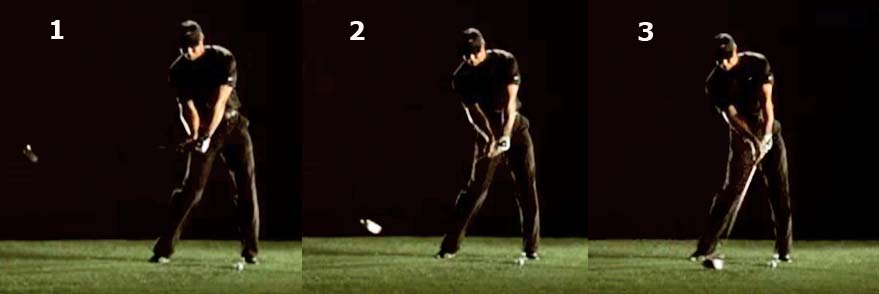 The sequence of the three images shows how the on-plane movement of Tiger Woods' right forearm during the release swivel phase of the swing causes the right palm to rotate into impact - thereby causing the left hand to roll into impact (release of PA#3) Jeff. |
Station 23
Quote:
You guys have by far a much greater knowledge of this MACHINE than I and I really value your input,I have asked this question on other sites with very poor response. I think that this area of the swing is greatly overlooked by so many,most guys are trying to look good in the B/swing and the high finish that they dont pay nearly enough attention to this area. Jeff,your comments really bring home "the magic of the R /forearm" in my mind,I am putting a lot of attention into learning this section and their componants,but being an average joe Im treating this section as my "station23" not trying to seperate the ACCs #2-#3 but treating them as one for easier understanding(for me) Slightly off topic,the great pics of tiger,if you have a look at the travel of the hands between each thigh plus also the comparitive distance travelled by clubhead in relation to each other is there a corelation with the kinetic chain in golf swing? Thanks again for great input guys |
Quote:
Also when you are looking at number 3 accum and its rate of roll out it can vary depending on the arc of the swing and how it can be influenced |
Brownman
I think that PA#2 and PA#3 release near-simultaneously in TW's swing because he has a late release. He gets his right elbow in front of his right hip and he still has a 90 degree angle between the left arm and clubshaft (still has a fully loaded PA#2) at that time point (image 1). Therefore, his PA#3 is releasing (under the control of the on-plane right forearm - as the PA#1 passively releases) while the left wrist uncocks. By contrast, PA #2 must release well before PA#3 in golfers who use a sweep release or random release - because PA#3 release only occurs during the release swivel phase of the swing (when the right forearm moves on-plane into impact). You wrote-: "Slightly off topic,the great pics of tiger,if you have a look at the travel of the hands between each thigh plus also the comparitive distance travelled by clubhead in relation to each other is there a corelation with the kinetic chain in golf swing?" I don't understand your question. Why are you trying to relate the clubhead travel during the release swivel phase of the golf swing to the kinetic chain? What part of the kinetic chain link are you thinking about? Pistol I think that PA #2 and PA#3 are releasing near-simultaneously in TW's swing because he has a late release, and not because he is a hitter. I cannot see anything in TW's swing that suggests a hitting action. He has many swing features that suggest a swinging action. 1) He employs a start up takeaway swivel action that causes the back of his left hand to face the ball-target line at the end of the takeaway and the toe of the club points upwards - while hitters resist any startup swivel and keep the clubface looking at the ball during the takeaway. 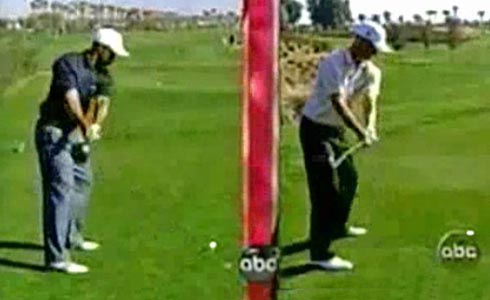 2) He has an extra 1/4 rotation of the left arm at the end-backswing that gets his clubshaft to be parallel to the ball-target line. Also, the relationship of his right forearm to the left arm flying wedge at the end-backswing fits the pattern of a swinger rather than a hitter. 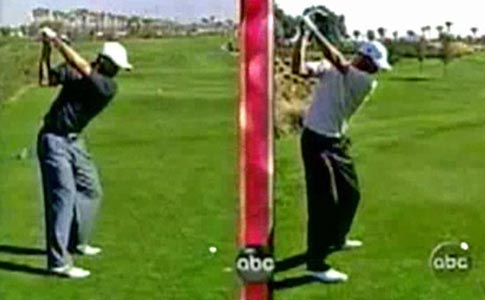 3) The back of his left hand is parallel to the plane during the mid-swing as his hands slide down the plane. 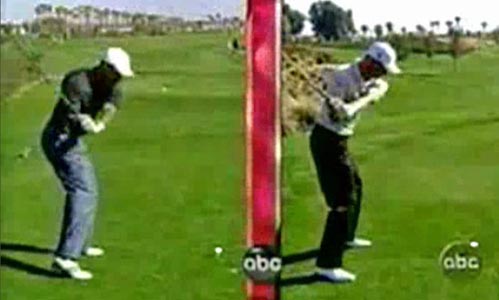 4) He definitely has a distinct release swivel action where release of PA#2 precedes release of PA#3 (although there is considerable overlap due to his late release action). Watch this swing video and you can see that PA#2 release precedes left hand rotation (release of PA#3), which occurs in the last part of the late downswing . http://www.youtube.com/watch?v=XPJtK-DxnV4 Jeff. |
Quote:
|
Pistol
I suspect that there is another factor that is responsible for the roll of PA#3 and that it is related to pure physics. Have you ever watched an Iron Byron-style machine in action? It has a passive universal joint at the peripheral hinge point - where the club is attached to the central arm. That universal joint allows the grip to rotate freely in all directions. During the Iron Byron's release action the club automatically rotates to become square at impact. How is that possible if there is no active force causing rotation of the grip end of the club? I believe that it is likely due to the fact that the COG of the clubhead is not in line with the clubshaft, which means that there is a natural rotary force occurring with respect to the clubhead-around-the-axis-of-the clubshaft that causes the clubhead to automatically rotate to square by impact. Jeff. |
Quote:
|
My station 23
Quote:
As far as my mention of the KINETIC chain,it was merely a question in relation to a kinetic link on Manzella.s kinetic chain vid where the lower body reaches a point where it allows the upper body to "catch-up" so to speak to keep or maintain the kinetic link....my comments where more of a query more than anything specific...just an observation tis all...and my friend Im not saying Im right...Cheers |
Quote:
As you stated above, being on plane to begin with. But let´s not forget about which loading the player is intending to use and thereby where the rear elbow is positioned. This would affect if the release is sequenced or simultanious. |
Brownman
You wrote-: "As far as my mention of the KINETIC chain,it was merely a question in relation to a kinetic link on Manzella.s kinetic chain vid where the lower body reaches a point where it allows the upper body to "catch-up" so to speak to keep or maintain the kinetic link....my comments where more of a query more than anything specific...just an observation tis all...and my friend Im not saying Im right...Cheers." Do you have a link to BM's video on the kinetic chain? I have read the thread on his website re: kinetic chain and I couldn't find one informed post. I have two questions for anybody who believes that snapping the kinetic chain is essential for the club to release in a golf swing. 1) How does the club release in the Iron Byron' swing where there is no kinetic link, and only a central arm rotating in space at a finite speed with no sudden deceleration prior to impact? 2) When I perform a left-handed single arm swing by simply swinging my left arm at an uniform speed across the front of my body (after allowing the clubshaft to acquire a 90 degree angle relative to the straight left arm at the top of the swing), I can easily/naturally/automatically/passively get the club to release in a natural manner without moving my body in space (in a kinetic link pivoting manner). How do I achieve the goal of releasing the club in a natural manner without any kinetic link phenomenon and without decelerating my left arm? Jeff. |
Manzella,s kinetic link
Hi Jeff,Manzellas vid is on youtube
Brianmanzella golf show video #8 Cheers |
Station 23
Quote:
|
Pistol
You wrote-: "Jeff there seems a lot of factors involved in #3 accum roll power and controlling it may well be the most important part of a swing..it seems a subject that is avoided simply cause its complicated." I agree that there are a lot of factors involved in PA#3 rollover, but I don't think that is requires conscious action to control these factors because they occur naturally. I have previously mentioned two factors that affect the PA#3 rollover action. 1) The on-plane movement of the right forearm pre-impact which causes the right palm to face the target by impact and 2) the physics of the clubhead/clubshaft which causes the clubhead to roll over naturally during the release phase. Consider a third factor. If a swinger performs a right forearm takeaway action the right hand gets to the end-backswing position and ends up like a waiter holding a tray of dishes. The left hand has to follow the right hand because they are conjoined at the grip. If one keeps the left arm straight and prevents the left wrist from bending, then the left arm is obliged to rotate clockwise during the backswing - so that the watchface on the left wrist, which faced the target at address, faces slightly skywards at the end-backswing position. During the downswing, when the shoulders rotate to a position that is parallel to the target line, or slightly open to the target line, then the left arm will have a natural/automatic tendency to rotate counterclockwise to its resting state (the back of the left hand will face the target when the left arm hangs down naturally from the shoulder). In other words, release of PA#3 (roll over of the left hand) occurs naturally if you do not interfere with its natural action, and it does not require conscious thought. One merely has to ensure that the right forearm is on-plane pre-impact, so that the right palm progressively faces the target as it reaches the impact zone. The combination of these three factors will allow the the left hand to roll-over naturally without any need for conscious thought. Jeff. |
Brownman
I reviewed that Brain Manzella video. Although he uses the term "snapping the kinetic chain" what he actually describes has nothing to do with a kinetic chain. Because I do not believe that the kinetic link model theory has applicability to the full golf swing, I could explain what he is saying without referring to the "kinetic chain". He is basically stating that it is important to hit against a firm left side. I also believe that it is important for two reasons. 1) If one braces the left leg in the downswing, and creates a "firm left side", then it stabilises the position of the lower spine during the mid-late downswing. If the head is kept back (so that the left side of the face doesn't get nearer the target) during the downswing, and one limits forward movement of the lumbar spine, then one creates the secondary spinal tilt that is necessary for the upper torso to rotate properly in the downswing - with the right shoulder moving downplane. That's a major factor in controlling the directional approach of the arms in the mid-late downswing. 2) If one braces the left leg in the downswing and prevents left-lateral swaying of the pelvis, then the upper torso and arms can rotate with more controlled power and allow for a solid compressive blow at impact. It is similar to a boxer who hits a knockout blow with his right arm driven to full extension. If the boxer doesn't brace his lead leg and lower body, he would simply fall-into-the-strike and all his potential strike-power would be lost. Jeff. |
kinetic link
Jeff,you can sit here and argue kinetics for hours if not months and still get no-where,we all have probably used the kinetic links to a lot of things in our life but been completly unaware of it,ie.skimming stones across a pond,cracking whips etc ,the list goes on and on,please dont tell me you dont believe in kinetics in golf application.....imo you would be errant,as for a boxer using a steady front leg to deliver a KO blow,WRONG,it is in fact the follow up movement of the rear leg that adds the power,trust me Im an ex pro boxer and I do know.
As for my station23,I am nearing 60,no intention of being a pro golfer,just looking to hit the ball using the info from Homers book and what I am learning from forums such as this great and VERY informative forum,My approach I believe is sound for what Im trying achieve,a sound and repetitive swing....Cheers |
Brownman
I believe in kinetic sequencing with respect to the full golf swing, but I don't believe in the kinetic link theory which espouses a COM principle - that external torque is inputted into the system when the golfer starts the downswing motion by "external torque applied as a function of translating ground reaction force at the feet into a force couple at the hips rotating the hips against the force of the ground" (Chris Welch's words) and that the momentum thereby generated is "fixed" and then transferred from one body part to another body part via the principle of COM. I can accept the first part of the kinetic link sequence whereby translational ground reaction forces allow the hips to start rotating, but I do not believe that COM is responsible for all (or most of) the subsequent rotational motion of the upper torso and arms. I certainly don't believe that the kinetic link theory has any relevance for golfers who use the Leslie King arm swing approach. http://www.golftoday.co.uk/proshop/t.../lesson11.html Leslie King states-: "Now, maintaining the shoulders in the fully turned position, we simply commence the downward swing of the left hand and arm. That is how the downswing starts, and nothing could be simpler! I stress again, the SHOULDERS MUST REMAIN IN THE FULLY TURNED POSITION at the beginning of the downswing! The same left foot action that has "charged" the hands with power is enabling us to control the shoulders. By keeping the shoulders fully turned the left hand and arm can swing freely from the left shoulder, taking the club-head down into the ball on a club line that will result in a swing into and along the line of flight through impact." What Leslie King is describing is the release of PA#4 via a left arm pulling action (left arm being pulled down to the ball by the left shoulder girdle muscles) rather than the usual pivot-induced release of PA#4. In this swing approach, the pelvis reacts to the pull of the left arm, which precedes the pelvic motion. I also don't think that kinetic link theory of a "fixed" amount of momentum being transferred from the hips => shoulders applies to the Hardy OPS. In the Hardy OPS, the golfer rotates the pelvis and upper torso simultaneously as single unit. Here is an example of an excellent Hardy OPS swing action. http://www.youtube.com/watch?v=Pu-wDdY8-g4 Jeff Ritter rotates his pelvis and shoulders at the same speed at the start of the downswing - as a single rotating unit. His pivot style is very different to the Hogan swing style of sequential rotation of the lower torso => upper torso. By the way, do you believe that followup movement of the rear leg supplies power in a golf swing? If yes, could you please explain your reasoning. Jeff. |
Quote:
Quote:
|
Pattern?
Sorry Amen,Please explain ....Seeing a pattern...Cheers
|
Quote:
|
hitters pattern
Oh ,I see,yes I have been using hitter pattern,but gone to swinger(trying) thanks pistol
|
pistol
I hope thats what you meant,Im no good on cryptics lol
|
Quote:
|
Hitting or swinging, jabbing or swinging a punch I bet you like to get your right shoulder close enough to the impact area before you thrust.
Being Canadian Im talking golf and hockey here, dont know anything about boxing. |
shoulder
close to it ,or thru it
|
"The "On plane" Right Forearm ALWAYS establishes and maintains the correct clubshaft-left arm angle through release and impact".
Jeff.[/quote] I say it is a combination of unicorn horn and pixie dust! Thanks. |
Quote:
Back to your original question. Per 4-D-0. Your simultaneous release of 2 and 3 might suggest you are hitting at release. Being an ex pro boxer that wouldn't surprise me in the least. A concentration on Hand Motion-#3, clubFACE, an active right tricept thrust, rather than Wrist motion-#2, clubHEAD, thowout, left hand karate chop, sequenced release etc. LUke will tell ya that the latter types are more like ballerinas than boxers. Me, I liked Ali, he could dance and hit. Double threat. |
platform 1
Quote:
As you can see I have named these different "stations-platforms" really for my own benefit as an easy learning method . Platform 1 is the combination of all componants to deal in take-away and backswing.... All by the way using strict TGM guidelines Call it silly if you like,but it helps poor old me,....Next part of my journey ???????? |
| All times are GMT -4. The time now is 12:53 AM. |