
|
Ah-Ha Moment 0001-2006
Today, after the better part of 2005 banging the head against the wall, I think I get it.
What I get is - YOU TRACE THE IMPACT PLANE LINE.... You don't trace the Plane Line...... You don't trace the Target Line (unless this is the Impact Plane Line). :smile: |
I'll bite:
how is the impact plane line different than the normal plane line? |
You can Trace either the Impact Point Plane Line or Low Point Plane Line with your Right Forearm. They produce exactly the same results.
|
Quote:
Look at 2-C-1. I realize Yoda says you can trace the Low Point Plane Line, but I would submit that this trace would put you to the outside of the point of impact which doesn't seem to be a desireable thing at least when at first mastering this. Plane Line definition, see 10-5. Baseline of the Incline Plane is the plane line which is not as shown in 10-5 the other lines. Simply put starting at the feet looking down with the ball located behind the low point you have a. Stance Line b. Plane Line c. Impact Line d. Line of Flight e. Low Point Line |
Quote:
|
Confusious Say...It's Confusing!
Quote:
I sense you are about to have a major "Aha!" moment. |
Quote:
We had a short discussion regarding Clubshaft's Plane and the Sweetspot's Impact Line. Reference Diag 1-L and 2-C-1#1. I made the statement that the sweetspot plane will always be flatter (smaller angle) than the clubshaft plane line (the inclined plane). You told me that I still hadn't grasped it or something to that effect. Along with this quest of mine is to accurately define the sweetspot plane and clarification of what is meant it goes throug PP#3. The Longitudal center of gravity, the line as Homer references is quite valid, but the description that it runs through PP#3 is incidental when stated it must be the aft of the shaft. Sorry off topic. Clearly looking at 2-C-1#1 you can see that sweetspot plane must be by defintion flatter. The order I gave the lines in stands and is supported by Homer's definitions (10-5 and 2-C-1#1). Part of where I am going with my quest is to validate the Full Plane Board. For a shaft to ride the surface, the Inclined Plane and the fact that the Sweetspot plane is flatter gives me a fuzzy picture. The Impact Line and Low Point Line do reside on the plane, the sweetspot plane. Anytime the ball is not at the Low Point, then these two line when projected on the surface will have separation (a visual thing) and the amount of separation is a function of the ball distance from low point. The further back the ball is the wider the lines appear. Thus my statement regarding tracing it may not be adviseable until the forearm move is mastered using the Impact Line. Given a square stance, the inclined plane line is parallel to the Impact line, to the inside and created by a different angle. The distance they are separated is determined by the distance between the hosel and sweetspot. One of my questions I am chasing is that to draw lines on photos and then attempt to use the clubshaft in reference to the lines seems to be misleading since unelss you are looking face on to the club (facing the toe and looking back to the shaft) you will not be monitoring the sweetspot plane/angle. Don't know if all this makes sense to you, I am still working on the details to get diagrams to validate. This includes Homers quick test for being on plane (parallel to the line or low end pointing to it and the low end needs to be the sweetspot or sweetspot line extension, I think) I could go into more depth, but this is already probably too much at this time. But the concept of tracing the sweetspot plane line makes 100% more cents than tracing the plane line. |
Finally I Got It....
Yup, finally got it. Only took, well lets not go into that.
After talking with a number of people over the years, Phd's included, I finally get it. 1. The Sweetspot Plane is something you FEEL that you are swing on. 2. The Sweetspot Plane is not something you can draw on a picture, it is FEEL. 3. The True Plane Angle should be defined and Impact and then applied backward to photo when analyzing them. 4. The Clubshaft Angle is set at Impact Fix is the most likely and accurate line you can identify for see the Inclined Plane. 5. All of this HAS TO BE TRUE, else Homer's Plastic Plane as shown in all the photos would be invalid. 6. 10-5 supports this. 7. 2-F supports this in the definition of On Plane. The Sweetspot Plane is just a Feel. Plane Boards wouldn't work, laser devices attached to the golf club shaft would be invalid. That is not to say you can't identify it, but a. It will always be flatter than the clubshaft plane b. It is dynamic in that as the clubshaft is move to this plane (see 2-F description of On Plane) it will be changing and I could go on... Now if you all are going to say no to this, then I would like to see a series of pictures of a golfer is swinging on the sweetspot plane and at impact is in that position as well including showing that the Forearm is on plane while the clubshaft is not.. Cause you can't have a clubshaft on plane, a forearm on plane and call that the sweetspot plane and state that the clubshaft plane (defined by the clubshaft angle at impact or lie depending upon setup). I wonder how many people really realize all the lines they are drawing are not the sweetspot plane. Even Homer addressed part of the concern regarding lie angle in 7-6. Feel vs Mechanical..... |
Easy Martee!
Afterall, it's only a few degrees of difference. Good enough for me :) But I always know which one I'm feeling... |
Quote:
|
The key thing you mention Marty is the 'feel' of the plane.
That feel is, without question - in the HANDS. So if you monitor the path and plane that the HANDS travel, that the force you generate is traveling, that of the pressure points. Bingo. There you have it. And to think, all this time it has been right in your HANDS! :) Simplicity buffs, see 5-0, 1-L, 6B-1D and 10-2-B, 2-0 A and B. Pay attention to the path, plane and force that your HANDS travel. |
But when you analyze the photos and videos, you can't draw the feel line. That has been the point I have been trying to address cause what is being said is it is the sweetspot plane angle, sweet spot plane line and that dog just doesn't hunt.
I have not issue stating you monitor and FEEL the sweetspot line, but that is not the actual path of the golf club. |
Hmmmm.....
Hang on. We got a guy overboard here (me). This is a great thread, and one that has smoke coming from my ears. But... Personally, I feel that impact planeline and lowpoint planeline are different animals. Both nocturnal, yes, but different. And I am seeing in 2-C (dual horizontal) two different planelines that will not produce the same results. Because the clubhead passes through both doesnt mean, to me, that either planeline can be used. Can anyone clear it up for me? Thanks. |
Quote:
Maybe this will help. When seeing both of these represented as lines on the ground you would see the Impact Plane Line inside the target line (between the ball and feet). The Low Point plane line would be on the target line. There is a difference between (space) them base on the distance the ball is from the low point. (can't locate reference, call it old age). Hinging not withstanding both will always be on the plane, this is not the incline plane that the clubshaft is on, but the sweetspot plane. The Lob shot would I believe require a different description but for standard strokes it is accurate. |
Quote:
Quote:
So...for any given point (in this case, impact), the clubhead continues downward to lowpoint (lowpoint planeline)...hence...I cant see how one could trace either and get the same result. Quote:
Patrick |
Ah icic what this is all about now....
Was making me crazy for a bit over here....seemed like it was too much for me to read when I'm all tired... So.....if you trace with the Clubshaft (i.e. keep the clubshaft pointing at the Plane Line)....TECHNICALLY, you'll hit it off the hosel....technically.... So either you trace just inside the Plane Line with it (the clubshaft)......or you trace with the (invisible, completely feel-based) Sweetspot Plane (if you connect a line between PP#3 [I assume it's PP#3] and the sweetspot of the clubface). I get it. |
When reading 2-C-1#1 remember that the Impact interval has been extended to Low Point (Homer has this statement in the first paragraph). Does that clear things up?
How you can trace either the impact line or the low point line since the ball could be located at low point, thus no difference in line. The Impact Plane Line and the Low Point Plane line reside on the same plane as shown in 2-C-1#1. The Low Point line is further down the sweet spot plane (lower) thus it presents a 2nd line outside the impact line when represented on the ground. I probably haven't explained this very well, but if you look at 2-C-1#1 and keep in mind the extended impact interval to Low Point, it should clear it up (I hope). |
Quote:
Your feel description has merit IMO for BUT if you were to draw lines on photo or vid to analyze the golf swing, this won't fly. There have been several threads over the past year regarding exercises and drills as well as what Homer wrote regarding how to test for being On Plane. In the latter, Homer using the Club Shaft as well as he did with his plane board and descriptions of the clubshaft against the plane. All of this is the clubshaft plane defined at Impact. The exercises were what really tossed me for a loop. Clearly Yoda taking the Dowel and spear fishing from the top showing the deliver line, or Chuck with his golf ball thrown at the ball. It does show the concept but incorrectly. It should not hit the ball but hit to the inside of the ball as what they are demonstrating is the travel of the golf shaft to the plane line, the club face sit to the outside of the club shaft. They demonstrated a bent plane line and if the club was deliver as such, it would have in fact been a hosel hit. My understanding does confirm Homer's points. The descriptions and instruction being given if applied to analysis is incorrect. This is Feel vs Mechanics, analysisis mechanics. Sorry for the rambling length, but blind acceptance or misunderstnading is something that just didn't fly with me on this topic. |
Quote:
Quote:
Quote:
Quote:
Let me see if I cant get my thoughts better organized and more concise. While I agree, both impact and low point are located on the same plane, my contention is, from a players perspective, one cannot trace both and get the same result. Give me a day or so and let me see if I can articulate this better. |
Quote:
Basically, even though the Low Point Plane Line is located on the same Inclined Plane as the Impact Point Plane Line (the one we usually Trace), from the player's perspective, that Low Point Plane Line looks like the Impact Plane Line, hence we have a devastatingly bent Plane Line. The way to break through this illusion is to realise that you are Tracing a line which is under the ground. But why go through all this effort I wonder. Just use the basic Plane Line. |
Quote:
Would you agree that the impact point and the separation point are on the plane but are not the same line? |
Quote:
Mechanically Tracing the basic plane line (clubshaft plane at impact definition) is what happens in a good golf shot and is what should be used when analyzing the golf stroke. Note the definition of this line IMO needs to be defined at IMPACT or IMPACT FIX, hopefully both are one of the same. To eliminate the mechanics in the golf stroke, to free up the golfers power, FEEL is the key here. I am sure that most people who first exerperience the plane board discover a new feel, even for partial shots. This is a case of 'Feels Like' but 'Really Is'. The more I review TGM, the more I am coming to realize that Homer wasn't explaining mechanics per-se he was explaining the 'Feels Like' of the 'Really Is'. For example the thrust applied cross line for a hitter is a the correct application and feel, but in reality the golf clubs path doesn't have a bent plane line to accomodate this cross line application. Cotton was definitely on to something when he said the golf stroke was in the hands, Homer was able to translate that and bridge the gap between mechanics and feel. Obviously I have been slow in my education cause as I look back at my notes, the book, Feel is all over the place in the book. Just because this book has a techincal format and style, it should not be approach or considered that is only a mechanical description, it is or I am coming to the conclusion that is foundation and bridge between the proper mechanics (as defined using geometry and physics) the Feel to accomplish this. I am not sure that this is the best anology, but here goes. When shooting a wadded up paper into a basket across the room, do you look at the basket, the front rim, the center, or the back rim? You focus on the back and apply the force to push it to the back to get it to drop in the center. |
Quote:
By the way, Thrust is always Cross Line (think Right Forearm Angle of Approach and Aiming Point), even for the Swinger. However, Delivery Motion is On Line. Please tell me I haven't opened another can of worms](*,) |
Quote:
As for you last statement, I didn't question the application of thrust crossline, I question that the description by itself leads to bent plane lines when a golfer reads crossline. Okay they don't understand the concept, actually the lack a good understanding of the geometry of golf stroke. Golfers don't bend plane lines cause they think they should, they bend them cause they have been told too or they think they have been told too by some other action in the golf stroke. |
Martee, remember that every separate item in the Stroke is properly understood only when learned and mastered separately and its separate identity maintained.
|
Quote:
|
Quote:
i.e.- if you were to trace the Plane Line (that goes right through the ball) with the ClubSHAFT (as if it physically extended out the sole of the club for a few inches....). Quote:
... I hope I have properly understood what you said in your post... |
Quote:
That plane line would be the Target Line, one might argue it is the sweetspot plane line, however if you move the club so that the shaft/hosel in on that line, then the sweetspot has move to the outside of the ball, etc. Yeah I think we are on the same page. I think I need to complete my diagram, maybe that would make it clearer, at least to see how the mechanic are, still the Feel is what the golfer should be using to make the golf stroke which is what Homer was stating. |
Quote:
Tongzilla has been able to articulate eloquently what I have not been able to...his post here says exactly what I was trying to say!!! Thanks Tong!!! Let's leave this sit and incubate for a little time...and then come back to it...my brain is fried!!! |
Ahhh...that feels better.
Quote:
|
 You do not have a bent plane line... |
Give me a Line
Nice visuals Martee, just make sure the red and blue arrows are both pointing at the Sweetspot Plane, not the ground. They appear to the player to be on the ground. But appearance can be deceiving and this is where things can go wrong (this is what Philly and I was trying to say).
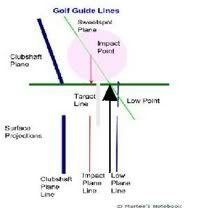 The chunky arrow I've used to vandalise your drawing with shows the line the player actually use to Trace (point at) with. That line is on the ground (and Sweetspot Plane) as the arrow shows. Remember, there can only be one line that lies on the ground and on the Sweetspot Plane (if you don't believe me, try find another one :D ) Now, can the player use the Impact Point Plane Line or the Low Point Plane Line to Trace with? Yes, with but great caution, because as long as one thinks these alternative lines are on the ground (rather than above or below the ground), they will be tracing the wrong line! Newbies reading this may be scared of Tracing now because they think it's so complicated. Forget it! You are probably Off Plane by 12 inches, and what we're talking here is a couple of inches max. Just draw a straight line through the white round thing and trace that line. |
Quote:
The red and blue (Impact & Low) arrowed lines are showing where they show up on the ground, they are already represented as being on the Sweetspot plane with the identification where they start. (Sorry for some reason the Blue line got stretched I will adjust it). There location on the Sweetspot Plane are two different area and when projected to the ground is what the second diagram was to show from the top down perspective of the golfer. The line or your arrow point is outside the center of the ball, outside the Target Line. I need to think about this a bit more, but initially I see several potential problems with this. Now if your indicator is the line on which the aiming point would fall, I probably can buy that but are you tracing of driving too? I need to researh this more. I agree with you caution is needed regarding which line you trace. To trace a line, you need a 'visual' reference point on the club from the top down perspective. Also the line traced or at least the start of the tracing is performed at the location where impact occurs (not the specific part of the ball) not at the separation point. I think those guys who have been hawking the laser/flashlight training devices that say you should trace the Target Line probably are in the ball park if the device is aligned properly. Having the pointing devices located in both ends of the shaft would not be correct unless they are tracing the clubshaft plane line. Plane Boards trace the clubshaft plane line. I think I will try to build a very accurate diagram from the down the line view to see exactly how much difference there is to see if in fact the Target Line may be an accurate resultant plane line to trace. I have been tracing or attempting to trace inside this the Target Line, the Impact Line as I have attempted to show it projection in red on the ground. Tracing the Low Point line required me to identify a different area of the club to line up with. Note the references to the clubhead are for measuring, not what is being monitored and driven. |
Appearance.....
Uh oh... |
| All times are GMT -4. The time now is 05:39 PM. |