lately ive been struggling with being too flat for the TSP, i start on the elbow plane and then shift up but not quite steep enough. my clubs are all very flat and im relatively short it feels more comfortable and simpler to me to start on the elbow plane and stay on the elbow plane, i shift back to the elbow plane at impact anyways so would the flatter plane really change anything as far as spin and angled hinge action, i know that the flatter the plane the more angled hinge becomes like horizontal hinge. is there any attributes of a zero shift elbow plane swing that are undesirable or require special attention?
The Elbow Plane is very "flat", is there a physical reason why you cant raise your Right Arm/Hand? A right arm injury or something?
A flatter than normal Plane Angle will see Angled Hinging Approach Horizontal as you mention but not in a clubface rotation manner or in feel. Its more like the clubface is staying perpendicular to the Plane but given the shallower angle with less layback and more clubface closing during the impact interval. But still accompanied by the "no roll" feel in the left wrist of Angled Hinging. There will be less associated Down and a more Out to the Clubheads Orbit on these angles. So your divots will be shallower as you sort of scalp the grass with a shallow Angle Of Attack. As there is more Out, ball positions back of Low Point will see an increased angle to the Angle of Approach if your hitting, more Out. Ball played back of low point will be pulled left unless you cover this Angle of Approach with more Out. Sand play will put you in Bob Vokey's "Slider" category. Ball position alters your direction more than your elevation.
With your hands lower than your TSP angle an On Plane turn of the Shoulders in Startdown would see your Arms and your Hands pulled down inside the plane.
I'd imagine your backswing is somewhat restricted and you tend to stop at Top which is great and has no implications to the force you can create. I'd also guess you are very rotational and fight coming inside the Plane on the Backswing. Need to concentrate on Tracing to separate the motions of the Shoulder Turn vis a vis the Right Forearm Takeaway in this regard maybe. Im guessing here though and dont wish to make any generalizations or anything.
I'd also venture that you play fantastic flop shots with the blade wide open, are good out of the sand and lets see play a .......draw no fade. You're young, dashing and women swoon when you walk in a room.
I had a little soreness at the very top of my left arm where it attaches to the shoulder. I'm not sure why, but I backed off on my extensor action a tad and it seems to have helped. Dont know if I was doing something wrong, letting a little tension creep in to the shoulder/arm connection or something.
I like to Hit from End too but am wondering if it is a good fit with an Angle of Approach or whether it is best stay on the Arc given that the #3 pp is on the knuckle in Startdown. Not sure, its a question I have for Luke or Yoda. From Top with Drive Loading and the #3pp on the first joint of the right index finger the Angle of Approach works really nicely. But I love that feeling of Float Loading and have trouble stopping at Top. I dunno? Still searching for my pattern.
Is there any way your soreness could be from a quick rotational swingers turn in Startdown, your low under the TSP angle left arm getting stretched to the max? The solution to this would be a Slow Startdown from Top with an active Drive or thrust of #1 against the #3 pp in the first joint at Release. Classic drive loading, Hitting, Angle of Approach procedure. Just an idea. Maybe send some tape to Luke for a proper diagnosis.
If you're like me the soreness in that particular place is a bit of a worry. What ever causes it must be removed from your swing lest you get a chronic golf related injury. Dont want to suffer like Ken Venturi did or anything.
i would say a quick swingers start down is exactly whats happening stretching it to the max, my hips get very aggressive and arm gets stuck behind me, i tend to be very 'FAST' with my swing. im pretty sure i tore my rotator cuff. not that it matters but is there anybody on tour that swings on the elbow plane, ive seen some flat swings but none below the shoulder
Practically all Tour Players use the Elbow Plane from Release through Impact and to Finish but at the Top of the backstroke they were on a steeper plane.
I realize that, to clarify, my question is how many tour players DO NOT SHIFT to steeper planes and remain on the elbow plane from startup to finish, i would guess very few if any but was curious if there was a player out there to study from, who employs a zero shift elbow plane swing. from my first post, my question is are impact conditions the same when employing a double shifting elbow plane-any steeper plane as employing a zero shift elbow plane swing, I'm thinking impact conditions with regards to spin and hinge action would be the same because with both swings impact occurs on the elbow plane.
I realize that, to clarify, my question is how many tour players STAY on the elbow plane from startup to finish i would guess very few if any. from my first post, my question is if you shift up to steeper planes but return to the elbow plane, it seems to me that impact conditions as far as hinge action would not change if you were to remain on the elbow throughout, in the book it states that staying on the elbow plane makes angled hinge more horizontal hinge and spin rate is reduced but if you return to the elbow plane anyway i dont see how it affects spin or hinge action at all. for example i startup on the elbow plane then shift to Turned shoulder plane start down returns to elbow plane and impact occurs on the elbow plane. wouldn't impact conditions be unaltered with regards to spin and hinge action if i were to remain on the elbow plain throughout?
You're correct. To answer your first question, many of them stay on the elbow plane throughout the swing for putting, chipping and pitch shots.
it's interesting then because homer states in 10-6-A that "it is the flattest normal plane that will still allow the right forearm to be on plane during impact this produces a very flat angle of attack with reduced backspin and should be avoided for short shots unless it is also part of your full stroke pattern." he's suggesting that ideal impact conditions for the short game would be on a steeper plane, a player that i learned the short game from taught me to play all short game shots with the heel of the club never touching the ground, the club resting on the toe, a much steeper plane for the short game then for other shots, one to ensure the heel of the club did not interfere and two to increase height and point the face more straight as you will find a flatly soled perpendicular leading edge wedge shot will hit shots consistently to the left with most modern wedges, however i have found the dave pelz wedges to always aim dead straight when the leading edge is perpendicular to the target line and flatly soled.
Practically all Tour Players use the Elbow Plane from Release through Impact and to Finish but at the Top of the backstroke they were on a steeper plane.
Are they really on the elbow plane or appearing to be so because they drop their heads/torso (Tiger) on the downswing?
Are they really on the elbow plane or appearing to be so because they drop their heads/torso (Tiger) on the downswing?
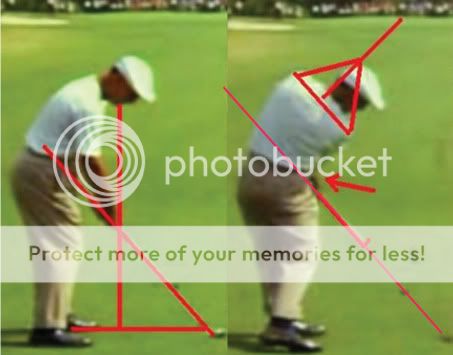
Whether it's an Elbow Plane or Turned Shoulder Plane, we're always talking about the Clubshaft angle. The following Image of Ben Hogan indicates that the Clubshaft angle at Impact points to the location on his side where his right elbow would touch.
So, regardless bobbing or swaying, it's the clubshaft that defines the plane.
Are they really on the elbow plane or appearing to be so because they drop their heads/torso (Tiger) on the downswing?
Hmmm. I'd say the player who establishes his Impact Alignments at Fix (his RFFW on the Shaft Plane) makes the adjustments required that you refer to above, bobs, waist bend, knee bend, skull line etc prior to Startup. Players who address the ball with their Right Elbows above the Shaft Plane must make these adjustments during the swing and suffer from the inconsistencies that result.
But to answer your question directly, Id say they are only on an Elbow Plane if their Elbow is on the Shaft Plane. Most pros do bob to achieve this impact alignment having addressed the ball with their right elbow above the Shaft Plane, Lie Angle.




 Linear Mode


