I would like to know if the divot direction is different for a hitter (relative to a swinger)?
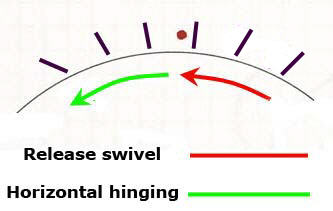
Here is a diagram showing the clubface orientation in a swinger's action.
Pre-impact the clubface is closing due to the release swivel action and post-impact the clubface continues to close due to a horizontal hinging action.
I therefore imagine the divot of a swinger being straight or slightly left-of-straight (especially the part of the divot beyond the low point).
What about a hitter who uses a crossline thrust action through impact? Is the crossline thrust action accompanying the release of PA#1 a "feeling" only or does it translate into a divot that is oriented to the right-of-straight?
I believe that in theory the divot should have a base straight line because the hosel of the clubface travels down and out the inclined plane.
This is due to tracing: You can picture this by moving your clubshaft along a bench: The clubhead will travel down-out-forward, go to low point, then up-in-foward while tracing the line.
So, the base of the divot (near the hosel of the clubface) will be a straigh line and the divot deeper at low point.
However, for the toe of the club it's a different story because it is constantly closing. So the upper part of the divot could probably be a curve.
Now, if you destroy the ground as I do, it ends up as tough to read divots as to read into chiken entrails! (Bucket's entrails?)
You seem to be implying that the hosel of the clubshaft is traveling in a straight line because the hosel (peripheral end of the clubshaft) traces a SPL. However, I believe that neither the hosel or the sweetspot of the clubface can ever travel in a straight line. The path must always be arced, and if the hosel is descending to its low point, then the first part of the divot (prior to the low point) must be arced (because the hosel is moving outwards and forwards and downwards).
The sweet spot plane (imagine a line from PP#3 running through the sweet spot of the clubhead and then extending past the clubhead through the ground) can trace a straight plane line.
Hope this helps. It's not the hosel or the "sweet spot of the clubface" instead it's an invisible plane made visible by understanding The Golfing Machine that traces the straight plane line.
The connection between pressure point #3 and the sweet spot is the plane of the sweet spot. This is how #3 traces the straight plane line.
It's a beautiful thing!
Sorting Through the Golf Nut's Catalog.
B-Ray
__________________
I have the best job in the world, I get to teach golf for a living!!!
Catch ya on the lesson tee.
I agree with you 100% - the sweetspot plane can trace a SPL. By definition, any inclined plane traces the base of its own plane (in the imaginary sense of placing a flashlight on that plane and moving it along that plane while pointing the flashlight beam at the base of the plane). However, the sweetspot of the clubface can never travel in a straight line.
Picture the Bench Drill: Find a bench and swing back and forth.
Your shaft will stay in contact with the bench while your clubhead travels in a arc. This is a natural phenomenon.
Remember that the inclined plane lies against the bench and ALSO on the ground.
So what happens on the bench ALSO happens on the ground!
If the ground "was raised" at the bench height the result would be the same: You would dig a giant divot that would be straight in its inner part (at the shaft/hosel).
What about a hitter who uses a crossline thrust action through impact? Is the crossline thrust action accompanying the release of PA#1 a "feeling" only or does it translate into a divot that is oriented to the right-of-straight?
Jeff.
Jeff,
I would say that according to the bench drill, there is no difference between the travel of the clubshaft along the bench for a hitter or a swinger.
So the inner part of the divot should be a straight line for both.
However, on the Hitting stroke, the rate of closing of the clubface is more gradual than in a Swing due to differences in the release of the power accumulators (Simultaneous release of #1,2,3 in the Hitting stroke).
This is why I believe that the divot of the Hitter will have its outer part less curved than the Swinger.
However, I doubt there is a way to measure that in the real world!
I can understand your point about the clubshaft staying on the inclined plane (bench edge) - whether swinging or hitting.
But wouldn't an assertive crossline thrust action through impact have some effect on the clubhead's travel through the impact zone (from impact to low point)?
Yodeli
But wouldn't an assertive crossline thrust action through impact have some effect on the clubhead's travel through the impact zone (from impact to low point)?
Jeff,
You must separate clubHEAD and clubFACE.
Hitting or Swinging, the clubHEAD travel is absolutely the same because either using centrifugal force or muscular thrust, the hinge pin is always located the left shoulder.
Because of that, the geometry/radius is the same (and so is low point and divot).
The only difference is the hinge action: horizontal for the swinger, with a closing only clubFACE, angled for the Hitter, with a clubFACE perpendicular to the inclined plane.
Because of those different hinges, the Swinger has a clubFACE that is looking to right field until the very last moment and then rotates in the impact zone.
The hitter has a clubFACE that rotates less and gradualy during the entire downstroke. So the rotation is less important in the impact zone.
This is why I think the inner part of the divot is straight for both actions : same clubHEAD travel and the rotation of the clubFACE doesn't affect the hosel. Whereas the outer part of the divot may show differences because the rate of closing of the clubFACE is different.
I have no problem differentiating clubhead movement from clubface movement (due to angled hinging).
I am interested in knowing whether the hitter's crossline thrust translates into a different clubhead movement through impact (compared to a swinger who doesn't use a crossline thrust action). You say not. Thank you for your opinion.




 Linear Mode


